
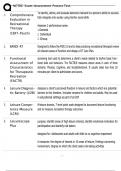
NCTRC Exam-Assessment Process Test.
To identify, define, and evaluate behaviors relevant to a person's ability to success-
1. Comprehensive
fully integrate into society using his/her social skills
Evaluation in
Recreational Assesses 3 performance areas
Therapy 1. General
(CERT-Psych) 2. Individual
3. Group
2. BANDI-RT Designed to follow the MDS 3.0 and to help practicing recreational therapist review
all relevant areas of function and design a RT Care Plan.
3. Functional screening tool used to determine a client's needs related to his/her basic func-
Assessment of tional skills and behaviors. The FACTR/R measures eleven areas in each of three
Characteristics domains: Physical, Cognitive, and Social/Emotional. It usually takes less than 20
for Therapeutic minutes per client to administer and score.
Recreation
(FACTR)
4. Leisure Diagnos- Assesses a client's perceived freedom in leisure and factors which are potential
tic Battery (LDB) barriers to this freedom. Includes versions for children and adults. May be used
in educational settings as part of an IEP
5. Leisure Compe- 8-leisure domain, 7-level point scale designed to document leisure functioning
tence Measure and to measure recreation therapy outcomes
(LCM)
6. Leisurescope purpose: identify areas of high leisure interest, identify emotional motivation for
Plus participation and identify risk takers
designed for: Adolescents and adults with little to no cognitive impairment
it measures: the degree of interest in 10 areas of leisure, Feelings concerning
involvement, Degree to which the client seeks risk taking activities
1/7
, NCTRC Exam-Assessment Process Test.
7. Functional Inde- 18-item, 7-level scale that assesses severity of disability in performing basic life
pendence Mea- activities
sure (FIM)
18-item measurement tool that explores an individual's physical, psychological and
social function. The tool is used to assess a patient's level of disability as well as a
change in patient status in response to rehabilitation or medical intervention. The
FIM uses the level of assistance an individual needs to grade functional status from
total independence to total assistance
8. American Spinal describes a person's functional impairment as a result of a SCI. This scale indicates
Injury Associa- how much sensation a person feels after light touch and a pin prick at multiple
tion (ASIA) im- points on the body and tests key motions on both sides of the body
pairment scale
9. Rachos Los Ami- renowned clinical tool used to rate how people with brain injury are recovering.
gos Scale of Cog- The ten levels of recovery noted in the scale also help to decide when a patient is
nitive Function- ready for rehabilitation. As patients "wake up" after a head injury, they go through
ing ditterent levels of recovery on the Rancho Scale. Each level describes a general
pattern of recovery, with a focus on cognition and behavior.
10. Glasgow Coma used primarily in rehabilitation units& hospitals
Scale (GCS) &
The Glasgow Coma Scale (GCS) is scored between 3 and 15, with 3 being the worst
Children's Coma
and 15 the best. It is composed of 3 parameters: best eye response (E), best verbal
Scale
response (V), and best motor response (M). The components of the GCS should
be recorded individually; for example, E2V3M4 results in a GCS of 9. A score of
13 or higher correlates with mild brain injury, a score of 9 to 12 correlates with
2/7

