
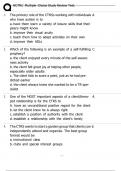
NCTRC Multiple Choice Study Review Test.
1. The primary role of the CTRSs working with individuals A
who have autism is to
a. have them learn a variety of leisure skills that their
peers might know
b. improve their visual acuity
c. teach them how to adapt activities on their own
d. improve their ADLs
2. Which of the following is an example of a self-fulfilling C
prophecy?
a. the client enjoyed every minute of the self-aware-
ness activity
b. the client felt great joy at helping other people,
especially older adults
c. The client fails to score a point, just as he had pre-
dicted earlier
d. the client always knew she wanted to be a TR spe-
cialist
3. One of the MOST important aspects of a client/thera- A
pist relationship is for the CTRS to
A. have an unconditional positive regard for the client
b. let the client know he is always right
c. establish a position of authority with the client
d. establish a relationship with the client's family
4. The CTRS wants to start a garden group that clients can b
independently attend and organize. The best group
format would be
a. instructional class
b. clubs and special interest groups
, NCTRC Multiple Choice Study Review Test.
c. drop-in center
d. out-trips
5. Which of the following organizations allows for chap- b
ter affiliation by local groups of TR specialists?
a. National Therapeutic Recreation Society (NTRS)
b. ATRA
c. Recreation Therapy Section (RTS)
d. NCTRC
6. Which of the following is an example of extinction that b
is meant to reduce a specific behavior?
a. taking a client to the zoo when they are afraid of
animals
b. taking away a toy when the client misbehaves
c. talking to the client about antecedents, behaviors,
and consequences
d. applying the principle of negative reinforcement
7. The CTRS was offered free tickets for patients to attend B
a special performance of a play during the afternoon,
but instead chose to have the patients pay and attend
a night performance. The CTRS was demonstrating
which of the following mainstreaming principles?
a. integration
b. normalization
c. least restrictive environment
d. deinstitutionalization
8. The CTRS is working with a group of chemically depen- c
dent teenagers. The goal of the program is "To gain an
understanding of the importance of leisure." The CTRS
decides to use an activity called "Twenty things I love

