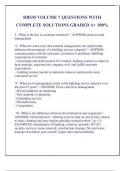
RBSM VOLUME 7 QUESTIONS WITH COMPLETE SOLUTIONS GRADED A+ 100%
2 - What is the key to customer retention? - ANSWERsound account management
9 - What are some ways that internal management can significantly influence the prosperity of a building service company? - ANSWER- communication with the customer: resolution of problems, fulfilling expectations of customer
- knowledge and skill resource for workers: helping workers to improve their methods, represent the company well, and fulfill customer expectations
- building worker morale to minimize turnover and provide more consistent service
9 - What are 6 management trends in the building service industry over the past 25 years? - ANSWER- Close cash flow management
- Strong emphasis on marketing
- New methods of planning
- Expanding services
- Diversification
- Competition
10 - What is the difference between diversification and expansion? - ANSWER- Diversification: "offering services that are not closely related to basic cleaning and may require specially trained worker" (p. 11) - EXAMPLES: maintenance of lighting, exteriors, grounds, HVAC; security services; snow removal; construction cleanup; fire and water damage restoration; pest control; carpet sales and installation
- Expansion: "offering new types of cleaning services that are closely related to basic cleaning, such as carpet and floor care or perhaps upholstery and drapery cleaning" (p. 10)
10 - What are common solutions to overextension of the mission of a cleaning company? - ANSWER- drop all business under a certain dollar amount
- start subsidiary companies to service smaller accounts, often using a key person from the parent company who shows entrepreneurial abilities
10 - Why is there so much competition in the cleaning industry? - ANSWER- relative ease of getting into the business (does not require large investment of money)
10 - What is a negative effect on the industry as a whole of smaller startup companies bidding low then eventually going out of business due to inadequate cash reserves? - ANSWER- winning bids by submitting low bids tends to drive prices down, making it hard for remaining companies to make a reasonable profit
12 - What are 4 changes in the design of today's buildings that affect building service companies? - ANSWER- Energy conservation
- Increase in rentable space
- Changes in perceptions and attitudes of tenants
- More luxurious office space
14 - What are 10 overall trends in the building service industry today (choose from these 12)? - ANSWER- Continued Competitiveness (grow or go out of business)
- High diversity with contracting companies of all sizes
- The growth of franchising (5% of the total market [what exactly is franchising?])
- Continued labor shortages (some solutions: hiring handicapped and other disadvantaged workers; introduce more attractive compensation and benefits packages)
- Changing labor force (traditionally, mostly young men between 18-25 years of age; now, more women and immigrants, as well as men seeking a second income stream)
- Automation and computerization (computer and smartphone use [WinTeam, eHub, Excel, Word, Outlook]; hi-tech cleaning equipment like improved scrubbers, backpack vacuums, and sanitizer equipment [e.g. Clorox has a line of high-tech room sanitizing products for hospitals])
- Increasing government regulation (equal opportunity, discrimination, sexual harassment, wage/hour issues, occupational safety)
- Stricter safety regulations (safety and training programs have become more important along with increased government regulation)
- Increased importance of training: cleaning techniques, chemical use, equipment use, safety, security, company policies
- Controversy over illegal subcontracting (some companies try to classify their workers as "independent contractors" to save money [e.g. to avoid FICA payments and other benefits] - the courts define this classification narrowly, so this practice can easily lead to legal action)
17 - What are 4 challenges facing building service companies today? - ANSWER- Recruiting and retaining cleaners
- Recruiting and developing management talent
- Increasing technical complexity
- Increasing competitiveness
19 - What is TQM? - ANSWERTotal Quality Management: "The company and the customer work together to reduce cost, improve service, and adapt to changing workplace requirements."
19 - List 5 reasons the building service industry is important. - ANSWER- Provides a clean work environment for customers and tenants
- Controls germs and the spread of disease
- Provides business opportunities for entrepreneurs and managers
- Provides full and part-time jobs for thousands of Americans
- Provides advancement opportunities for managers and workers
20 - What are 5 major factors of realizing quality service and profit? - ANSWER- The company's name (reputation): superior service
- Work (standard of quality, morale [attitude of workers toward job at hand]): aware of needs, communication of their value to them -- workers must see themselves as an essential part of any success achieved
- Information: promotes stability
- Leadership: awareness of other people's dignity and their desire to do their best
- Customers (we form a partnership with them): do not exploit or manipulate them; build trust; remain competitive in terms of productivity, efficiency, and quality
25 - What are 6 measures of success in the building service industry? - ANSWER- Quality service and high customer satisfaction
- High customer retention
- Increased sales volume through new accounts
- Positive public image
- Growth opportunities for employees
- Increased profitability
26 - What is the key to being a successful manager? - ANSWER"overcome...obstacles with a positive 'can-do' attitude without putting blame on the company, the customer, or the employee"
26 - How can managers become a valuable asset? - ANSWER"successfully communicate company needs to the customer and customer needs to the company" -- they thereby build a cooperative rather than an adversarial relationship with the customer
26 - Describe the organization of your company's operations division. - ANSWER1. Operations manager
2. Area/contract manager
3. Lead/supervisor
4. Cleaner
27 - Describe the typical functions of a building supervisor, area manager, operations manager, and general manager. - ANSWER- A building supervisor has direct responsibility for the nightly or daily cleaning of buildings.
- An area manager supervises the servicing of assigned accounts to conform to direct cost budgets, quality standards, and customer satisfaction.
- An operations manager plans, organizes, directs, and controls operational activities so as to achieve specified costs and profit objectives and to ensure that all work is performed in accordance with contract specifications.
- A general manager guides and directs company staff in the identification of objectives and preparation of plans and programs.
28 - Define the terms planning, organizing, directing, and controlling. - ANSWER- Planning mean developing specific courses of action to achieve agreed upon objectives.
- Organizing means establishing and assembling the human and physical resources of the organization leading to the effective accomplishment of its purpose.
- Directing mean helping individual member of the organization to receive satisfaction from achieving the results expected of them.
- Controlling means identifying deviation from plans and objectives and the need for corrective activities.
28 - Give examples of the four functions defined above. - ANSWER- Planning: work loading and budgeting.
- Organizing: scheduling and inventory management.
- Directing: Training, supervising, and coaching.
- Controlling: Quality control and cost controls.
29 - What is the "principle of unity of command"? - ANSWERUnity of command means that every person at every level is directly responsible to only one supervisor.
29 - Describe the 3 steps involved in organizational planning. - ANSWER1. Define work objectives.
2. Identify and gather the resources needed to achieve those objectives.
3. Schedule and assign tasks and resources to complete the work.
32 - Identify the 6 steps involved in problem solving. - ANSWER1. Define the problem.
2. Identify the facts.
3. Develop alternatives.
4. Select the best alternative.
5. Decide of a course of action.
6. Carry out the action.
35 - List 7 general rules for effective time management. - ANSWER- Decide what you want from your time.
- Plan carefully, on paper, each day, or at least each week, how you will use your time.
- Put time in where it counts the most.
- Train well.
- Delegate well.
- Concentrate on the job at hand.
- Respect time.
36 - How should managers prioritize their time between 1) managing the routine and repetitive aspects of their job and 2) activities that contribute to the company's growth and their own personal growth? - ANSWER1) 1/2 to 2/3
2) the remainder [1/3 to 1/2]
36 - What are 6 pitfalls of effective time management? - ANSWER- Faulty perception: thinking you spend your time differently than you actually do
- Procrastination and indecision
- Hastiness: gather facts and make calculated decisions
- Failure to develop alternatives: do not skip brainstorming problems before deciding on solutions
- Failure to overcome habit patterns: i.e. habit patterns that inhibit effectiveness or success
- Work expansion: work tends to expand to fill available time, so set time limits and due dates or times
37 - What are 5 steps to effective planning of time - ANSWER1. Planning - "Every hour spent in effective planning saves three to four in execution and achieves better results. Failure to plan is planning to fail."
2. Daily planning - preferably on paper, for quick reference (note how the author of Deep Work also advocates the value of daily planning on scrap paper that is then disposed of after unfinished items are transferred to the next day)
3. Time analysis - daily log of activities for one week, taken in 15-minute increments; repeat at least annually; goal: "to avoid reverting to poor time management practices"
4. Anticipation - expect the unexpected and plan for it; plan for Murphy's Law to pay a visit (if anything can go wrong it will)
5. Realistic time estimates - managers tend to underestimate how long tasks will take and hope others will complete their tasks sooner than is likely
38 - What are 6 steps for using your time more effectively (i.e. prioritizing)? - ANSWERa. Set priorities (what tasks have greater potential benefit?).
b. Focus on critical efforts (remember the Pareto principle).
c. Set deadlines (and keep them).
d. Emphasize effectiveness versus efficiency (effectiveness = doing the right job efficiently).
e. Avoid the tyranny of the urgent (reduce urgent tasks; categorize tasks carefully; delegate).
f. Handle paperwork once (approve, disapprove, pass on, pass back - take action rather than leaving for later).
39 - What are 5 questions all employees have? - ANSWER- What do you want me to do?
- How do you want me to do it?
- Why do you want me to do it?
- When do you want it done?
- How am I doing?
40 - Define delegation. - ANSWER"Entrusting activities and tasks to subordinates after first coming to a meeting of the minds on exactly what is to be done."
40 - What are 6 principles of effective delegation? - ANSWER- Delegate routine tasks (if of low value to overall objectives).
- Delegate entire tasks (whenever possible).
- Prevent upward delegation (avoid fostering dependence of subordinates on you for answers that they are capable of discovering).
- Delegate to the lowest practical level.
- Delegate clearly (simply, concise, unambiguous language).
- Provide feedback (performance against goals, predetermined intervals).
41 - How can a manager maintain good concentration? - ANSWER- Keep tasks visible (especially short-term tasks).
- Consolidate tasks (group together similar tasks: avoid unnecessary repetition and interruptions).
41 - What are two cardinal rules for respecting time? - ANSWER- Implement time planning and follow-up (daily).
- Remain flexible (avoid over- or under-scheduling).
45 - What is Work Loading? - ANSWERThe allocation of labor required to clean a specific building; it is originally developed as part of the bid process.
45 - What is Retuning? - ANSWERReevaluating the original work loading after a period of time to see if it should be modified.
45 - What is the most significant cost of any contract? - ANSWERDirect labor expense
46 - What are the essential items of a proposal? - ANSWER- Description of areas to be cleaned
- List of services to be performed and their frequencies
- Cost sheet
- Contractual terms
46 - What variables affecting speed, productivity and cleaning frequencies affect Standard Production Rates - ANSWER- Level of quality required
- Building use
- Cleaning Frequency
- Size and layout of space to be cleaned
- Density
- Traffic
- Supplies used
- Equipment used
- Smoking versus nonsmoking buildings
- Building materials
- Building design
- Building size
- Climate
- Labor pool
- Average employee turnover
- Quality of supervision
- Quality of training
- Daytime versus nighttime cleaning
50 - What are two ways to develop time standards? - ANSWER- Base time standards on existing jobs (consider an account with similar size, density, and service detail: total square footage / total worker hours).
- Base time standards on industrial engineering methods (have an above-average employee perform the task in normal working conditions at least three times and calculate an average).
60 - What Key Factors affect staffing requirements? - ANSWER- Nonproductive time
- Travel time
- Absenteeism relief
- Limited worker allowance- for temporary or permanent disabilities
- Non-cleaning duties
- Indivisibility allowance (EXAMPLE: a calculation of 2.85 personnel required to clean a floor would result in an assignment of three people to that floor.)
- Job Cards (a time-based job description) and Quadrant cleaning (regular vs. detail cleaning areas)
63 - What are three good reasons to retune? - ANSWER- increase margins by reducing expenses
- help the company avoid raising prices
- to remain competitive
64 - When is the best time to retune? - ANSWER- Three months after the account begins (rough spots in the account have been ironed out; if you need to ask for an increase, this is the best time to ask)
- Annually on the anniversary date of the contract
70 - What items should be the focus of retuning site inspections? - ANSWER- Cleaning quality
- Number of tenants and building traffic
- Square footage of cleanable space
- Floor arrangement and division
- Building Density
- Floor and wall coverings
- Normal hours of operation and special requests
- Smoking Versus nonsmoking
- Specifications versus actual need
- Inventories
- Use of equipment
- Use of labor
75 - EXAMPLE: 5 4-hour cleaners; retune to one less hour per night.
Using the example above, what are four options for retuning an account? - ANSWER- Replace a 4-hour cleaner who quits or is fired with a three-hour cleaner.
- Rebalance the workload and cut everyone back one hour per week.
- Shift 1/2-hour of work from a four-hour assignment to a three-hour assignment; then hire a new worker for 3 1/2 hours a night and cut one employee's time by 1/2-hour per night.
80 - Operational Budgets are generally divided into what two categories? - ANSWER- Direct Expenses
- Indirect Expenses
81 - What are examples of Direct Expenses? - ANSWER- Labor
- Supervision
- Labor overhead
- Expendable supplies
- Cleaning materials
- Equipment
- Equipment repair
- Travel and lodging
- Training
- Uniforms and ID badges
- Computers, phones, pager
- Vehicle expenses
- Performance bonds
82
What are examples of indirect expenses? - ANSWER- Salaries for admin staff and upper management
- Labor overhead for admin and upper MGMT salaries
- Education and training for admin and upper MGMT
- Fees to accountants, attorneys and other professionals
- Dues and publications
- Bad debt expense
- Political and charitable contributions
- Interest on loans
- Entertainment and lodging
- Transportation
- Sales and marketing expenses, including salaries and overhead of sales personnel
- Office expenses- supplies, phones, computers ect.
- Facility expenses- rent, utilities, mortgage interest
- Taxes- sales, use, business licenses, corporate income
83 - What is Mark-up? - ANSWERIt is a percentage that the company adds to cost to arrive at the total billing amount. Cost + Mark-up = total sales.
83 - What is Profit? - ANSWERIt is calculated as a percentage of total sales. It is always a smaller percentage than mark-up.
83 - What is Gross Sales or total income? - ANSWERThe total dollar amount billed to the customer.
83 - What is Total Expense? - ANSWERThe total cost of servicing the account.
83 - What is Net income (or loss)? - ANSWERThe amount remaining after expenses have been subtracted from gross sales/ This represents profit. If the account has a loss, this figure is in parentheses and represents a negative number.
84 - How does Variance affect the budget? - ANSWERActual operational costs almost always include variances from the budget. While variances are likely, they should always be examined to understand their causes.
85 - What are the two most important things to do to reduce labor costs? - ANSWER- Minimize employee turnover.
- Increase productivity.
85 - What are direct measures to control labor costs? - ANSWER- Use a time control system. (Pay for actual hours worked. Start and stop on time.)
- Establish and follow work schedules
- Provide work breaks in accordance with local law and company policy
- Provide employee incentives
- Call in all direct labor hours used nightly
- Keep employees motivated
- Require strict adherence to company policies and procedures
- Use current communication technology
- Retune
86 - What are two key areas of labor overhead? - ANSWER- Workers compensation insurance
- State unemployment taxes
86 - What is EMR and how does it affect workers' compensation insurance rates? - ANSWER- EMRs means "Experience Modifier Rates": If the accident rate is higher than average, the modifier rate (EMR) will be higher than 1.00, if it is lower than average it will be lower than 1.00.
- The EMR is used to determine what proportion of the manual rate per industry is paid by a company. For example, the manual rate might be $11.12 per $100.
87 - What partially determines state unemployment taxes? - ANSWERThe number of successful claims filed by former employees.
87 - What are 2 ways to keep state unemployment tax costs down? - ANSWER- Reduce turnover.
- Document disciplinary actions (from reprimands to discharge): Careful documentation can help defeat unemployment claims for employees who are discharged for cause.
87 - What are some considerations that influence management of materials and material cost? - ANSWER- The correct quantities and types of materials must be on hand at the proper time to permit cleaning to proceed on schedule.
- Materials must be protected from loss or theft.
- Investment in inventory must not tie up funds that could be used more profitably in other areas.
- The risk of spoilage and obsolescence must be avoided.
- The cost of materials handling and storage must be minimized.
88 - What factors are part of most modern systems for controlling materials? - ANSWER- Formal procedures for purchasing materials.
- Adequate safeguards for the receipt, storage, and issuance of materials.
- A perpetual inventory system that provides a written record of the quantity and value of each type of material received, issued and on hand.
88 - What are 7 basic rules for successful purchasing of chemicals and equipment? - ANSWER- Question manufacturer claims.
- Test the product.
- Get references.
- Check reliability and repair specifications.
- Minimize your chemical inventory.
- Look for ease of use.
- Compare costs.
92 - What are 4 elements of a modern purchasing system? - ANSWER- Purchase requisition (formal request for supplies)
- Purchase order (prepared by the purchasing agent after choosing the best source)
- Receiving report (describes the quantity and condition of the materials received)
- Principles of internal control
92 - What are 5 principles of internal control? - ANSWER- The purchase requisition must be made by an authorized person.
- A purchase order must be prepared and approved by an authorized person after the purchase REQ has been received.
- All materials received must be carefully checked to see that they correspond to those ordered and are in good condition.
- Payment should be made only after proper approval.
- Various steps in the purchasing process should be delegated to different persons to lessen the risk of fraud or error.
93 - What is the key to good inventory management? - ANSWEROptimum turnover (not carrying too much inventory)
93 - What control measures are used to safeguard purchasing? - ANSWER- Initiate inventory tracking (pape
Vista previa del contenido
RBSM VOLUME 7 QUESTIONS WITH
COMPLETE SOLUTIONS GRADED A+ 100%
2 - What is the key to customer retention? - ANSWERsound account
management
9 - What are some ways that internal management can significantly
influence the prosperity of a building service company? - ANSWER-
communication with the customer: resolution of problems, fulfilling
expectations of customer
- knowledge and skill resource for workers: helping workers to improve
their methods, represent the company well, and fulfill customer
expectations
- building worker morale to minimize turnover and provide more
consistent service
9 - What are 6 management trends in the building service industry over
the past 25 years? - ANSWER- Close cash flow management
- Strong emphasis on marketing
- New methods of planning
- Expanding services
- Diversification
- Competition
10 - What is the difference between diversification and expansion? -
ANSWER- Diversification: "offering services that are not closely related
to basic cleaning and may require specially trained worker" (p. 11) -
EXAMPLES: maintenance of lighting, exteriors, grounds, HVAC;
security services; snow removal; construction cleanup; fire and water
damage restoration; pest control; carpet sales and installation
,- Expansion: "offering new types of cleaning services that are closely
related to basic cleaning, such as carpet and floor care or perhaps
upholstery and drapery cleaning" (p. 10)
10 - What are common solutions to overextension of the mission of a
cleaning company? - ANSWER- drop all business under a certain dollar
amount
- start subsidiary companies to service smaller accounts, often using a
key person from the parent company who shows entrepreneurial abilities
10 - Why is there so much competition in the cleaning industry? -
ANSWER- relative ease of getting into the business (does not require
large investment of money)
10 - What is a negative effect on the industry as a whole of smaller
startup companies bidding low then eventually going out of business due
to inadequate cash reserves? - ANSWER- winning bids by submitting
low bids tends to drive prices down, making it hard for remaining
companies to make a reasonable profit
12 - What are 4 changes in the design of today's buildings that affect
building service companies? - ANSWER- Energy conservation
- Increase in rentable space
- Changes in perceptions and attitudes of tenants
- More luxurious office space
14 - What are 10 overall trends in the building service industry today
(choose from these 12)? - ANSWER- Continued Competitiveness (grow
or go out of business)
- High diversity with contracting companies of all sizes
- The growth of franchising (5% of the total market [what exactly is
franchising?])
- Continued labor shortages (some solutions: hiring handicapped and
other disadvantaged workers; introduce more attractive compensation
and benefits packages)
,- Changing labor force (traditionally, mostly young men between 18-25
years of age; now, more women and immigrants, as well as men seeking
a second income stream)
- Automation and computerization (computer and smartphone use
[WinTeam, eHub, Excel, Word, Outlook]; hi-tech cleaning equipment
like improved scrubbers, backpack vacuums, and sanitizer equipment
[e.g. Clorox has a line of high-tech room sanitizing products for
hospitals])
- Increasing government regulation (equal opportunity, discrimination,
sexual harassment, wage/hour issues, occupational safety)
- Stricter safety regulations (safety and training programs have become
more important along with increased government regulation)
- Increased importance of training: cleaning techniques, chemical use,
equipment use, safety, security, company policies
- Controversy over illegal subcontracting (some companies try to
classify their workers as "independent contractors" to save money [e.g.
to avoid FICA payments and other benefits] - the courts define this
classification narrowly, so this practice can easily lead to legal action)
17 - What are 4 challenges facing building service companies today? -
ANSWER- Recruiting and retaining cleaners
- Recruiting and developing management talent
- Increasing technical complexity
- Increasing competitiveness
19 - What is TQM? - ANSWERTotal Quality Management: "The
company and the customer work together to reduce cost, improve
service, and adapt to changing workplace requirements."
19 - List 5 reasons the building service industry is important. -
ANSWER- Provides a clean work environment for customers and
tenants
- Controls germs and the spread of disease
- Provides business opportunities for entrepreneurs and managers
- Provides full and part-time jobs for thousands of Americans
, - Provides advancement opportunities for managers and workers
20 - What are 5 major factors of realizing quality service and profit? -
ANSWER- The company's name (reputation): superior service
- Work (standard of quality, morale [attitude of workers toward job at
hand]): aware of needs, communication of their value to them -->
workers must see themselves as an essential part of any success achieved
- Information: promotes stability
- Leadership: awareness of other people's dignity and their desire to do
their best
- Customers (we form a partnership with them): do not exploit or
manipulate them; build trust; remain competitive in terms of
productivity, efficiency, and quality
25 - What are 6 measures of success in the building service industry? -
ANSWER- Quality service and high customer satisfaction
- High customer retention
- Increased sales volume through new accounts
- Positive public image
- Growth opportunities for employees
- Increased profitability
26 - What is the key to being a successful manager? -
ANSWER"overcome...obstacles with a positive 'can-do' attitude without
putting blame on the company, the customer, or the employee"
26 - How can managers become a valuable asset? -
ANSWER"successfully communicate company needs to the customer
and customer needs to the company" --> they thereby build a
cooperative rather than an adversarial relationship with the customer
26 - Describe the organization of your company's operations division. -
ANSWER1. Operations manager
2. Area/contract manager
3. Lead/supervisor