
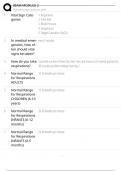
IBAM MODULE 2
Study online at https://quizlet.com/_geuihc
1. Vital Sign Cate- 1. Respirations
gories 2. Pulse Rate
3. Blood Pressure
4. Temperature
5. Oxygen Saturation (SpO2)
2. In medical emer- every 5 minutes
gencies, how of-
ten should vital
signs be taken?
3. How do you take Count the number of times the chest rises and returns to its normal position for
respirations? 30 seconds and then multiply count by 2
4. Normal Range 12-20 breaths per minute
for Respirations
ADULTS
5. Normal Range 15-30 breaths per minute
for Respirations
CHILDREN (6-10
years)
6. Normal Range 20-30 breaths per minute
for Respirations
INFANTS (6-12
months)
7. Normal Range 25-40 breaths per minute
for Respirations
INFANTS (0-5
months)
, IBAM MODULE 2
Study online at https://quizlet.com/_geuihc
8. What types of 1. Normal
respirations are 2. Dyspnea (difficult or labored)
there? 3. Tachypnea (rapid)
4. Noisy
5. Apnea (absent respirations)
9. What are the 3 Rate, Rhythm, Quality
keys to deter-
mine normal/ab-
normal pulse
rate
10. What pulse do Brachial Pulse
you palpate for
both responsive
and unrespon-
sive patients less
than 1 year of
age?
11. What pulse do Radial Pulse at the wrist
you palpate if pa-
tient is respon-
sive and older
than 1 year of
age?
12. What pulse do Carotid Pulse on neck
you palpate if pa-
tient is unrespon-
sive and older
than 1 year?
, IBAM MODULE 2
Study online at https://quizlet.com/_geuihc
13. How do you fig- Palpate pulse for 30 seconds and multiply number by 2
ure out a pa-
tient's pulse rate?
14. How do you fig- Palpate pulse for a full minute
ure out a pa-
tient's pulse rate
if it is difficult to
palpate or irregu-
lar?
15. Normal Pulse 60-100 bpm
Rate
ADULTS
16. Normal Pulse 70-110 bpm
Rate
CHILDREN
17. Normal Pulse 80-140 bpm
Rate
INFANTS (6-12
months)
18. Normal Pulse 90-140 bpm
Rate
INFANTS (0-5
months)
19. Tachycardia when an adult patient pulse rate exceeds 100 bpm (fast)
20. Bradycardia when an adult patient pulse rate is less than 60 bpm (slow)
21. Loss of blood, loss of vascular tone, or a cardiac pumping problem
Study online at https://quizlet.com/_geuihc
1. Vital Sign Cate- 1. Respirations
gories 2. Pulse Rate
3. Blood Pressure
4. Temperature
5. Oxygen Saturation (SpO2)
2. In medical emer- every 5 minutes
gencies, how of-
ten should vital
signs be taken?
3. How do you take Count the number of times the chest rises and returns to its normal position for
respirations? 30 seconds and then multiply count by 2
4. Normal Range 12-20 breaths per minute
for Respirations
ADULTS
5. Normal Range 15-30 breaths per minute
for Respirations
CHILDREN (6-10
years)
6. Normal Range 20-30 breaths per minute
for Respirations
INFANTS (6-12
months)
7. Normal Range 25-40 breaths per minute
for Respirations
INFANTS (0-5
months)
, IBAM MODULE 2
Study online at https://quizlet.com/_geuihc
8. What types of 1. Normal
respirations are 2. Dyspnea (difficult or labored)
there? 3. Tachypnea (rapid)
4. Noisy
5. Apnea (absent respirations)
9. What are the 3 Rate, Rhythm, Quality
keys to deter-
mine normal/ab-
normal pulse
rate
10. What pulse do Brachial Pulse
you palpate for
both responsive
and unrespon-
sive patients less
than 1 year of
age?
11. What pulse do Radial Pulse at the wrist
you palpate if pa-
tient is respon-
sive and older
than 1 year of
age?
12. What pulse do Carotid Pulse on neck
you palpate if pa-
tient is unrespon-
sive and older
than 1 year?
, IBAM MODULE 2
Study online at https://quizlet.com/_geuihc
13. How do you fig- Palpate pulse for 30 seconds and multiply number by 2
ure out a pa-
tient's pulse rate?
14. How do you fig- Palpate pulse for a full minute
ure out a pa-
tient's pulse rate
if it is difficult to
palpate or irregu-
lar?
15. Normal Pulse 60-100 bpm
Rate
ADULTS
16. Normal Pulse 70-110 bpm
Rate
CHILDREN
17. Normal Pulse 80-140 bpm
Rate
INFANTS (6-12
months)
18. Normal Pulse 90-140 bpm
Rate
INFANTS (0-5
months)
19. Tachycardia when an adult patient pulse rate exceeds 100 bpm (fast)
20. Bradycardia when an adult patient pulse rate is less than 60 bpm (slow)
21. Loss of blood, loss of vascular tone, or a cardiac pumping problem

