Chloë van Beukering Life Sciences Notes 2020
Human Reproduction
- Sexual reproduction: fusion of a male and female gamete
- Asexual reproduction: production of offspring without gametes, one parent
- Gonad: an organ that produces gametes and hormones
- Gamete: haploid sex cells
- Zygote: fusion of gametes
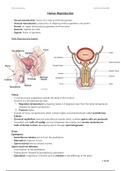
Male Reproductive System
Testes:
- 2 oval structures suspended outside the body in the scrotum
- Scrotum is a thin-skinned sac that:
1. Regulates temperature by keeping testes 2-3 degrees lower than the body temperature
(needed for sperm production)
2. Protects testes
- Consist of many compartments which contain highly convoluted tubules called seminiferous
tubules
- Germinal epithelium lines the seminiferous tubules which is where sperm cells are produced
- Interstitial cells (cells of Leydig) are found between the tubules and secrete testosterone
- Cells of Sertoli nurture developing sperm through spermatogenesis
Ducts:
Epididymis:
- Seminiferous tubules join to form the epididymis
- Maturation of sperm occurs
- Sperm stored here for several months
Sperm duct/vas deferens:
- Continuation of the epididymis
- Pushes sperm forward by peristalsis by ejaculation
- Ejaculation is expulsion of semen and an erection is the stiffening of the penis
1 of 21
,Chloë van Beukering Life Sciences Notes 2020
Urethra:
- Functions as the common duct for semen and urine to pass, although never together
- Semen is sperm and seminal uid
- Average number of sperm ejaculated is 700 million per ejaculation
Internal structure of a testis:
Prostate Gland and Seminal Vesicles:
- Prostate is a plum-sized gland surrounding the urethra
- Secretes a milky uid to neutralise acidity of any urine and protects sperm from acidic
secretions in the female tract
- Seminal vesicle uid is clear and functions in nourishing the sperm
- Cowper’s glands secrete seminal fluid that acts as a lubricant
Penis:
- Consists of spongy, erectile tissue
- Arteries dilate to bring an erection
- Foreskin protects the head of the penis
- Deposits semen with sperm into the female’s vagina to increase the chance of fertilisation
Structure of sperm:
- Smallest of all human cells
- Consists of head, neck, body and tail
- Sperm can survive in the female tract for up to 48 hours
- Tail: contains contractile fibres that allow for whip-like movements
- Mitochondria: provides energy (ATP) for tail movements
- Nucleus: contains haploid set of chromosomes
- Acrosome: contains hydrolytic enzymes to digest outer layers surrounding egg cell and allow
sperm to penetrate
2 of 21
flfl fl
, Chloë van Beukering Life Sciences Notes 2020
Male Infertility
- Due to low sperm production, misshapen or immobile sperm or blockages that prevent the
delivery of sperm
- Illnesses, injuries, chronic health problems, lifestyle choices and other factors can play a role
in causing infertility
- Signs and symptoms: inability to conceive a child, problems with sexual function (erectile
dysfunction, ejaculation difficulty), pain and swelling in the testicle area, decreased face or body
hair, lower than normal sperm count
- Possible environmental causes: industrial chemicals, heavy metal exposure, radiation or x-rays,
alcohol use, stress, weight, tobacco smoking, prolonged cycling
- Possible medical causes: infection, ejaculation causes, antibodies that attack sperm, tumours,
chromosome defects, celiac disease, sperm duct defects, certain medications
- Treatments may include: surgery, treating infections, hormone treatments, assisted
reproductive technology involving obtaining sperm through normal ejaculation, surgical
extraction or from donors
Female Reproductive System
3 of 21
Human Reproduction
- Sexual reproduction: fusion of a male and female gamete
- Asexual reproduction: production of offspring without gametes, one parent
- Gonad: an organ that produces gametes and hormones
- Gamete: haploid sex cells
- Zygote: fusion of gametes
Male Reproductive System
Testes:
- 2 oval structures suspended outside the body in the scrotum
- Scrotum is a thin-skinned sac that:
1. Regulates temperature by keeping testes 2-3 degrees lower than the body temperature
(needed for sperm production)
2. Protects testes
- Consist of many compartments which contain highly convoluted tubules called seminiferous
tubules
- Germinal epithelium lines the seminiferous tubules which is where sperm cells are produced
- Interstitial cells (cells of Leydig) are found between the tubules and secrete testosterone
- Cells of Sertoli nurture developing sperm through spermatogenesis
Ducts:
Epididymis:
- Seminiferous tubules join to form the epididymis
- Maturation of sperm occurs
- Sperm stored here for several months
Sperm duct/vas deferens:
- Continuation of the epididymis
- Pushes sperm forward by peristalsis by ejaculation
- Ejaculation is expulsion of semen and an erection is the stiffening of the penis
1 of 21
,Chloë van Beukering Life Sciences Notes 2020
Urethra:
- Functions as the common duct for semen and urine to pass, although never together
- Semen is sperm and seminal uid
- Average number of sperm ejaculated is 700 million per ejaculation
Internal structure of a testis:
Prostate Gland and Seminal Vesicles:
- Prostate is a plum-sized gland surrounding the urethra
- Secretes a milky uid to neutralise acidity of any urine and protects sperm from acidic
secretions in the female tract
- Seminal vesicle uid is clear and functions in nourishing the sperm
- Cowper’s glands secrete seminal fluid that acts as a lubricant
Penis:
- Consists of spongy, erectile tissue
- Arteries dilate to bring an erection
- Foreskin protects the head of the penis
- Deposits semen with sperm into the female’s vagina to increase the chance of fertilisation
Structure of sperm:
- Smallest of all human cells
- Consists of head, neck, body and tail
- Sperm can survive in the female tract for up to 48 hours
- Tail: contains contractile fibres that allow for whip-like movements
- Mitochondria: provides energy (ATP) for tail movements
- Nucleus: contains haploid set of chromosomes
- Acrosome: contains hydrolytic enzymes to digest outer layers surrounding egg cell and allow
sperm to penetrate
2 of 21
flfl fl
, Chloë van Beukering Life Sciences Notes 2020
Male Infertility
- Due to low sperm production, misshapen or immobile sperm or blockages that prevent the
delivery of sperm
- Illnesses, injuries, chronic health problems, lifestyle choices and other factors can play a role
in causing infertility
- Signs and symptoms: inability to conceive a child, problems with sexual function (erectile
dysfunction, ejaculation difficulty), pain and swelling in the testicle area, decreased face or body
hair, lower than normal sperm count
- Possible environmental causes: industrial chemicals, heavy metal exposure, radiation or x-rays,
alcohol use, stress, weight, tobacco smoking, prolonged cycling
- Possible medical causes: infection, ejaculation causes, antibodies that attack sperm, tumours,
chromosome defects, celiac disease, sperm duct defects, certain medications
- Treatments may include: surgery, treating infections, hormone treatments, assisted
reproductive technology involving obtaining sperm through normal ejaculation, surgical
extraction or from donors
Female Reproductive System
3 of 21