Chloë van Beukering Life Sciences Notes 2020
Human Endocrine System
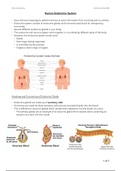
- Uses chemical messengers called hormones to send information from one body part to another
- Endocrine system consists of endocrine glands and hormones (and blood for transporting
hormones)
- Several different endocrine glands in your body
- The endocrine and nervous system work together in co-ordinating different parts of the body
- However, the endocrine system works more:
- Slowly
- Has longer lasting responses
- Is controlled by the pituitary
- Targets a wider range of organs
Histology and Functioning of Endocrine Glands
- Endocrine glands are made up of secretory cells
- Hormones are made by these secretory cells and are secreted directly into the blood
- This is different to exocrine glands which secrete their substance into the blood via a duct
- The salivary glands are an example of an exocrine gland which secrete saliva containing an
enzyme via a duct into the mouth
1 of 7
, Chloë van Beukering Life Sciences Notes 2020
- Hormones: organic substances (contain carbon) made from either proteins e.g. insulin or lipids/
steroids e.g. testosterone
- Travel in the blood to other parts of the body that are called target organs
- Each hormone has a specific target organ where it creates an effect
- It can either stimulate or inhibit this target organ
- Too much or too little of a hormone leads to various problems
- Each hormone will only affect one type of target cell
- These hormones can be released in small amounts and are rather slow to start working but
their effects last much longer than the nervous system
- Some hormones can be broken down in the cells or blood very quickly though and lost in the
urine
Hypothalamus
- This part of the brain links the nervous system with the endocrine system
- When it receives a signal from the nervous system, it produces hormone that stop or start the
production of other hormones
- e.g. produces gonadotropin — releasing hormone which stimulates the anterior pituitary gland
to release follicle stimulating hormone and luteinising hormone which work on the ovaries and
testes
- Produces many other trophic hormones
- In addition, produces the important Anti-Diuretic Hormone (ADH) which acts on the kidneys
by increasing water reabsorption
- Functions:
- Helps to conserve water in the loop of Henle
- Reduces amount of urine produced, so urine is more concentrated
- Therefore, controls blood water content
- Also raises blood pressure by allowing blood vessels to constrict
- Hyper secretion:
- Stimulus: vomiting, diarrhoea, exercise, pain
- Response: less urine, more concentrated urine
- Effect: amount of water in the blood increases
- Hypo secretion:
- Stimulus: high intracellular fluid volume, decreased osmotic pressure
- Response: more urine and more dilute urine produced
- Effect: amount of water in blood decreases
Pituitary Gland (situated below brain)
- Attached to the hypothalamus
- Called the master gland because hormones it secretes control the activities of many other
endocrine glands
Hormones secreted by the pituitary gland:
Growth hormone:
- Function:
- Promotes skeletal and muscular growth by increasing mitosis and differentiation
2 of 7
Human Endocrine System
- Uses chemical messengers called hormones to send information from one body part to another
- Endocrine system consists of endocrine glands and hormones (and blood for transporting
hormones)
- Several different endocrine glands in your body
- The endocrine and nervous system work together in co-ordinating different parts of the body
- However, the endocrine system works more:
- Slowly
- Has longer lasting responses
- Is controlled by the pituitary
- Targets a wider range of organs
Histology and Functioning of Endocrine Glands
- Endocrine glands are made up of secretory cells
- Hormones are made by these secretory cells and are secreted directly into the blood
- This is different to exocrine glands which secrete their substance into the blood via a duct
- The salivary glands are an example of an exocrine gland which secrete saliva containing an
enzyme via a duct into the mouth
1 of 7
, Chloë van Beukering Life Sciences Notes 2020
- Hormones: organic substances (contain carbon) made from either proteins e.g. insulin or lipids/
steroids e.g. testosterone
- Travel in the blood to other parts of the body that are called target organs
- Each hormone has a specific target organ where it creates an effect
- It can either stimulate or inhibit this target organ
- Too much or too little of a hormone leads to various problems
- Each hormone will only affect one type of target cell
- These hormones can be released in small amounts and are rather slow to start working but
their effects last much longer than the nervous system
- Some hormones can be broken down in the cells or blood very quickly though and lost in the
urine
Hypothalamus
- This part of the brain links the nervous system with the endocrine system
- When it receives a signal from the nervous system, it produces hormone that stop or start the
production of other hormones
- e.g. produces gonadotropin — releasing hormone which stimulates the anterior pituitary gland
to release follicle stimulating hormone and luteinising hormone which work on the ovaries and
testes
- Produces many other trophic hormones
- In addition, produces the important Anti-Diuretic Hormone (ADH) which acts on the kidneys
by increasing water reabsorption
- Functions:
- Helps to conserve water in the loop of Henle
- Reduces amount of urine produced, so urine is more concentrated
- Therefore, controls blood water content
- Also raises blood pressure by allowing blood vessels to constrict
- Hyper secretion:
- Stimulus: vomiting, diarrhoea, exercise, pain
- Response: less urine, more concentrated urine
- Effect: amount of water in the blood increases
- Hypo secretion:
- Stimulus: high intracellular fluid volume, decreased osmotic pressure
- Response: more urine and more dilute urine produced
- Effect: amount of water in blood decreases
Pituitary Gland (situated below brain)
- Attached to the hypothalamus
- Called the master gland because hormones it secretes control the activities of many other
endocrine glands
Hormones secreted by the pituitary gland:
Growth hormone:
- Function:
- Promotes skeletal and muscular growth by increasing mitosis and differentiation
2 of 7