

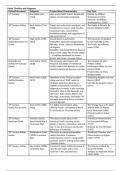
Gothic Timeline and Subgenres
Period/Movement Subgenre Tropes/Ideas/Characteristics Key Texts
th
17 Century Pre-Gothic (pre- Uses many Gothic tropes, despite the Hamlet, by William
1764) Gothic not yet being recognised. Shakespeare (1601)
Macbeth, by William
Shakespeare (c. 1605)
18th Century Gothic Early Gothic (1764- Tropes are rudimentary and basic, and The Castle of Otranto, By
1788) include terror, horror, weak females, Horace Walpole (1764)
tyrannical males, sexual desire,
forbidding settings and suggestions of
the supernatural.
18th Century High Gothic (1789- Sexual desire is particularly The Mysteries of Udolpho,
Gothic/Romantic-era 1813) intensified, especially transgressions by Ann Radcliffe (1794)
Gothic like rape, incest, sodomy, destruction The Monk, by Matthew
of virginity. Lewis (1796)
Radcliffe’s novels signified the dawn of
what is now called ‘The female Gothic’
– a tradition developed by Austen,
Bronte and Carter, amongst others.
Romantic-era Late Gothic (1814- The excesses, stereotypes, and The Vampyre by John
Gothic/19th Century 1838) frequent absurdities of traditional Polidori (1816)
Gothic Gothic made it rich territory for satire; Northanger Abbey, by Jane
pastiche and parody became common. Austen (1818)
Frankenstein, by Mary
Shelley (1818)
19th Century Post-Gothic (1838- Popularity of the ‘Penny Dreadful’ – Wuthering Heights, by Emily
Gothic/Victorian 1879) cheap and short ‘thrill’ reads for Bronte (1847)
Gothic Victorian audiences, focusing on Carmilla, by Joseph Le Fanu,
exploits of detectives, criminals, or (1871)
supernatural entities. It also searches
for Gothic ideas in the domestic, e.g.
the home, high society, history, etc.
Marriage, domesticity, femininity, for
example, may act as forms of torture
and entrapment.
19th Century Post-Gothic (1880- It is highly psychological, often The Strange Case of Dr Jekyll
Gothic/Fin de siècle 1901) utilising Freud’s conception of the Id. and Mr Hyde, by Robert
It comments on Victorian society. Louis Stevenson (1886)
Dracula, by Bram Stoker
(1897)
20th Century Southern Gothic This places Gothic ideas in the A Streetcar Named Desire,
American Gothic (post-World War II American South, focusing on the by Tennessee Williams
to present day) ghosts of slavery, colonialism, and civil (1947)
war. It sees the decay in society and Beloved, by Toni Morrison
grotesque in humanity. (1987)
20th Century British Postmodern Gothic This seeks to parody and pastiche The Bloody Chamber and
Gothic (1950s to present Gothic literature. It explores Other Stories, by Angela
day) contemporary concerns using Gothic Carter (1979)
contexts. Carter’s writing is also called
‘Feminist Gothic’.
20th Century Gothic Neo-Gothic (1980s A revival of classic Gothic literature. It The Woman in Black, by
to present day) recycles old tropes and is more Susan Hill (1983)
common in film and television. Twilight, by Stephanie Meyer
(2005-2008)
Period/Movement Subgenre Tropes/Ideas/Characteristics Key Texts
th
17 Century Pre-Gothic (pre- Uses many Gothic tropes, despite the Hamlet, by William
1764) Gothic not yet being recognised. Shakespeare (1601)
Macbeth, by William
Shakespeare (c. 1605)
18th Century Gothic Early Gothic (1764- Tropes are rudimentary and basic, and The Castle of Otranto, By
1788) include terror, horror, weak females, Horace Walpole (1764)
tyrannical males, sexual desire,
forbidding settings and suggestions of
the supernatural.
18th Century High Gothic (1789- Sexual desire is particularly The Mysteries of Udolpho,
Gothic/Romantic-era 1813) intensified, especially transgressions by Ann Radcliffe (1794)
Gothic like rape, incest, sodomy, destruction The Monk, by Matthew
of virginity. Lewis (1796)
Radcliffe’s novels signified the dawn of
what is now called ‘The female Gothic’
– a tradition developed by Austen,
Bronte and Carter, amongst others.
Romantic-era Late Gothic (1814- The excesses, stereotypes, and The Vampyre by John
Gothic/19th Century 1838) frequent absurdities of traditional Polidori (1816)
Gothic Gothic made it rich territory for satire; Northanger Abbey, by Jane
pastiche and parody became common. Austen (1818)
Frankenstein, by Mary
Shelley (1818)
19th Century Post-Gothic (1838- Popularity of the ‘Penny Dreadful’ – Wuthering Heights, by Emily
Gothic/Victorian 1879) cheap and short ‘thrill’ reads for Bronte (1847)
Gothic Victorian audiences, focusing on Carmilla, by Joseph Le Fanu,
exploits of detectives, criminals, or (1871)
supernatural entities. It also searches
for Gothic ideas in the domestic, e.g.
the home, high society, history, etc.
Marriage, domesticity, femininity, for
example, may act as forms of torture
and entrapment.
19th Century Post-Gothic (1880- It is highly psychological, often The Strange Case of Dr Jekyll
Gothic/Fin de siècle 1901) utilising Freud’s conception of the Id. and Mr Hyde, by Robert
It comments on Victorian society. Louis Stevenson (1886)
Dracula, by Bram Stoker
(1897)
20th Century Southern Gothic This places Gothic ideas in the A Streetcar Named Desire,
American Gothic (post-World War II American South, focusing on the by Tennessee Williams
to present day) ghosts of slavery, colonialism, and civil (1947)
war. It sees the decay in society and Beloved, by Toni Morrison
grotesque in humanity. (1987)
20th Century British Postmodern Gothic This seeks to parody and pastiche The Bloody Chamber and
Gothic (1950s to present Gothic literature. It explores Other Stories, by Angela
day) contemporary concerns using Gothic Carter (1979)
contexts. Carter’s writing is also called
‘Feminist Gothic’.
20th Century Gothic Neo-Gothic (1980s A revival of classic Gothic literature. It The Woman in Black, by
to present day) recycles old tropes and is more Susan Hill (1983)
common in film and television. Twilight, by Stephanie Meyer
(2005-2008)

