Returning Value to Shareholders-
Doctrine of maintenance of share capital (Restricting the return of value to shareholders)-
On the purchase of shares, to invest in the company, the value cannot usually be returned to the
shareholder
(a company cannot usually return capital to shareholders)
o Meaning they cannot release money from the equity account & share premium account
o This is the Doctrine of Maintenance of Share Capital
Payment to shareholder must be out of profits
o If a shareholder wants a capital return on his investment, his only recourse is to sell his
shares
There are exceptions to the doctrine
-
Reasons for the doctrine -
During the life of a company, its capital is a liability owed to its shareholders.
(Trevor v Whitworth) - Share capital of a company is seen as a permanent fund available to its creditors
Creditors are able to assume that nominal value + any premium has been paid up & no company
capital will be dissipated in the ordinary course of business
The obligation on a company to maintain its share capital mirrors the fact that the liability of its
members (on a winding up) is generally limited to the amount unpaid on their shares - s.74 IA ‘86
Common law principles established in (Trevor v Whitworth) have been enshrined in;
S658(1) CA ‘06 - A limited company must not acquire its own shares, whether by purchase, subscription
or otherwise, except in accordance with the provisions of this Part.
Rule is subject to an acquisition by the company in accordance with Part 18
(2)If a company purports to act in contravention of this section—
o (a)an offence is committed by—
(i)the company, and
(ii)every officer of the company who is in default, and
o (b)the purported acquisition is void.
(3)A person guilty of an offence under this section is liable—
o (a)on conviction on indictment, to imprisonment for a term not exceeding two
years or a fine (or both);
o (b)on summary conviction—
Directors should account for their duties when considering an own share purchase or a redemption of
redeemable shares by the company
-
,On the balance sheet -
(pg 3 – 4)
-
Dividends-
A company may not make a distribution of assets (including cash) to shareholders except out of realised
profit that is available for distribution.
S830 (1)A company may only make a distribution out of profits available for the purpose.
(2)A company's profits available for distribution are its accumulated, realised profits, so far as
not previously utilised by distribution or capitalisation, less its accumulated, realised losses, so
far as not previously written off in a reduction or reorganisation of capital duly made.
In contravention = unlawful dividends
Part 23 sets out various additional provisions which stipulate how ‘profits’ should be determined
+ look at anything in the company articles
Articles may state that the company can declare a dividend by ordinary resolution of the
shareholders - MA 30 provides for this too
o The amount of the dividend cannot exceed the amount recommended by the directors
Directors recommend a dividend in a BM and the shareholders vote at a GM by ordinary res
if it is a private limited company, - Can be done by written res
Commonly known as a final dividend and is typically paid after looking at the company’s
financial results for the year.
MA 30 also provides that directors can by board res, decide to pay interim dividends
any dividend that the directors pay without asking the shareholders for approval in a GM
o It is usually a portion of the profits for the year and is effectively an estimate, as it is
calculated before the company’s annual earnings have been determined. The final
dividend can then add an appropriate amount in addition to the interim dividend to
ensure that the final dividend is reasonable for the year.
S847 - Consequences of unlawful distribution
No criminal sanctions
-
Declaring and paying dividends-
Always check articles & shareholder agreements
, where the articles are silent, common law gives companies an implied power to distribute
profits to shareholders
Articles may include a restriction/prohibition on paying dividends
Alternatively the articles (or a shareholders’ agreement) could contain a mechanism requiring
the payment of dividends where legally permissible. In this scenario the mechanism would
usually work on the basis of a percentage of distributable profits.
Dividends do not carry interest against the company unless otherwise provided by the rights attached to
the shares
Eg: MA 32
The shareholders entitled to a dividend will be those on the register of members at the time of the
declaration
For some companies the articles may provide for a record date to be set to establish which
shareholders are entitled to receive the dividend. This would be the case for a company where
there are significant numbers of shareholders that change frequently, for example, in listed
companies.
Articles will typically state that dividends are declared and paid according to the amounts paid up on the
relevant shares. In the absence of such an article, the amount paid to each member would be calculated
on the nominal value of each relevant share
Company directors need to consider their statutory duties and the company’s future financial
requirements before recommending a final dividend or resolving to pay an interim dividend.
They can also set aside part of the profits as a reserve, for example, to fund dividends in any
future low profit years.
-
Preference shares and cumulative dividends-
Preference shares-
The holder will have some preferred right – usually a first fixed dividend, often stated as a % on
the amount of paid up shares
o Right to be paid in priority to ordinary shareholders in any year in which the company
has sufficient distributable profits
Cumulative preference shares-
The holder has a right to accumulate the right to dividends where they are expressed to be
payable in a year but are then not paid
o The dividend accumulates as a debt owed to the cumulative preference shareholder
until it is paid, unless there are provisions in the articles or shareholders’ agreement to
the contrary.
Doctrine of maintenance of share capital (Restricting the return of value to shareholders)-
On the purchase of shares, to invest in the company, the value cannot usually be returned to the
shareholder
(a company cannot usually return capital to shareholders)
o Meaning they cannot release money from the equity account & share premium account
o This is the Doctrine of Maintenance of Share Capital
Payment to shareholder must be out of profits
o If a shareholder wants a capital return on his investment, his only recourse is to sell his
shares
There are exceptions to the doctrine
-
Reasons for the doctrine -
During the life of a company, its capital is a liability owed to its shareholders.
(Trevor v Whitworth) - Share capital of a company is seen as a permanent fund available to its creditors
Creditors are able to assume that nominal value + any premium has been paid up & no company
capital will be dissipated in the ordinary course of business
The obligation on a company to maintain its share capital mirrors the fact that the liability of its
members (on a winding up) is generally limited to the amount unpaid on their shares - s.74 IA ‘86
Common law principles established in (Trevor v Whitworth) have been enshrined in;
S658(1) CA ‘06 - A limited company must not acquire its own shares, whether by purchase, subscription
or otherwise, except in accordance with the provisions of this Part.
Rule is subject to an acquisition by the company in accordance with Part 18
(2)If a company purports to act in contravention of this section—
o (a)an offence is committed by—
(i)the company, and
(ii)every officer of the company who is in default, and
o (b)the purported acquisition is void.
(3)A person guilty of an offence under this section is liable—
o (a)on conviction on indictment, to imprisonment for a term not exceeding two
years or a fine (or both);
o (b)on summary conviction—
Directors should account for their duties when considering an own share purchase or a redemption of
redeemable shares by the company
-
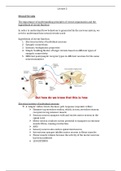
,On the balance sheet -
(pg 3 – 4)
-
Dividends-
A company may not make a distribution of assets (including cash) to shareholders except out of realised
profit that is available for distribution.
S830 (1)A company may only make a distribution out of profits available for the purpose.
(2)A company's profits available for distribution are its accumulated, realised profits, so far as
not previously utilised by distribution or capitalisation, less its accumulated, realised losses, so
far as not previously written off in a reduction or reorganisation of capital duly made.
In contravention = unlawful dividends
Part 23 sets out various additional provisions which stipulate how ‘profits’ should be determined
+ look at anything in the company articles
Articles may state that the company can declare a dividend by ordinary resolution of the
shareholders - MA 30 provides for this too
o The amount of the dividend cannot exceed the amount recommended by the directors
Directors recommend a dividend in a BM and the shareholders vote at a GM by ordinary res
if it is a private limited company, - Can be done by written res
Commonly known as a final dividend and is typically paid after looking at the company’s
financial results for the year.
MA 30 also provides that directors can by board res, decide to pay interim dividends
any dividend that the directors pay without asking the shareholders for approval in a GM
o It is usually a portion of the profits for the year and is effectively an estimate, as it is
calculated before the company’s annual earnings have been determined. The final
dividend can then add an appropriate amount in addition to the interim dividend to
ensure that the final dividend is reasonable for the year.
S847 - Consequences of unlawful distribution
No criminal sanctions
-
Declaring and paying dividends-
Always check articles & shareholder agreements
, where the articles are silent, common law gives companies an implied power to distribute
profits to shareholders
Articles may include a restriction/prohibition on paying dividends
Alternatively the articles (or a shareholders’ agreement) could contain a mechanism requiring
the payment of dividends where legally permissible. In this scenario the mechanism would
usually work on the basis of a percentage of distributable profits.
Dividends do not carry interest against the company unless otherwise provided by the rights attached to
the shares
Eg: MA 32
The shareholders entitled to a dividend will be those on the register of members at the time of the
declaration
For some companies the articles may provide for a record date to be set to establish which
shareholders are entitled to receive the dividend. This would be the case for a company where
there are significant numbers of shareholders that change frequently, for example, in listed
companies.
Articles will typically state that dividends are declared and paid according to the amounts paid up on the
relevant shares. In the absence of such an article, the amount paid to each member would be calculated
on the nominal value of each relevant share
Company directors need to consider their statutory duties and the company’s future financial
requirements before recommending a final dividend or resolving to pay an interim dividend.
They can also set aside part of the profits as a reserve, for example, to fund dividends in any
future low profit years.
-
Preference shares and cumulative dividends-
Preference shares-
The holder will have some preferred right – usually a first fixed dividend, often stated as a % on
the amount of paid up shares
o Right to be paid in priority to ordinary shareholders in any year in which the company
has sufficient distributable profits
Cumulative preference shares-
The holder has a right to accumulate the right to dividends where they are expressed to be
payable in a year but are then not paid
o The dividend accumulates as a debt owed to the cumulative preference shareholder
until it is paid, unless there are provisions in the articles or shareholders’ agreement to
the contrary.