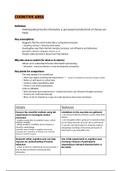
COGNITIVE AREA
Definition:
- Understanding how the information is processed and what kind of choices are
made
Key assumptions:
- Suggests that the mind works like a computer-processor
↪ inputting, storing + retrieving information
- Investigates way that internal mental processes can influence our behaviour
(perception, attention, language, memory, e.t.c)
- People make decisions about how they behave
Why this area is useful (for what or to whom):
- Allows us to understand human information processing
↪ education - memory attention, moral development, perception
Key points for comparison:
- The way research is carried out:
↪ often uses highly controlled lab experiments → ∴ tends to be reliable but may lack ecological validity
↪ Relies on self-report to collect data
↪ Tends to collect quantitative data
↪ Tends to use adults participants
- Links to debates:
↪ Both individual (past experiences) + situational factors can influence thought processes
↪ Tends to be conducted ethically
↪ More of role for freewill as it says we make decisions about how we behave
Strengths Weaknesses
Favours the scientific method, using lab Limitations to the way data are gathered
experiments to investigate mental ↪ can only be studied by inference, cannot study them
processes directly
↪ enables researchers to establish cause + effect ↪ can only gather what is going on in someone’s head
between variables by recording what they can/can’t tell us (self-report)
↪ Brings academic credibility, since it favours a or can/can’t do (observation) or at best by making +
scientific methodology interpreting recordings of the active parts parts of
(scientific value of studies in cognitive area can be
their brains e.g by using MRI scans
increased, since replication of findings is an important
feature of scientific enquiry)
Research within cognitive area can help Use of lab experiments in cognitive area
improve our understanding of human increases chances of participants
behaviour responding to demand characteristics in
↪ extent to which it is affected by the way we think + the study
how our brain processes incoming sensory
information
, CLASSIC: LOFTUS & PALMER - MEMORY
Link to Key theme:
- Provides empirical evidence into effects of information recieved after
the event on a person’s memory of an event
↪ experimental demonstration of the effects of leading questions on eyewitness
testimony & shows how memory is reconstructive in nature
Link to Area:
- Investigating the cognitive process of memory
↪ aimed to investigate reconstructive nature of memory, showing that information
introduced after an event in the form of leading questions would have an effect on
eye witnesses’ memory of the event
Links to debates:
PSYCHOLOGY AS A SCIENCE:
+ Carried out controlled laboratory experiments & these fulfill
scientific criteria of theory, control, evidence and replication
↪ Supports claim that psychology is a scientific discipline
USEFULNESS:
useful Showed that it is possible to distort memories of eyewitnesses
to events
↪ considerable repercussions for the police - such studies have
led to great deal of research being carried out into the best way
for police officers to question witnesses
↪ suggesting that this study has real-life applications
not useful HOWEVER responses of participants in 2nd experiments:
- 150 of participants questioned, 121 answered correctly,
‘No’, including over ⅔ of paritcipants in ‘smashed’
condition
↪ so perhaps it is not easy to change a memory for an
important event & must be careful not to exaggerate
extent to which recall of witnesses is affected by
leading questions