

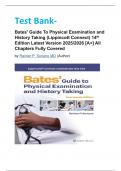
Test Bank-
Bates' Guide To Physical Examination and
History Taking (Lippincott Connect) 14th
Edition Latest Version 2025/2026 [A+] All
Chapters Fully Covered
by Rainier P. Soriano MD (Author)
,Bates’ Guide to Physical Examination and History Taking 14th Edition is the
trusted resource for mastering patient assessment, carefully tailored to meet the evolving
needs of students, educators, and healthcare practitioners. Whether you’re beginning your
career in healthcare or seeking to enhance your clinical skills, this updated edition has been
thoughtfully updated to address the evolving needs of today’s healthcare landscape .
By focusing on enhancing clinical reasoning through the integration of common symptoms
with high-yield health history questions, it empowers users to conduct more accurate and
effective patient evaluations. With a refined two-column layout, new high-quality images, and
expanded tables, the content is both comprehensive and accessible. The inclusion of point -
of-care ultrasound (POCUS) techniques in regional physical examination chapters, where
they correlate with specific PE findings, further enriches the learning and diagnostic process.
Additionally, the text incorporates inclusive language and thoughtfully addresses health
disparities, ensuring a holistic approach to patient care.
This fourteenth international edition is an indispensable resource for those committed
to mastering patient assessment and excelling in today’s healthcare environment.
NEW! Common symptoms with high-yield health history questions are
integrated throughout, emphasizing that clinical reasoning skills are at the core
of effective interviewing and PE techniques.
NEW! POCUS techniques and a dedicated ultrasound chapter provide an
understanding of how ultrasound can elevate PE skills, improving diagnostic
accuracy and confidence.
NEW! Tables on PE modifications for patients with clinical devices and
procedures, ensuring comprehensive and accurate assessments in complex
cases.
NEW! Clinical reasoning-focused interpretation of sample
documentations, enhancing the practical application of diagnostic skills.
UPDATED! Inclusive language and non-stigmatizing terminology are
employed throughout, with health disparities framed within the context of
Social Determinants of Health (SDH). Teaching and Learning Support:
UPDATED! Integration with Connect Courseware, providing seamless
access to interactive learning modules, customizable course content, and
progress tracking tools.
,Bates’ Guide To Physical Examination And History Taking 14th
International Edition
CHAPTER 1 Foundations For Clinical Proficiency
MULTIPLE CHOICE
1. After Completing An Initial Assessment Of A Patient, The Nurse Has Charted That His
Respirations Are Eupneic And His Pulse Is 58 Beats Per Minute. These Types Of Data Would Be:
A Objective.
.
B Reflective.
.
C Subjective.
.
D Introspective.
.
ANS;A
Objective Data Are What The Health Professional Observes By Inspecting, Percussing, Palpating, And
Auscultating During The Physical Examination. Subjective Data Is What The Person Says About Him Or
Herself During History Taking. The Terms Reflective And Introspective Are Not Used To Describe Data.
DIFFERENCE; Cognitive Level: Understanding (Comprehension) REF: P. 2
MSC: Client Needs: Safe And Effective Care Environment: Management Of Care
2. A Patient Tells The Nurse That He Is Very Nervous, Is Nauseated, And Feels Hot. These Types Of
Data Would Be:
A Objective.
.
, B Reflective.
.
C Subjective.
.
D Introspective.
.
ANS;C
Subjective Data Are What The Person Says About Him Or Herself During History Taking. Objective Data
Are What The Health Professional Observes By Inspecting, Percussing, Palpating, And
Auscultating During The Physical Examination. The Terms Reflective And Introspective Are Not Used
To Describe Data.
DIFFERENCE;Cognitive Level: Understanding (Comprehension) REF: P. 2
MSC: Client Needs: Safe And Effective Care Environment: Management Of Care
3. The Patients Record, Laboratory Studies, Objective Data, And Subjective Data Combine To Form
The:
A Data Base.
.
B Admitting Data.
.
C Financial Statement.
.
D Discharge Summary.
Bates' Guide To Physical Examination and
History Taking (Lippincott Connect) 14th
Edition Latest Version 2025/2026 [A+] All
Chapters Fully Covered
by Rainier P. Soriano MD (Author)
,Bates’ Guide to Physical Examination and History Taking 14th Edition is the
trusted resource for mastering patient assessment, carefully tailored to meet the evolving
needs of students, educators, and healthcare practitioners. Whether you’re beginning your
career in healthcare or seeking to enhance your clinical skills, this updated edition has been
thoughtfully updated to address the evolving needs of today’s healthcare landscape .
By focusing on enhancing clinical reasoning through the integration of common symptoms
with high-yield health history questions, it empowers users to conduct more accurate and
effective patient evaluations. With a refined two-column layout, new high-quality images, and
expanded tables, the content is both comprehensive and accessible. The inclusion of point -
of-care ultrasound (POCUS) techniques in regional physical examination chapters, where
they correlate with specific PE findings, further enriches the learning and diagnostic process.
Additionally, the text incorporates inclusive language and thoughtfully addresses health
disparities, ensuring a holistic approach to patient care.
This fourteenth international edition is an indispensable resource for those committed
to mastering patient assessment and excelling in today’s healthcare environment.
NEW! Common symptoms with high-yield health history questions are
integrated throughout, emphasizing that clinical reasoning skills are at the core
of effective interviewing and PE techniques.
NEW! POCUS techniques and a dedicated ultrasound chapter provide an
understanding of how ultrasound can elevate PE skills, improving diagnostic
accuracy and confidence.
NEW! Tables on PE modifications for patients with clinical devices and
procedures, ensuring comprehensive and accurate assessments in complex
cases.
NEW! Clinical reasoning-focused interpretation of sample
documentations, enhancing the practical application of diagnostic skills.
UPDATED! Inclusive language and non-stigmatizing terminology are
employed throughout, with health disparities framed within the context of
Social Determinants of Health (SDH). Teaching and Learning Support:
UPDATED! Integration with Connect Courseware, providing seamless
access to interactive learning modules, customizable course content, and
progress tracking tools.
,Bates’ Guide To Physical Examination And History Taking 14th
International Edition
CHAPTER 1 Foundations For Clinical Proficiency
MULTIPLE CHOICE
1. After Completing An Initial Assessment Of A Patient, The Nurse Has Charted That His
Respirations Are Eupneic And His Pulse Is 58 Beats Per Minute. These Types Of Data Would Be:
A Objective.
.
B Reflective.
.
C Subjective.
.
D Introspective.
.
ANS;A
Objective Data Are What The Health Professional Observes By Inspecting, Percussing, Palpating, And
Auscultating During The Physical Examination. Subjective Data Is What The Person Says About Him Or
Herself During History Taking. The Terms Reflective And Introspective Are Not Used To Describe Data.
DIFFERENCE; Cognitive Level: Understanding (Comprehension) REF: P. 2
MSC: Client Needs: Safe And Effective Care Environment: Management Of Care
2. A Patient Tells The Nurse That He Is Very Nervous, Is Nauseated, And Feels Hot. These Types Of
Data Would Be:
A Objective.
.
, B Reflective.
.
C Subjective.
.
D Introspective.
.
ANS;C
Subjective Data Are What The Person Says About Him Or Herself During History Taking. Objective Data
Are What The Health Professional Observes By Inspecting, Percussing, Palpating, And
Auscultating During The Physical Examination. The Terms Reflective And Introspective Are Not Used
To Describe Data.
DIFFERENCE;Cognitive Level: Understanding (Comprehension) REF: P. 2
MSC: Client Needs: Safe And Effective Care Environment: Management Of Care
3. The Patients Record, Laboratory Studies, Objective Data, And Subjective Data Combine To Form
The:
A Data Base.
.
B Admitting Data.
.
C Financial Statement.
.
D Discharge Summary.

