Unit 2: Practical Scientific Procedures and Techniques
Assignment 1/ Learning Aim A – Keeping up the standards
Risk assessments are carried out before every experiment to identify health and safety standards
and evaluate the risks they pose. In addition, risk assessments assess existing control measures and
ensure additional costs are implemented wherever necessary [1].
In order to abide by normal lab safety procedures, employees and students must do the following:
- Lab coats must be worn at all times
- Safety goggles must be worn
- No food or drink is allowed in the lab
- Hang up their coats
- Put stools under the desk
- Mop up any spills that occur
- Replace tops on chemical bottles [2]
1) Aims of the assignment:
● Calibration of equipment
● Produce a standard solution of sodium carbonate
● Carry out a titration experiment with the use of sodium carbonate to standardise
hydrochloric acid
● Carry out a titration experiment with the use of hydrochloric acid to standardise sodium
hydroxide
● Determine the concentration of a coloured solution using a colorimeter
2) Calibration of apparatus:
How to calibrate a balance:
1. Place the balance on a level surface
2. Turn on the balance
3. Ensure that the pan on the balance is clean
4. Allow the balance to present the numerical screen
5. Alter the units to grams (g) using the units button
6. Put a certified mass of 10g onto the balance and weigh the mass
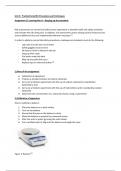
Figure 1: Balance [3]
, Mass reading Mean mass Difference (g) Intolerance?
on balance (g) reading (g)
1 2 3
10.05 10.15 10.10 10.10 0.10 YES
Balances in tolerance have a+ /-1% reading.
1% of 10g is 10.00/100 x 1 = 0.1g
So, the reading should be between 9.90g and 10.10g.
If the balance is not in tolerance re-level it and use the screw at the balance to reset to 10.00g with
the mass on.
● pH probes
1. Turn on the probe
2. Allow the probe to equilibrate with the environment
3. Remove the plastic and rubber caps
4. Rinse the probe with distilled water
5. Place the probe into the pH 4 buffer, wait 30 seconds, take 3 pH readings and record
6. Repeat with pH 7 and 10
7. Calculate the tolerance
pH Reading of pH Mean pH Actual pH Difference Intolerance?
1 2 3
4 4.01 4.03 4.02 4.02 4.00 + 0.02 YES
7 6.98 6.98 6.98 6.98 7.00 -0.02 YES
9 9.01 9.01 9.00 9.007 9.00 +0.07 YES
The pH probe should read to +/- 1% of the actual pH to be intolerance.
pH 4 - 4.00/100 x 1 = 0.04
pH 7 - 7.00/100 x 1 = 0.07
pH 9 - 9.00/100 x 1 = 0.09
If the pH is not within tolerance, use the screw on the back to change the reading.
,Figure 2: pH probe [4]
Use of pH meters: The pH change that occurs during a reaction is measured using a pH meter. The
pH is determined as little amounts of solution are added into the base. Then, a graph is created with
the volume of base added along the horizontal axis and pH along the vertical axis. This graph can be
used to calculate the base’s molarity and find the equivalency point [5].
Calibration of pH meters: pH meter calibration is a vital process that entails assessing and modifying
the accuracy and precision of apparatus. The goal of this procedure is frequently to reduce
instrument reading bias. The pH meter is calibrated since it is possible for it to fluctuate partially
when measurements are being taken [6].
How a pH meter is calibrated:
- Turn on the pH meter and press the CAL button
- Set the pH meter’s reading to 4.01
- After inserting the pH probe into the pH 4.01 solution and waiting for the reading to appear,
confirm by pressing CFM.
- To prevent contamination, rinse the pH probe with distilled water to get rid of anything from
the pH 4.01 solution.
- Once pH 7.01 is displayed on the pH metre, use the same procedure as for pH 4.01.
Figure 3: pH Meter Checker [7]
, ● Using water as a standard for calibration
1) Measure the temperature of the room.
2) Using a pipette and filler, measure 25cm3 of distilled water.
3) Calibrate a balance, place a small beaker on the pan, and zero the balance.
4) Pour the pipette water into the beaker and measure the mass.
Temperature Density of Volume (cm3) Mass (g) Difference Intolerance?
(Co) water (g/cm3)
25.1 0.9948 25.0 25.2 +0.2 YES
Photos:
Assignment 1/ Learning Aim A – Keeping up the standards
Risk assessments are carried out before every experiment to identify health and safety standards
and evaluate the risks they pose. In addition, risk assessments assess existing control measures and
ensure additional costs are implemented wherever necessary [1].
In order to abide by normal lab safety procedures, employees and students must do the following:
- Lab coats must be worn at all times
- Safety goggles must be worn
- No food or drink is allowed in the lab
- Hang up their coats
- Put stools under the desk
- Mop up any spills that occur
- Replace tops on chemical bottles [2]
1) Aims of the assignment:
● Calibration of equipment
● Produce a standard solution of sodium carbonate
● Carry out a titration experiment with the use of sodium carbonate to standardise
hydrochloric acid
● Carry out a titration experiment with the use of hydrochloric acid to standardise sodium
hydroxide
● Determine the concentration of a coloured solution using a colorimeter
2) Calibration of apparatus:
How to calibrate a balance:
1. Place the balance on a level surface
2. Turn on the balance
3. Ensure that the pan on the balance is clean
4. Allow the balance to present the numerical screen
5. Alter the units to grams (g) using the units button
6. Put a certified mass of 10g onto the balance and weigh the mass
Figure 1: Balance [3]
, Mass reading Mean mass Difference (g) Intolerance?
on balance (g) reading (g)
1 2 3
10.05 10.15 10.10 10.10 0.10 YES
Balances in tolerance have a+ /-1% reading.
1% of 10g is 10.00/100 x 1 = 0.1g
So, the reading should be between 9.90g and 10.10g.
If the balance is not in tolerance re-level it and use the screw at the balance to reset to 10.00g with
the mass on.
● pH probes
1. Turn on the probe
2. Allow the probe to equilibrate with the environment
3. Remove the plastic and rubber caps
4. Rinse the probe with distilled water
5. Place the probe into the pH 4 buffer, wait 30 seconds, take 3 pH readings and record
6. Repeat with pH 7 and 10
7. Calculate the tolerance
pH Reading of pH Mean pH Actual pH Difference Intolerance?
1 2 3
4 4.01 4.03 4.02 4.02 4.00 + 0.02 YES
7 6.98 6.98 6.98 6.98 7.00 -0.02 YES
9 9.01 9.01 9.00 9.007 9.00 +0.07 YES
The pH probe should read to +/- 1% of the actual pH to be intolerance.
pH 4 - 4.00/100 x 1 = 0.04
pH 7 - 7.00/100 x 1 = 0.07
pH 9 - 9.00/100 x 1 = 0.09
If the pH is not within tolerance, use the screw on the back to change the reading.
,Figure 2: pH probe [4]
Use of pH meters: The pH change that occurs during a reaction is measured using a pH meter. The
pH is determined as little amounts of solution are added into the base. Then, a graph is created with
the volume of base added along the horizontal axis and pH along the vertical axis. This graph can be
used to calculate the base’s molarity and find the equivalency point [5].
Calibration of pH meters: pH meter calibration is a vital process that entails assessing and modifying
the accuracy and precision of apparatus. The goal of this procedure is frequently to reduce
instrument reading bias. The pH meter is calibrated since it is possible for it to fluctuate partially
when measurements are being taken [6].
How a pH meter is calibrated:
- Turn on the pH meter and press the CAL button
- Set the pH meter’s reading to 4.01
- After inserting the pH probe into the pH 4.01 solution and waiting for the reading to appear,
confirm by pressing CFM.
- To prevent contamination, rinse the pH probe with distilled water to get rid of anything from
the pH 4.01 solution.
- Once pH 7.01 is displayed on the pH metre, use the same procedure as for pH 4.01.
Figure 3: pH Meter Checker [7]
, ● Using water as a standard for calibration
1) Measure the temperature of the room.
2) Using a pipette and filler, measure 25cm3 of distilled water.
3) Calibrate a balance, place a small beaker on the pan, and zero the balance.
4) Pour the pipette water into the beaker and measure the mass.
Temperature Density of Volume (cm3) Mass (g) Difference Intolerance?
(Co) water (g/cm3)
25.1 0.9948 25.0 25.2 +0.2 YES
Photos: