

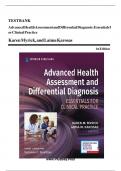
TEST BANK
N
Advanced Health Assessment and Differential Diagnosis: Essentials f
N N N N N N N
or Clinical Practice
N N
Karen Myrick, and Laima Karosas
N N N N
1st Edition
N
www.PlusBay.Plus
,Table of Contents
N N
Chapter 1. Health History, The Patient Interview, And Motivational Interviewing
N N N N N N N N N 1
Chapter 2. Advanced Health Assessment of the Head, Neck, and Lymphatic System
N N N N N N N N N N N 13
Chapter 3. Advanced Health Assessment of the Nose, Mouth, and Throat
N N N N N N N N N N 24
Chapter 4. Advanced Health Assessment of the Eyes and Ears
N N N N N N N N N 36
Chapter 5. Advanced Health Assessment of Skin, Hair, and Nails
N N N N N N N N N 42
Chapter 6. Advanced Health Assessment of the Cardiovascular System
N N N N N N N N 48
Chapter 7. Advanced Health Assessment of the Respiratory System
N N N N N N N N 60
Chapter 8. Advanced Health Assessment of the Abdomen, Rectum, and Anus
N N N N N N N N N N 72
Chapter 9. Advanced Health Assessment of the Male Genitourinary System
N N N N N N N N N 83
Chapter 10. Advanced Assessment of the Female Reproductive System
N N N N N N N N 93
Chapter 11. Advanced Health Assessment of the Neurological System
N N N N N N N N 105
Chapter 12. Advanced Health Assessment of the Musculoskeletal System
N N N N N N N N 117
www.PlusBay.Plus
, Test Bank - Advanced Health Assessment and Differential Diagnosis, 1st Edition (Myrick, 2020)
N N N N N N N N N N N N
Chapter 1. Health History, The Patient Interview, And Motivational Interviewing
N N N N N N N N N
MULTIPLE CHOICE N
1. The nurse is preparing to conduct a health history. Which of these statements best describes the purp
N N N N N N N N N N N N N N N N
ose of a health history?
N N N N
a. To provide an opportunity for interaction between the patient and the nurse
N N N N N N N N N N N
b. To provide a form for obtaining the patients biographic information
N N N N N N N N N
c. To document the normal and abnormal findings of a physical assessment
N N N N N N N N N N
d. To provide a database of subjective information about the patients past and current health
N N N N N N N N N N N N N
ANS: D N
The purpose of the health history is to collect subjective data what the person says about him or herself. Th
N N N N N N N N N N N N N N N N N N N
e other options are not correct.
N N N N N
DIF: Cognitive Level: Understanding (Comprehension) N N N
REF: dm. 49 MSC: Client Needs: Safe and Effective Care Environment: M N N N N N N N N N N N
anagement of Care N N
2. When the nurse is evaluating the reliability of a patients responses, which of these statements would be
N N N N N N N N N N N N N N N N
correct? The patient: N N
a. Has a history of drug abuse and therefore is not reliable.
N N N N N N N N N N
b. Provided consistent information and therefore is reliable. N N N N N N
c. Smiled throughout interview and therefore is assumed reliable. N N N N N N N
d. Would not answer questions concerning stress and therefore is not reliable.
N N N N N N N N N N
ANS: B N
A reliable person always gives the same answers, even when questions are rephrased or are repeated later in
N N N N N N N N N N N N N N N N N N
the interview. The other s t a t W
N e mWe nWt s.a T
reB
noS
t cMor.reW
ct.S N N N N N
DIF: Cognitive Level: Applying (Application) N N N
REF: dm. 49 MSC: Client Needs: Safe and Effective Care Environment: M N N N N N N N N N N N
anagement of Care N N
3. A 59-year-N
old patient tells the nurse that he has ulcerative colitis. He has been having black stools for the last 24 hours
N N N N N N N N N N N N N N N N N N N N
. How would the nurse best document his reason for seeking care?
N N N N N N N N N N N
a. J.M. is a 59-year-old man seeking treatment for ulcerative colitis.
N N N N N N N N N
b. J.M. came into the clinic complaining of having black stools for the past 24 hours.
N N N N N N N N N N N N N N
c. J.M. is a 59-year-old man who states that he has ulcerative colitis and wants it checked.
N N N N N N N N N N N N N N N
d. J.M. is a 59-year- N N N
old man who states that he has been having black stools for the past 24 hours.
N N N N N N N N N N N N N N N
ANS: D N
The reason for seeking care is a brief spontaneous statement in the persons own words that describes the rea
N N N N N N N N N N N N N N N N N N
son for the visit. It states one (possibly two) signs or symptoms and their duration. It is enclosed in quotation
N N N N N N N N N N N N N N N N N N N N
marks to indicate the persons exact words.
N N N N N N
DIF: Cognitive Level: Applying (Application) N N N
REF: dm. 50 MSC: Client Needs: Safe and Effective Care Environment: M N N N N N N N N N N N
anagement of Care N N
4. A patient tells the nurse that she has had abdominal pain for the past week. What would be the nurses best r
N N N N N N N N N N N N N N N N N N N N N
esponse?
a. Can you point to where it hurts? N N N N N N
b. Well talk more about that later in the interview.
N N N N N N N N
c. What have you had to eat in the last 24 hours? N N N N N N N N N N
1|Page
N N N N N
www.PlusBay.Plus
, Test Bank - Advanced Health Assessment and Differential Diagnosis, 1st Edition (Myrick, 2020)
N N N N N N N N N N N N
d. Have you ever had any surgeries on your abdomen? A N N N N N N N N N
NS: A N
A final summary of any symptom the person has should include, along with seven other critical characteristics
N N N N N N N N N N N N N N N N
, Location: specific. The person is asked to point to the location.
N N N N N N N N N N N
DIF: Cognitive Level: Applying (Application) N N N
REF: dm. 50 MSC: Client Needs: Safe and Effective Care Environment: M N N N N N N N N N N N
anagement of Care N N
5. A 29-year-
N
old woman tells the nurse that she has excruciating pain in her back. Which would be the nurses appropri
N N N N N N N N N N N N N N N N N N
ate response to the womans statement?
N N N N N
a. How does your family react to your pain? N N N N N N N
b. The pain must be terrible. You probably pinched a nerve.
N N N N N N N N N
c. Ive had back pain myself, and it can be excruciating.
N N N N N N N N N
d. How would you say the pain affects your ability to do your daily activities?
N N N N N N N N N N N N N
ANS: D N
The symptom of pain is difficult to quantify because of individual interpretation. With pain, adjectives should
N N N N N N N N N N N N N N N N
be avoided and the patient should be asked how the pain affects his or her daily activities. The other responses
N N N N N N N N N N N N N N N N N N N N
are not appropriate.
N N
DIF: Cognitive Level: Applying (Application) N N N
REF: dm. 50 MSC: Client Needs: Safe and Effective Care Environment: M N N N N N N N N N N N
anagement of Care N N
6. In recording the childhood illnesses of a patient who denies having had any, which note by the nurse woul
N N N N N N N N N N N N N N N N N N
d be most accurate?
N N N
a. Patient denies usual childhood illnesses. N N N N
b. Patient states he was a very healthy child. N N N N N N N
c. Patient states his sister had measles, but he didnt. N N N N N N N N
d. Patient denies measles, m umps,WruWbeWll .a, T
chB
ickSenMp.
oxW
, pSertussis, and strep throat.
N N N N N N N N
ANS: D N
Childhood illnesses include measles, mumps, rubella, chickenpox, pertussis, and strep throat. Avoid reco
N N N N N N N N N N N N
rding usual childhood illnesses because an illness common in the persons childhood may be unusual toda
N N N N N N N N N N N N N N N
y (e.g., measles).
N N
DIF: Cognitive Level: Remembering (Knowledge) N N N
REF: dm. 51 MSC: Client Needs: Safe and Effective Care Environment: M N N N N N N N N N N N
anagement of Care N N
7. A female patient tells the nurse that she has had six pregnancies, with four live births at term and two sponta
N N N N N N N N N N N N N N N N N N N N
neous abortions. Her four children are still living. How would the nurse record this information?
N N N N N N N N N N N N N N
a. P-6, B-4, (S)Ab-2 N N
b. Grav 6, Term 4, (S)Ab-2, Living 4 N N N N N N
c. Patient has had four living babies. N N N N N
d. Patient has been pregnant six times. N N N N N
ANS: B N
Obstetric history includes the number of pregnancies (gravidity), number of deliveries in which the fetu
N N N N N N N N N N N N N N
s reached term (term), number of preterm pregnancies (preterm), number of incomplete pregnancies (a
N N N N N N N N N N N N N
bortions), and number of children living (living). This is recorded: Grav
N Term N N N N N N N N N N N N
Preterm Ab Living N N N
. For any incomplete pregnancies, the duration is recorded and whether the pregn N N N N N N N N N N N N
ancy resulted in a spontaneous (S) or an induced (I) abortion.
N N N N N N N N N N
DIF: Cognitive Level: Applying (Application) N N N REF: dm. 51 N N N
2|Page
N N N N N
www.PlusBay.Plus
N
Advanced Health Assessment and Differential Diagnosis: Essentials f
N N N N N N N
or Clinical Practice
N N
Karen Myrick, and Laima Karosas
N N N N
1st Edition
N
www.PlusBay.Plus
,Table of Contents
N N
Chapter 1. Health History, The Patient Interview, And Motivational Interviewing
N N N N N N N N N 1
Chapter 2. Advanced Health Assessment of the Head, Neck, and Lymphatic System
N N N N N N N N N N N 13
Chapter 3. Advanced Health Assessment of the Nose, Mouth, and Throat
N N N N N N N N N N 24
Chapter 4. Advanced Health Assessment of the Eyes and Ears
N N N N N N N N N 36
Chapter 5. Advanced Health Assessment of Skin, Hair, and Nails
N N N N N N N N N 42
Chapter 6. Advanced Health Assessment of the Cardiovascular System
N N N N N N N N 48
Chapter 7. Advanced Health Assessment of the Respiratory System
N N N N N N N N 60
Chapter 8. Advanced Health Assessment of the Abdomen, Rectum, and Anus
N N N N N N N N N N 72
Chapter 9. Advanced Health Assessment of the Male Genitourinary System
N N N N N N N N N 83
Chapter 10. Advanced Assessment of the Female Reproductive System
N N N N N N N N 93
Chapter 11. Advanced Health Assessment of the Neurological System
N N N N N N N N 105
Chapter 12. Advanced Health Assessment of the Musculoskeletal System
N N N N N N N N 117
www.PlusBay.Plus
, Test Bank - Advanced Health Assessment and Differential Diagnosis, 1st Edition (Myrick, 2020)
N N N N N N N N N N N N
Chapter 1. Health History, The Patient Interview, And Motivational Interviewing
N N N N N N N N N
MULTIPLE CHOICE N
1. The nurse is preparing to conduct a health history. Which of these statements best describes the purp
N N N N N N N N N N N N N N N N
ose of a health history?
N N N N
a. To provide an opportunity for interaction between the patient and the nurse
N N N N N N N N N N N
b. To provide a form for obtaining the patients biographic information
N N N N N N N N N
c. To document the normal and abnormal findings of a physical assessment
N N N N N N N N N N
d. To provide a database of subjective information about the patients past and current health
N N N N N N N N N N N N N
ANS: D N
The purpose of the health history is to collect subjective data what the person says about him or herself. Th
N N N N N N N N N N N N N N N N N N N
e other options are not correct.
N N N N N
DIF: Cognitive Level: Understanding (Comprehension) N N N
REF: dm. 49 MSC: Client Needs: Safe and Effective Care Environment: M N N N N N N N N N N N
anagement of Care N N
2. When the nurse is evaluating the reliability of a patients responses, which of these statements would be
N N N N N N N N N N N N N N N N
correct? The patient: N N
a. Has a history of drug abuse and therefore is not reliable.
N N N N N N N N N N
b. Provided consistent information and therefore is reliable. N N N N N N
c. Smiled throughout interview and therefore is assumed reliable. N N N N N N N
d. Would not answer questions concerning stress and therefore is not reliable.
N N N N N N N N N N
ANS: B N
A reliable person always gives the same answers, even when questions are rephrased or are repeated later in
N N N N N N N N N N N N N N N N N N
the interview. The other s t a t W
N e mWe nWt s.a T
reB
noS
t cMor.reW
ct.S N N N N N
DIF: Cognitive Level: Applying (Application) N N N
REF: dm. 49 MSC: Client Needs: Safe and Effective Care Environment: M N N N N N N N N N N N
anagement of Care N N
3. A 59-year-N
old patient tells the nurse that he has ulcerative colitis. He has been having black stools for the last 24 hours
N N N N N N N N N N N N N N N N N N N N
. How would the nurse best document his reason for seeking care?
N N N N N N N N N N N
a. J.M. is a 59-year-old man seeking treatment for ulcerative colitis.
N N N N N N N N N
b. J.M. came into the clinic complaining of having black stools for the past 24 hours.
N N N N N N N N N N N N N N
c. J.M. is a 59-year-old man who states that he has ulcerative colitis and wants it checked.
N N N N N N N N N N N N N N N
d. J.M. is a 59-year- N N N
old man who states that he has been having black stools for the past 24 hours.
N N N N N N N N N N N N N N N
ANS: D N
The reason for seeking care is a brief spontaneous statement in the persons own words that describes the rea
N N N N N N N N N N N N N N N N N N
son for the visit. It states one (possibly two) signs or symptoms and their duration. It is enclosed in quotation
N N N N N N N N N N N N N N N N N N N N
marks to indicate the persons exact words.
N N N N N N
DIF: Cognitive Level: Applying (Application) N N N
REF: dm. 50 MSC: Client Needs: Safe and Effective Care Environment: M N N N N N N N N N N N
anagement of Care N N
4. A patient tells the nurse that she has had abdominal pain for the past week. What would be the nurses best r
N N N N N N N N N N N N N N N N N N N N N
esponse?
a. Can you point to where it hurts? N N N N N N
b. Well talk more about that later in the interview.
N N N N N N N N
c. What have you had to eat in the last 24 hours? N N N N N N N N N N
1|Page
N N N N N
www.PlusBay.Plus
, Test Bank - Advanced Health Assessment and Differential Diagnosis, 1st Edition (Myrick, 2020)
N N N N N N N N N N N N
d. Have you ever had any surgeries on your abdomen? A N N N N N N N N N
NS: A N
A final summary of any symptom the person has should include, along with seven other critical characteristics
N N N N N N N N N N N N N N N N
, Location: specific. The person is asked to point to the location.
N N N N N N N N N N N
DIF: Cognitive Level: Applying (Application) N N N
REF: dm. 50 MSC: Client Needs: Safe and Effective Care Environment: M N N N N N N N N N N N
anagement of Care N N
5. A 29-year-
N
old woman tells the nurse that she has excruciating pain in her back. Which would be the nurses appropri
N N N N N N N N N N N N N N N N N N
ate response to the womans statement?
N N N N N
a. How does your family react to your pain? N N N N N N N
b. The pain must be terrible. You probably pinched a nerve.
N N N N N N N N N
c. Ive had back pain myself, and it can be excruciating.
N N N N N N N N N
d. How would you say the pain affects your ability to do your daily activities?
N N N N N N N N N N N N N
ANS: D N
The symptom of pain is difficult to quantify because of individual interpretation. With pain, adjectives should
N N N N N N N N N N N N N N N N
be avoided and the patient should be asked how the pain affects his or her daily activities. The other responses
N N N N N N N N N N N N N N N N N N N N
are not appropriate.
N N
DIF: Cognitive Level: Applying (Application) N N N
REF: dm. 50 MSC: Client Needs: Safe and Effective Care Environment: M N N N N N N N N N N N
anagement of Care N N
6. In recording the childhood illnesses of a patient who denies having had any, which note by the nurse woul
N N N N N N N N N N N N N N N N N N
d be most accurate?
N N N
a. Patient denies usual childhood illnesses. N N N N
b. Patient states he was a very healthy child. N N N N N N N
c. Patient states his sister had measles, but he didnt. N N N N N N N N
d. Patient denies measles, m umps,WruWbeWll .a, T
chB
ickSenMp.
oxW
, pSertussis, and strep throat.
N N N N N N N N
ANS: D N
Childhood illnesses include measles, mumps, rubella, chickenpox, pertussis, and strep throat. Avoid reco
N N N N N N N N N N N N
rding usual childhood illnesses because an illness common in the persons childhood may be unusual toda
N N N N N N N N N N N N N N N
y (e.g., measles).
N N
DIF: Cognitive Level: Remembering (Knowledge) N N N
REF: dm. 51 MSC: Client Needs: Safe and Effective Care Environment: M N N N N N N N N N N N
anagement of Care N N
7. A female patient tells the nurse that she has had six pregnancies, with four live births at term and two sponta
N N N N N N N N N N N N N N N N N N N N
neous abortions. Her four children are still living. How would the nurse record this information?
N N N N N N N N N N N N N N
a. P-6, B-4, (S)Ab-2 N N
b. Grav 6, Term 4, (S)Ab-2, Living 4 N N N N N N
c. Patient has had four living babies. N N N N N
d. Patient has been pregnant six times. N N N N N
ANS: B N
Obstetric history includes the number of pregnancies (gravidity), number of deliveries in which the fetu
N N N N N N N N N N N N N N
s reached term (term), number of preterm pregnancies (preterm), number of incomplete pregnancies (a
N N N N N N N N N N N N N
bortions), and number of children living (living). This is recorded: Grav
N Term N N N N N N N N N N N N
Preterm Ab Living N N N
. For any incomplete pregnancies, the duration is recorded and whether the pregn N N N N N N N N N N N N
ancy resulted in a spontaneous (S) or an induced (I) abortion.
N N N N N N N N N N
DIF: Cognitive Level: Applying (Application) N N N REF: dm. 51 N N N
2|Page
N N N N N
www.PlusBay.Plus

