

Hoorcollege 4:
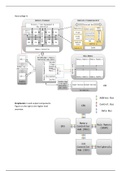
Peripherals: in and output components.
Figure on the right is the higher level
overview.
,What is memory in general? Memory has small cells which stores hexadecimal numbers. Each cell
stores one hexadecimal. Physically a memory cell is a transistor (SRAM). Logically a memory cell is a:
1. Memory cell, 2. A byte, 3. A hexadecimal number. Memory cells store hexadecimal numbers
because, hexadecimal are very ease to convert to binary and has a higher information content.
The memory is segmented(separated) into different segments. So some of these memory cells
actually stores instruction or codes. Some of the other memory cells can store data, like the numbers
you want to compute with. And then we have the stack segments, which has a base address.
, We can use paging to make the memory more flexible. We cluster several units of memory cells into
a page. In this example a page is 32 byte large, this will be one page. We can organise the page in
any form we like, they don’t need to be lay out in the typical sequential. A memory page is a virtual
fixed length of virtual memory, it has a local address but also a specific page address that is being
given by the processor so it doesn’t get into the memory area of other programs.
If we want to store more information than fit into physical memory, we can use virtual memory. The
active pages are in physical memory and the inactive pages are in external storage such as hard
drives.
We use virtual addresses
to address this wider
range of memory
addresses of memory
cells. We have a archive
that’s sits somewhere
outside. We extinguish
them because the CPU is
generally the one
component that askes for
the content of these
memory information.
For the CPU it is small a
route to access main
memory and it’s very
quick. While information
that is stored outside the
physical memory, it’s very
hard to get to it and slow.
Peripherals: in and output components.
Figure on the right is the higher level
overview.
,What is memory in general? Memory has small cells which stores hexadecimal numbers. Each cell
stores one hexadecimal. Physically a memory cell is a transistor (SRAM). Logically a memory cell is a:
1. Memory cell, 2. A byte, 3. A hexadecimal number. Memory cells store hexadecimal numbers
because, hexadecimal are very ease to convert to binary and has a higher information content.
The memory is segmented(separated) into different segments. So some of these memory cells
actually stores instruction or codes. Some of the other memory cells can store data, like the numbers
you want to compute with. And then we have the stack segments, which has a base address.
, We can use paging to make the memory more flexible. We cluster several units of memory cells into
a page. In this example a page is 32 byte large, this will be one page. We can organise the page in
any form we like, they don’t need to be lay out in the typical sequential. A memory page is a virtual
fixed length of virtual memory, it has a local address but also a specific page address that is being
given by the processor so it doesn’t get into the memory area of other programs.
If we want to store more information than fit into physical memory, we can use virtual memory. The
active pages are in physical memory and the inactive pages are in external storage such as hard
drives.
We use virtual addresses
to address this wider
range of memory
addresses of memory
cells. We have a archive
that’s sits somewhere
outside. We extinguish
them because the CPU is
generally the one
component that askes for
the content of these
memory information.
For the CPU it is small a
route to access main
memory and it’s very
quick. While information
that is stored outside the
physical memory, it’s very
hard to get to it and slow.

