

Introduction to Cryptography - D334 ACTUAL EXAM QUESTIONS WITH
Introduction to Cryptography - D334
COMPLETE SOLUTION GUIDE (A+ GRADED 100% VERIFIED) LATEST
Study online at https://quizlet.com/_dnol27
VERSION 2025!!
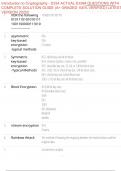
1. XOR the following 1100010101101101
0101110101010111
1001100000111010
------------------
2. asymmetric RSA
key-based DSA
encryption El Gamal
-typical methods
3. Symmetric RC2- 40 bit key size 64 bit block
key-based RC4- (Stream Cipher)- Used in SSL and WEP
encryption RC5- (Variable Key size, 32, 64, or 128 bit block size)
-Typical Methods AES- (128, 192 or 256 bit key size, 128 bit block size)
DES- (56 bit key size. 64 bit Block size)
3DES- (112 bit key size, 64 bit block size)
4. Block Encryption RC2(40 bit key size)
RC5(Variable block size)
IDEA
DES
3DES
AES (Rijndael)
Blowfish
twofish
5. stream encryption RC4
Chacha
6. Rainbow Attack The method of knowing the mapping between the hashed values and the
original data
7. a brute force analysis
, Introduction to Cryptography - D334
Study online at https://quizlet.com/_dnol27
Dictionary-type at-
tack
8. does not belong to
when an object is not in a set
9. Belongs to
when an object is within a set
10. † subset
subset has fewer elements or equal to the set
11. A *B union (objects that belong to set A or set B)
12. | such that
13. A )B Intersection: in both A and B
14. Enigma Machine Used a polyalphabetic substitution cipher, which did not repeat within a rea-
-Cypher 10 sonable time period, along with a secret key. For the cracking of the Enigma
cipher, the challenge was thus to determine both the algorithm used and the
key. Enigma's main weakness, though, was that none of the plain text letters
could be ciphered as itself.
15. Four-square ci- Uses four 5 × 5 matrices arranged in a square, are where each matrix contains
pher9 25 letters for encoding and decoding operations.
16. One-time pad Cypher Code mapping that is only used once.
cypher8 Advantage: it is essentially unbreakable.
Disadvantage: it takes lots of work as you would have to generate the pad to
be used, each time.
17. Vigenere Cipher 7 Polyalphabetic cipher that involves using a different mapping, based on a
keyword, for each character of the cipher. An advantage of this type of cipher
, Introduction to Cryptography - D334
Study online at https://quizlet.com/_dnol27
is that the same plaintext character is likely to be coded to different mappings,
depending on the position of the keyword, making guessing more difficult.
18. Ceasar Cipher6 Mono-alphabetic substitution cipher known as "shift" cipher. Involves plaintext
being replaced by a letter some fixed number of positions down the alphabet.
i.e., a Caesar Cipher using a shift of +3 would mean a plaintext letter A would
result in a ciphertext letter D (a shift of three positions to the right in the
alphabet)
19. Morse Code cipher Encoding method, rather than a cipher, that works by translating characters
5 into sequences of dots (.) and dashes (-)
20. Playfair Cipher 4 5 × 5 matrix containing the alphabet less the letter J. Cipher/decipher process
consists of a set of rules outlining use of column and row combinations.
21. BIFID Cipher 3 Makes use of a grid and which maps the letters into numeric values.
22. Rail Code Cipher 2 Employs a method to scramble text by writing it in a sequence across a number
of rails.
23. Pig Pen Cipher 1 Mono- alphabetic substitution cipher that makes use of mapping plaintext
characters to graphical characters rather than to alphabetic ones. i.e. A=(pick
a symbol), vs A=(pick a letter). Disadvantage: once the mapping is known, it is
difficult to keep the message secret.
24. Encryption in simplest terms is changing plaintext into ciphertext
25. Decryption The process of converting a ciphertext into plaintext.
26. AESCrypt Encrypt individual files and encrypt full disks with options such as Bitlocker and
FileVault
27. Mono-alphabetic c code or substitution is where a single mapping from our alphabet to a cipher
alphabet is created. Many early cryptosystems used this.
, Introduction to Cryptography - D334
Study online at https://quizlet.com/_dnol27
28. Polyalphabetic refers to the mapping of our alphabet to a number of cipher alphabets. This
approach added a bit of complexity to early cryptosystems.
29. One-time pad is considered to be unbreakable since it only uses its cipher code once.
30. Pseudo-Random This method repeats the random numbers after a given time (periodic). They
Number are fast and are also deterministic and are useful in producing a repeatable
Generators set of random numbers.
(PRNGs)
31. Frequency Analysis is cipher cracking methodology that involves identifying patterns and varia-
tions in the probability of codes. i.e. a three-letter ciphered text combination
spotted at the beginning of a string too often could tip us off that those three
letters correlate the letters THE in the English alphabet.
32. True Random Num- This method generates a true random number and uses some form of random
ber Generators process. One approach is to monitor the movements of a mouse pointer on a
(TRNGs) screen or from the pauses between keystrokes. Overall, the method is generally
slow, especially if it involves human interaction, but is non-deterministic and
aperiodic.
33. Entropy measures level of unpredictability; in encryption relates to the degree of
uncertainty of the encryption process.
34. ASCII 8-bit values, up to 256 characters
35. UTF-16 16- bit values, up to 65,536 characters
36. Hardware vs Soft- Hardware encryption is more efficient than software encryption.
ware encryption
37. Hardware Security is a tamper-evident and intrusion-resistant physical device that safeguards and
Module (HSM) manages cryptographic keys and provides cryptographic processing.
Introduction to Cryptography - D334
COMPLETE SOLUTION GUIDE (A+ GRADED 100% VERIFIED) LATEST
Study online at https://quizlet.com/_dnol27
VERSION 2025!!
1. XOR the following 1100010101101101
0101110101010111
1001100000111010
------------------
2. asymmetric RSA
key-based DSA
encryption El Gamal
-typical methods
3. Symmetric RC2- 40 bit key size 64 bit block
key-based RC4- (Stream Cipher)- Used in SSL and WEP
encryption RC5- (Variable Key size, 32, 64, or 128 bit block size)
-Typical Methods AES- (128, 192 or 256 bit key size, 128 bit block size)
DES- (56 bit key size. 64 bit Block size)
3DES- (112 bit key size, 64 bit block size)
4. Block Encryption RC2(40 bit key size)
RC5(Variable block size)
IDEA
DES
3DES
AES (Rijndael)
Blowfish
twofish
5. stream encryption RC4
Chacha
6. Rainbow Attack The method of knowing the mapping between the hashed values and the
original data
7. a brute force analysis
, Introduction to Cryptography - D334
Study online at https://quizlet.com/_dnol27
Dictionary-type at-
tack
8. does not belong to
when an object is not in a set
9. Belongs to
when an object is within a set
10. † subset
subset has fewer elements or equal to the set
11. A *B union (objects that belong to set A or set B)
12. | such that
13. A )B Intersection: in both A and B
14. Enigma Machine Used a polyalphabetic substitution cipher, which did not repeat within a rea-
-Cypher 10 sonable time period, along with a secret key. For the cracking of the Enigma
cipher, the challenge was thus to determine both the algorithm used and the
key. Enigma's main weakness, though, was that none of the plain text letters
could be ciphered as itself.
15. Four-square ci- Uses four 5 × 5 matrices arranged in a square, are where each matrix contains
pher9 25 letters for encoding and decoding operations.
16. One-time pad Cypher Code mapping that is only used once.
cypher8 Advantage: it is essentially unbreakable.
Disadvantage: it takes lots of work as you would have to generate the pad to
be used, each time.
17. Vigenere Cipher 7 Polyalphabetic cipher that involves using a different mapping, based on a
keyword, for each character of the cipher. An advantage of this type of cipher
, Introduction to Cryptography - D334
Study online at https://quizlet.com/_dnol27
is that the same plaintext character is likely to be coded to different mappings,
depending on the position of the keyword, making guessing more difficult.
18. Ceasar Cipher6 Mono-alphabetic substitution cipher known as "shift" cipher. Involves plaintext
being replaced by a letter some fixed number of positions down the alphabet.
i.e., a Caesar Cipher using a shift of +3 would mean a plaintext letter A would
result in a ciphertext letter D (a shift of three positions to the right in the
alphabet)
19. Morse Code cipher Encoding method, rather than a cipher, that works by translating characters
5 into sequences of dots (.) and dashes (-)
20. Playfair Cipher 4 5 × 5 matrix containing the alphabet less the letter J. Cipher/decipher process
consists of a set of rules outlining use of column and row combinations.
21. BIFID Cipher 3 Makes use of a grid and which maps the letters into numeric values.
22. Rail Code Cipher 2 Employs a method to scramble text by writing it in a sequence across a number
of rails.
23. Pig Pen Cipher 1 Mono- alphabetic substitution cipher that makes use of mapping plaintext
characters to graphical characters rather than to alphabetic ones. i.e. A=(pick
a symbol), vs A=(pick a letter). Disadvantage: once the mapping is known, it is
difficult to keep the message secret.
24. Encryption in simplest terms is changing plaintext into ciphertext
25. Decryption The process of converting a ciphertext into plaintext.
26. AESCrypt Encrypt individual files and encrypt full disks with options such as Bitlocker and
FileVault
27. Mono-alphabetic c code or substitution is where a single mapping from our alphabet to a cipher
alphabet is created. Many early cryptosystems used this.
, Introduction to Cryptography - D334
Study online at https://quizlet.com/_dnol27
28. Polyalphabetic refers to the mapping of our alphabet to a number of cipher alphabets. This
approach added a bit of complexity to early cryptosystems.
29. One-time pad is considered to be unbreakable since it only uses its cipher code once.
30. Pseudo-Random This method repeats the random numbers after a given time (periodic). They
Number are fast and are also deterministic and are useful in producing a repeatable
Generators set of random numbers.
(PRNGs)
31. Frequency Analysis is cipher cracking methodology that involves identifying patterns and varia-
tions in the probability of codes. i.e. a three-letter ciphered text combination
spotted at the beginning of a string too often could tip us off that those three
letters correlate the letters THE in the English alphabet.
32. True Random Num- This method generates a true random number and uses some form of random
ber Generators process. One approach is to monitor the movements of a mouse pointer on a
(TRNGs) screen or from the pauses between keystrokes. Overall, the method is generally
slow, especially if it involves human interaction, but is non-deterministic and
aperiodic.
33. Entropy measures level of unpredictability; in encryption relates to the degree of
uncertainty of the encryption process.
34. ASCII 8-bit values, up to 256 characters
35. UTF-16 16- bit values, up to 65,536 characters
36. Hardware vs Soft- Hardware encryption is more efficient than software encryption.
ware encryption
37. Hardware Security is a tamper-evident and intrusion-resistant physical device that safeguards and
Module (HSM) manages cryptographic keys and provides cryptographic processing.

