MORAL
PHILOSOPHY
___
Ethics
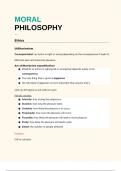
Utilitarianism
Consequentialist: an action is right or wrong depending on the consequences it leads to
Minimise pain and maximise pleasure
Act utilitarianism (quantitative)
● Whether an action is right/good or wrong/bad depends solely on its
consequences
● The only thing that is good is happiness
● No individual’s happiness is more important than anyone else’s.
Adds up all happiness and subtracts pain
Felicific calculus
● Intensity: how strong the pleasure is
● Duration: how long the pleasure lasts
● Certainty: how likely the pleasure is to occur
● Propinquity: how soon the pleasure will occur
● Fecundity: how likely the pleasure will lead to more pleasure
● Purity: how likely the pleasure will lead to pain
● Extent: the number of people affected
Problems
Diff to calculate:
, - Inability to predict future (eg. 1 morally good act might lead to morally bad 1s in
future)
- How to measure intensity of pleasure / quantify each of the 7 variables
- How to compare the 7 variables to each other
- Which beings to include in the calculation and how to compare their degrees of
pleasure and pain ?
Hw: this could be a general guide to be “kept in view” rather than to be worked out every
time we act
Tyranny of the majority
Eg. Their collective happiness is likely to outweigh the innocent man’s pain at being
falsely imprisoned
- concerned only with the greatest good for the greatest number. There are no
grounds, then, to justify acting to maximise their happiness over some random
person on the street.
- certain relationships have a unique moral status and that act utilitarianism forces
us to ignore these moral obligations.
- Ignores evil intentions that result instead in good consequences
- “Doctine of swine”: reduces value of human life to simple pleasures
Qualitative approach to happiness: humans prefer higher pleasures over lower
pleasures because they value dignity – and dignity is an important component of
happiness
people who have experienced the higher pleasures of thought, feeling, and imagination
always prefer them to the lower pleasures of the body and the senses
Experience machine
Many would prefer to avoid it and instead experience reality even though it might result
in more suffering and less pleasure
Contradicts hedonism: things in life far more important than simple pleasure
Rule utilitarianism
consequences of general rules rather than specific actions
, Actions are deemed right/wrong depending on on whether they’re in
accordance with these rules
Strong rule utilitarianism: Strictly follow the rules – even in instances where breaking
them would lead to greater happiness.
Hw: = “rule worship” which loses sight of the whole point of this ethical theory (increase
happines)
● Weak rule utilitarianism: Follow the rules – unless breaking the rule would lead to
greater happiness.
○ Problem: But then how is this different from act utilitarianism? If we can
break the rule whenever the consequences justify doing so, then there’s no
point of having the rule and we’re back to the tyranny of the majority.
Preference utilitarianism
Non-hedonistic: maximise pp’s preferences instead of their happiness
How to decide btw competing preferences?
If preferences are what makes actions good/bad, then what grounds does this theory have to say
a preference to maximise everyone’s happiness is any better morally, than that of spneding
time torturing animals and living immorally.
Deontological ethics
● Good will is good without qualification
● Duty to follow moral law which is universal
Good will
Acting for the sake of duty = source of moral worth
Deontology: study of duty
Duty to follow moral law
2 kinds of maxims (rules):
● Hypothetical: qualified by “if” statement
● Categorical: applied universally
PHILOSOPHY
___
Ethics
Utilitarianism
Consequentialist: an action is right or wrong depending on the consequences it leads to
Minimise pain and maximise pleasure
Act utilitarianism (quantitative)
● Whether an action is right/good or wrong/bad depends solely on its
consequences
● The only thing that is good is happiness
● No individual’s happiness is more important than anyone else’s.
Adds up all happiness and subtracts pain
Felicific calculus
● Intensity: how strong the pleasure is
● Duration: how long the pleasure lasts
● Certainty: how likely the pleasure is to occur
● Propinquity: how soon the pleasure will occur
● Fecundity: how likely the pleasure will lead to more pleasure
● Purity: how likely the pleasure will lead to pain
● Extent: the number of people affected
Problems
Diff to calculate:
, - Inability to predict future (eg. 1 morally good act might lead to morally bad 1s in
future)
- How to measure intensity of pleasure / quantify each of the 7 variables
- How to compare the 7 variables to each other
- Which beings to include in the calculation and how to compare their degrees of
pleasure and pain ?
Hw: this could be a general guide to be “kept in view” rather than to be worked out every
time we act
Tyranny of the majority
Eg. Their collective happiness is likely to outweigh the innocent man’s pain at being
falsely imprisoned
- concerned only with the greatest good for the greatest number. There are no
grounds, then, to justify acting to maximise their happiness over some random
person on the street.
- certain relationships have a unique moral status and that act utilitarianism forces
us to ignore these moral obligations.
- Ignores evil intentions that result instead in good consequences
- “Doctine of swine”: reduces value of human life to simple pleasures
Qualitative approach to happiness: humans prefer higher pleasures over lower
pleasures because they value dignity – and dignity is an important component of
happiness
people who have experienced the higher pleasures of thought, feeling, and imagination
always prefer them to the lower pleasures of the body and the senses
Experience machine
Many would prefer to avoid it and instead experience reality even though it might result
in more suffering and less pleasure
Contradicts hedonism: things in life far more important than simple pleasure
Rule utilitarianism
consequences of general rules rather than specific actions
, Actions are deemed right/wrong depending on on whether they’re in
accordance with these rules
Strong rule utilitarianism: Strictly follow the rules – even in instances where breaking
them would lead to greater happiness.
Hw: = “rule worship” which loses sight of the whole point of this ethical theory (increase
happines)
● Weak rule utilitarianism: Follow the rules – unless breaking the rule would lead to
greater happiness.
○ Problem: But then how is this different from act utilitarianism? If we can
break the rule whenever the consequences justify doing so, then there’s no
point of having the rule and we’re back to the tyranny of the majority.
Preference utilitarianism
Non-hedonistic: maximise pp’s preferences instead of their happiness
How to decide btw competing preferences?
If preferences are what makes actions good/bad, then what grounds does this theory have to say
a preference to maximise everyone’s happiness is any better morally, than that of spneding
time torturing animals and living immorally.
Deontological ethics
● Good will is good without qualification
● Duty to follow moral law which is universal
Good will
Acting for the sake of duty = source of moral worth
Deontology: study of duty
Duty to follow moral law
2 kinds of maxims (rules):
● Hypothetical: qualified by “if” statement
● Categorical: applied universally