

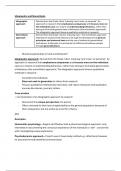
Idiographic and Nomothetic
Idiographic Derived from the Greek ‘idios’ meaning ‘one’s own, or personal’. An
approach approach to research that emphasises uniqueness and focuses more on
the individual case as a means of understanding behaviour, rather than
aiming to formulate general laws of behaviour (the nomothetic approach).
The idiographic approach favours qualitative methods in research.
Nomothetic Derived from the Greek ‘nomos’ meaning ‘law’. The nomothetic approach
approach attempts to study human behaviour through the development of general
principles and universal laws and the use of statistical (quantitative)
techniques. It attempts to summarise the differences between people
through generalisations.
- Should we generalise or look at individuals?
Idiographic approach: derived from the Greek ‘idios’ meaning ‘one’s own, or personal’. An
approach to research that emphasises uniqueness and focuses more on the individual
case as a means of understanding behaviour, rather than aiming to formulate general laws
of behaviour (the nomothetic approach). The idiographic approach favours qualitative
methods in research.
- Considers the individual
- Does not seek to generalise to others from research
- Favours qualitative methods like interviews, self-report measures and qualitative
sources like diaries, journals, letters
Case studies
-> An illustration of an idiographic approach to research
- Document the unique perspective of a person
- Often criticised for their lack of applicability to the general population because of
their uniqueness, but are useful as a test for a theory
A03
Examples:
Humanistic psychology – Rogers and Maslow took a phenomenological approach, only
interested in documenting the conscious experience of the individual or ‘self’ - concerned
with investigating unique experience
Psychodynamic approach – Freud’s use of case study method e.g. Little Hans (however
he assumed he had identified universal laws)
, Nomothetic approach: derived from the Greek ‘nomos’ meaning ‘law’. The nomothetic
approach attempts to study human behaviour through the development of general
principles and universal laws and the use of statistical (quantitative) techniques. It
attempts to summarise the differences between people through generalisations.
Proposed that there are 3 types of general laws:
- Classification
-> idea that people can be classified into certain groups according to
characteristics/attitude/behaviour
-> foundation of ICD10 and DSM5
- Establishing principles
-> focus on trying to establish laws and principles that can be applied to human
behaviour
-> e.g. behaviourism
- Establishing dimensions
-> attempt to document continuums upon which an individual can be placed –
allows comparison with others + facilitates scientific measurement
-> e.g. personality research – introversion vs extraversion, locus of control –
examples of dimensions that can be applied to everyone
- Quantitative methods of data collection and analysis are appropriate
- Stance of natural sciences
- Objective, laboratory conditions, controlled variables
- Employs scientific methods, hypotheses formulated, findings are analysed for
statistical significance
A03
Examples:
Behaviourists – laws of learning
Biological psychologists
Relationships
Aggression – neural, hormonal, genetic, ethological, evolutionary theories
Attachment – attachment styles (A,B,C)
Idiographic Derived from the Greek ‘idios’ meaning ‘one’s own, or personal’. An
approach approach to research that emphasises uniqueness and focuses more on
the individual case as a means of understanding behaviour, rather than
aiming to formulate general laws of behaviour (the nomothetic approach).
The idiographic approach favours qualitative methods in research.
Nomothetic Derived from the Greek ‘nomos’ meaning ‘law’. The nomothetic approach
approach attempts to study human behaviour through the development of general
principles and universal laws and the use of statistical (quantitative)
techniques. It attempts to summarise the differences between people
through generalisations.
- Should we generalise or look at individuals?
Idiographic approach: derived from the Greek ‘idios’ meaning ‘one’s own, or personal’. An
approach to research that emphasises uniqueness and focuses more on the individual
case as a means of understanding behaviour, rather than aiming to formulate general laws
of behaviour (the nomothetic approach). The idiographic approach favours qualitative
methods in research.
- Considers the individual
- Does not seek to generalise to others from research
- Favours qualitative methods like interviews, self-report measures and qualitative
sources like diaries, journals, letters
Case studies
-> An illustration of an idiographic approach to research
- Document the unique perspective of a person
- Often criticised for their lack of applicability to the general population because of
their uniqueness, but are useful as a test for a theory
A03
Examples:
Humanistic psychology – Rogers and Maslow took a phenomenological approach, only
interested in documenting the conscious experience of the individual or ‘self’ - concerned
with investigating unique experience
Psychodynamic approach – Freud’s use of case study method e.g. Little Hans (however
he assumed he had identified universal laws)
, Nomothetic approach: derived from the Greek ‘nomos’ meaning ‘law’. The nomothetic
approach attempts to study human behaviour through the development of general
principles and universal laws and the use of statistical (quantitative) techniques. It
attempts to summarise the differences between people through generalisations.
Proposed that there are 3 types of general laws:
- Classification
-> idea that people can be classified into certain groups according to
characteristics/attitude/behaviour
-> foundation of ICD10 and DSM5
- Establishing principles
-> focus on trying to establish laws and principles that can be applied to human
behaviour
-> e.g. behaviourism
- Establishing dimensions
-> attempt to document continuums upon which an individual can be placed –
allows comparison with others + facilitates scientific measurement
-> e.g. personality research – introversion vs extraversion, locus of control –
examples of dimensions that can be applied to everyone
- Quantitative methods of data collection and analysis are appropriate
- Stance of natural sciences
- Objective, laboratory conditions, controlled variables
- Employs scientific methods, hypotheses formulated, findings are analysed for
statistical significance
A03
Examples:
Behaviourists – laws of learning
Biological psychologists
Relationships
Aggression – neural, hormonal, genetic, ethological, evolutionary theories
Attachment – attachment styles (A,B,C)

