

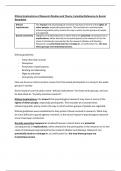
Ethical Implications of Research Studies and Theory, Including Reference to Social
Sensitivity
Ethical The impact that psychological research may have in terms of the rights of
implications other people, especially participants. This includes at a societal level,
influencing public policy and/or the way in which certain groups of people
are regarded.
Social sensitivity Happens in studies/theories in which there are potential consequences or
implications, either directly for the participants in the research or for the
class of individuals represented by the research (Sieber and Stanley).
Research can potentially lead to a change in, or justification for, the way
these groups are treated/perceived.
Ethical guidelines:
- Fully informed consent
- Deception
- Protection of participants
- Briefing and debriefing
- Right to withdraw
- Anonymity and confidentiality
Here we focus on ethics section moves from the actual participants in a study to the wider
groups in society
Some research can be said to have “ethical implications” for these wider groups, and can
be described as “socially sensitive research”
Ethical implications: the impact that psychological research may have in terms of the
rights of other people, especially participants. This includes at a societal level,
influencing public policy and/or the way in which certain groups of people are regarded.
Ethical guidelines were established to help protect those involved in research. What may
be more difficult to guard against, however, is the social impact of psychological research
once it has been conducted.
Socially sensitive happens in: studies/theories in which there are potential
consequences or implications, either directly for the participants in the research or for the
class of individuals represented by the research (Sieber and Stanley). Research can
potentially lead to a change in, or justification for, the way these groups are
treated/perceived.
, Some areas of research are more likely to be more controversial, and be subject to greater
social sensitivity, than others.
Studies that tackle socially sensitive ‘taboo’ topics, such as aspects of race or sexuality,
attract a good deal of attention.
Joan Sieber and Liz Stanley have identified a number of concerns that researchers
should be mindful of when conducting socially sensitive research:
- Implications – wider effects of such research – don't want to give scientific
credibility to prejudice and discrimination
- Uses/public policy – what is the research to be used for? - findings may be adopted
by government for political ends or to shape public policy
- The validity of research – findings need to be objective and valid – unlike cases
such as Cyril Burt, 11+ examination in UK
Sieber and Stanley identified 4 aspects in the research process at which ethical issues
with social consequences may occur:
- The research question
Simply asking a question e.g. ‘is homosexuality inherited?’ may be damaging to
members of a particular group as it appears to add scientific credibility to the
prevailing prejudice
- Conduct of research and treatment of participants
Confidentiality should be maintained
- Institutional context
Research may be funded/managed by private institutions who may misuse the data
or may misunderstand the data that is produced. The media may obtain reports of
such research and misreport findings
- Interpretation and application of findings
Research findings may be used for purposes other than originally intended – e.g.
development of IQ tests, subsequently used to demonstrate the inferiority of
certain groups of people
Ways of dealing with socially sensitive research
- Submit research proposals to ethics committees and abide by any
recommendations
Sensitivity
Ethical The impact that psychological research may have in terms of the rights of
implications other people, especially participants. This includes at a societal level,
influencing public policy and/or the way in which certain groups of people
are regarded.
Social sensitivity Happens in studies/theories in which there are potential consequences or
implications, either directly for the participants in the research or for the
class of individuals represented by the research (Sieber and Stanley).
Research can potentially lead to a change in, or justification for, the way
these groups are treated/perceived.
Ethical guidelines:
- Fully informed consent
- Deception
- Protection of participants
- Briefing and debriefing
- Right to withdraw
- Anonymity and confidentiality
Here we focus on ethics section moves from the actual participants in a study to the wider
groups in society
Some research can be said to have “ethical implications” for these wider groups, and can
be described as “socially sensitive research”
Ethical implications: the impact that psychological research may have in terms of the
rights of other people, especially participants. This includes at a societal level,
influencing public policy and/or the way in which certain groups of people are regarded.
Ethical guidelines were established to help protect those involved in research. What may
be more difficult to guard against, however, is the social impact of psychological research
once it has been conducted.
Socially sensitive happens in: studies/theories in which there are potential
consequences or implications, either directly for the participants in the research or for the
class of individuals represented by the research (Sieber and Stanley). Research can
potentially lead to a change in, or justification for, the way these groups are
treated/perceived.
, Some areas of research are more likely to be more controversial, and be subject to greater
social sensitivity, than others.
Studies that tackle socially sensitive ‘taboo’ topics, such as aspects of race or sexuality,
attract a good deal of attention.
Joan Sieber and Liz Stanley have identified a number of concerns that researchers
should be mindful of when conducting socially sensitive research:
- Implications – wider effects of such research – don't want to give scientific
credibility to prejudice and discrimination
- Uses/public policy – what is the research to be used for? - findings may be adopted
by government for political ends or to shape public policy
- The validity of research – findings need to be objective and valid – unlike cases
such as Cyril Burt, 11+ examination in UK
Sieber and Stanley identified 4 aspects in the research process at which ethical issues
with social consequences may occur:
- The research question
Simply asking a question e.g. ‘is homosexuality inherited?’ may be damaging to
members of a particular group as it appears to add scientific credibility to the
prevailing prejudice
- Conduct of research and treatment of participants
Confidentiality should be maintained
- Institutional context
Research may be funded/managed by private institutions who may misuse the data
or may misunderstand the data that is produced. The media may obtain reports of
such research and misreport findings
- Interpretation and application of findings
Research findings may be used for purposes other than originally intended – e.g.
development of IQ tests, subsequently used to demonstrate the inferiority of
certain groups of people
Ways of dealing with socially sensitive research
- Submit research proposals to ethics committees and abide by any
recommendations

