

The Working Memory Model
A01
The Working (STM) Memory Model: Baddeley and Hitch (Digging a ditch = working)
First proposed in 1974 but later adapted (e.g., 2000 added episodic buffer)
The working memory model (WMM) is an alternative to the multi-store model of memory. It only
focuses on one memory store – short term memory or “working memory”. Baddeley and Hitch
developed the Working Memory Model. We already know that Baddeley conducted research into
semantic encoding in LTM and that this supports Atkinson and Shiffrin. However...
Baddeley and Hitch believed that short term memory is far more complex and sophisticated
than Atkinson and Shiffrin suggest.
Instead of seeing it as a temporary storage depot with a limited capacity and duration, Baddeley
and Hitch suggest that STM is active and dynamic and where we hold information that we are
actively working on (hence working memory).
Baddeley and Hitch developed the working memory model to provide a better explanation of how
STM works and to show what it is capable of.
Baddeley and Hitch believe that short-term memory/working memory is not a unitary store as
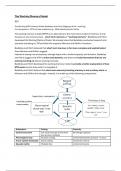
Atkinson and Shiffrin first thought. Instead, it is made up of the following components:
Subsystem Coding Capacity
Central executive Can code any type of info (from No storage capacity
any sensory modality)
Phonological loop Acoustic coding Limited (articulatory process = 2 secs)
Visuo-spatial sketchpad Visual coding Limited (3-4 items)
Episodic buffer Modality free Limited (4 chunks)
, Flashcards
Who created the working memory model? Baddeley and Hitch
What type of memory does the working Short term memory
memory model focus on?
What are 4 adjectives to describe the - Complex
working memory model in comparison to - Sophisticated
the multi-store model - Active
- Dynamic
Do Baddeley and Hitch believe short term No
memory is a unitary store?
What are the 4 components of the working - Central executive
memory model? - Episodic buffer
- Visuo-spatial sketchpad
- Phonological loop
What is the supervisory component in the Central executive
working memory model?
What are the 3 subsidiary/slave - Episodic buffer
components in the working memory - Visuo-spatial sketchpad
model? - Phonological loop
What are the 2 subdivisions of the - Articulatory control system
phonological loop? - Phonological store
Central Executive
The central executive is the supervisory component that has overall control over the other
slave or subsidiary components. It is involved in high level mental processes such as
decision making.
The central executive determines which information is and is not attended to. For
example, if you were having a conversation whilst driving and you had to complete a
difficult manoeuvre, the central executive would direct your attention to the manoeuvre
and stop you talking until you had completed it. It therefore permits us to switch
attention between different sources of information.
The central executive is flexible and can process information from all the senses (i.e. is
modality-free)
It allocates tasks and resources to the other slave/subsidiary systems, directing
information to them and collecting responses.
A01
The Working (STM) Memory Model: Baddeley and Hitch (Digging a ditch = working)
First proposed in 1974 but later adapted (e.g., 2000 added episodic buffer)
The working memory model (WMM) is an alternative to the multi-store model of memory. It only
focuses on one memory store – short term memory or “working memory”. Baddeley and Hitch
developed the Working Memory Model. We already know that Baddeley conducted research into
semantic encoding in LTM and that this supports Atkinson and Shiffrin. However...
Baddeley and Hitch believed that short term memory is far more complex and sophisticated
than Atkinson and Shiffrin suggest.
Instead of seeing it as a temporary storage depot with a limited capacity and duration, Baddeley
and Hitch suggest that STM is active and dynamic and where we hold information that we are
actively working on (hence working memory).
Baddeley and Hitch developed the working memory model to provide a better explanation of how
STM works and to show what it is capable of.
Baddeley and Hitch believe that short-term memory/working memory is not a unitary store as
Atkinson and Shiffrin first thought. Instead, it is made up of the following components:
Subsystem Coding Capacity
Central executive Can code any type of info (from No storage capacity
any sensory modality)
Phonological loop Acoustic coding Limited (articulatory process = 2 secs)
Visuo-spatial sketchpad Visual coding Limited (3-4 items)
Episodic buffer Modality free Limited (4 chunks)
, Flashcards
Who created the working memory model? Baddeley and Hitch
What type of memory does the working Short term memory
memory model focus on?
What are 4 adjectives to describe the - Complex
working memory model in comparison to - Sophisticated
the multi-store model - Active
- Dynamic
Do Baddeley and Hitch believe short term No
memory is a unitary store?
What are the 4 components of the working - Central executive
memory model? - Episodic buffer
- Visuo-spatial sketchpad
- Phonological loop
What is the supervisory component in the Central executive
working memory model?
What are the 3 subsidiary/slave - Episodic buffer
components in the working memory - Visuo-spatial sketchpad
model? - Phonological loop
What are the 2 subdivisions of the - Articulatory control system
phonological loop? - Phonological store
Central Executive
The central executive is the supervisory component that has overall control over the other
slave or subsidiary components. It is involved in high level mental processes such as
decision making.
The central executive determines which information is and is not attended to. For
example, if you were having a conversation whilst driving and you had to complete a
difficult manoeuvre, the central executive would direct your attention to the manoeuvre
and stop you talking until you had completed it. It therefore permits us to switch
attention between different sources of information.
The central executive is flexible and can process information from all the senses (i.e. is
modality-free)
It allocates tasks and resources to the other slave/subsidiary systems, directing
information to them and collecting responses.

