
NUR 265 Exam 4 Final with Correct Answers
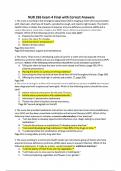
1. The nurse is working in the emergency department (ED) is triaging a client who has presented with chest pain, shortness of breath, a productive cough, and reports night sweats. The client’s health history includes the presence of acquired immune deficiency syndrome (AIDS) and a recent laboratory result that reveals a low CD4+ count. Airborne precautions have been initiated. Which of the following actions should the nurse take next? A. Prepare the client for insertion of chest tube. B. Assess the client for shingles. C. Check the client’s temperature.* D. Obtain a throat culture. Page 351 chart 19-5 Page 353 respiratory support and maintenance. 2. The newly. Hired nurse is developing a plan of care for a client who has acquired immune deficiency syndrome (AIDS) and was just diagnosed with Pneumocystis jiroveci pneumonia (PJP) and pain. Which of the following interventions should the nurse preceptor question? A. Telling the client to keep the door to the room closed at all times. (page 420, PJP is airborne precautions) B. Placing the client on a pressure reliving mattress.* C. Instructing the client to drink at least three liters of fluid throughout the day. (Page 354) D. Offering the client food high in calories and protein. (T, page 354) Page 346 3. The nurse is caring for a client with acquired immune deficiency syndrome (AIDS) who has just been diagnosed with cryptococcal meningitis. Which of the following actions should the nurse take? A. Initiate airborne precautions for the next 72 hours. B. Initiate seizure precautions with padded siderails.* C. Administer IV pentamidine isethionate. D. Thicken the client’s liquids to honey consistency. Page 347 second paragraph on the left 4. The nurse has provided medication instructions to a client who has human immunodeficiency virus (HIV) and has been prescribed combination antiretroviral therapy (cART). Which of the following client statements indicates a correct understanding of the teaching? A. “I am less likely to develop opportunistic infections once I begin taking my prescribed medications.” B. “I should discontinue my medications if I develop severe diarrhea.” C. “I can avoid developing drug resistance if I take 90% of my drugs on time.”* D. “I understand that this combination of drugs will kill the virus.” Page 351 nursing safety priority drug alert box 5. The nurse working in a community health center has instructed a group of clients who have acquired immune deficiency syndrome (AIDS) about ways to prevent infection. Which of the following statements, if made by a client, would indicated for additional teaching? A. “I will eat plenty of fresh fruits and raw vegetables.”* B. “I will make sure no one uses my deodorant or toothpaste.” C. “I will avoid planting vegetables and flowers in our garden.” D. “I will wear gloves and then wash my hands immediately if I need to change my cat’s litter box.” Page 351 chart 19-4 and chart 19-5 6. The nurse is precepting a newly hired nurse who is caring for a client who has acquired immune deficiency syndrome (AIDS) and has developed Kaposi’s sarcoma (KS). It requires additional teaching by the preceptor if the newly hired nurse A. Keeps open, weeping lesions clean and covered with prescribed dressing. (page 351 chart 19-5) B. Applies a surgical mask before entering the client’s room* C. Inspects the client’s mouth at least once every 8 hours. (page 351 chart 19-5) D. Instructs the client that make-up can be applied to lesions that are not open. Page 347 Kaposi’s sarcoma 7. The nurse is caring for a client who had a heart transplant 24 hours ago. Which of the following findings indicates the client is developing a complication? A. Prothrombin time (PTT) of 11 seconds. B. Abdominal distention* C. Hypertension D. Facial flushing Page 716 chart 35-10 (SOB, FATIGUE, FLUID GAIN,ABDOMINAL BLOATING,NEW BRADYCARDIA,HYPOTENSION, AFIB OR FLUTTER,DECREASED ACTIIVITY INTOLERANCE,DECREASED EJECTION FRACTION-LATE SIGN) 8. The nurse is caring for a client who had a lung transplant 10 days ago. It would be a priority for the nurse to notify the primary health care provider (PHCP) if the client has A. Developed sputum that is yellow-tinged.* B. A pain rating of “7” when taking a deep breath. C. Only used the incentive spirometer once since last evening. D. Refused to get out of bed for the past 24 hours. Page 584 major problems after lung transplantation are bleeding, infection and transplant rejection. 9. The nurse is caring for a client who had a liver transplant 48 hours ago. Which findings from the box below is a priority for the nurse to report to the primary health care provider (PHCP)? 1. A decrease in urine output from 50 to 30 mL/hr. since surgery. 2. An increase in aspartate aminotransferase (AST) from 28-32 units/L in the past 24 hours. 3. A pulse rate that has decreased from 88 to 72 over the last 8 hours. 4. A prothrombin time (PT) of 20 seconds. 5. An international normalized ration (INR) of 2.5 seconds. 6. An increase in serum bilirubin levels over the last 12 hours. 7. A decrease in alkaline phosphatase levels. A. 2,3,5 B. 1,3,7 C. 1,4,6,7 D. 2,4,5,6 ??? 10. The nurse is caring for the client who had a kidney transplant 2 weeks ago. Which of the following findings should the nurse correlate to possible organ rejection? A. Blood pressure of 172/96 B. Urinalysis that is positive for protein C. Serum creatine level of 0.9 mg/dL D. Blood urea nitrogen (BUN) level of 15 mg/dL 11. The nurse working in a primary health care provider’s (PHCP)office has just administered a routine immunization to a client. The client is asked to wait in the waiting room for the next 15 minutes. Five minutes later, the client develops swelling of the eyes and reports feeling anxious, SOB, and dizzy. Which of the following actions should the nurse take first? A. Perform a respiratory assessment* B. Prepare to administer diphenhydramine C. Elevate the client’s feet and legs. D. Obtain a full set of vital signs. 12. the nurse is caring for a client who just received the pneumococcal polysaccharide vaccine. The client report feeling anxious, short of breath, dizzy, and has audible wheezing. Which actions from the box below should the nurse take? 1. Initiate oxygen via a nonrebreather mask 2. Obtain intravenous (IV) access with a large-bore IV catheter 3. Administer intramuscular (IM) epinephrine 0.3 mL 4. Have a crash cart available in the client’s room 5. Complete a facility incident report 6. Administer 0.5mg of lorazepam PO A. 1,2,5 B. 1,3,6 C. 1,2,3,4* D. 1,4,5,6 13. The newly hired nurse has attended a continuing education conference regarding anaphylaxis with allergen exposure. Which of the following statements by the newly hired nurse indicated a correct understanding of assessment findings in the client? A. “The client can have swollen lips and reports polyuria.” B. “The client will have audible wheezes and abdominal distention.” C. “The client will present with widespread hives and hypoxia.” D. “The client will report new onset abdominal cramping with hyperreflexia.” 14. The nurse is assessing a client who has systemic lupus erythematosus (SLE). Which of the following findings would the nurse identify as a complication of this disease? A. Butterfly rash – expected finding B. Deep vein thrombosis (DVT) C. Dysphagia D. Pericardial friction rub ??? 15. The nurse has taught a 25-year-old female client who has systemic lupus erythematosus (SLE). Which of the following client statements indicates a correct understanding of the teaching? A. “I should use powder on my skin to prevent excessive moisture on my skin”.
Información del documento
- Subido en
- 6 de mayo de 2025
- Número de páginas
- 11
- Escrito en
- 2024/2025
- Tipo
- Examen
- Contiene
- Preguntas y respuestas

