
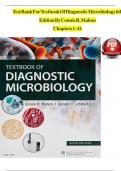
Test Bank For Textbook Of Diagnostic Microbiology 6th
t t t t t t t
t Edition By Connie R. Mahon
t t t t t
Chapters 1 - 41 t t t
, Mahon: Textbook of Diagnostic Microbiology, 6th Edition Test Bank
t t t t t t t t
Table of contents
t t
Part 1: Introduction to Clinical Microbiology
t t t t t
Chapter 1. Bacterial Cell Structure, Physiology, Metabolism, and Genetics
t t t t t t t t
Chapter 2. Host-Parasite Interaction
t t t
Chapter 3. The Laboratory Role in Infection Control
t t t t t t t
Chapter 4. Control of Microorganisms: Disinfection, Sterilization, and Microbiology Safety
t t t t t t t t t
Chapter 5. Performance Improvement in the Microbiology Laboratory
t t t t t t t
Chapter 6. Specimen Collection and Processing
t t t t t
Chapter 7. Microscopic Examination of Materials from Infected Sites
t t t t t t t t
Chapter 8. Use of Colony Morphology for the Presumptive Identification of Microorganisms
t t t t t t t t t t t
Chapter 9. Biochemical Identification ofGram-Negative Bacteria
t t t t t t
Chapter 10. Immunodiagnosis of Infectious Diseases
t t t t t
Chapter 11. Applications of Molecular Diagnostics
t t t t t
Chapter 12. Antibacterial Mechanisms of Action and Bacterial Resistance Mechanisms
t t t t t t t t t
Chapter 13. Antimicrobial SusceptibilityTesting
t t t t
Part 2: Laboratory Identification of Significant Isolates
t t t t t t
Chapter 14. Staphylococci
t t
Chapter 15. Streptococcus, Enterococcus, and Other Catalase-Negative, Gram-Positive Cocci
t t t t t t t t
Chapter 16. Aerobic Gram-Positive Bacilli
t t t t
Chapter 17. Neisseria Species and Moraxella catarrhalis
t t t t t t
Chapter 18. Haemophilus, HACEK, Legionella and Other Fastidious Gram-Negative Bacilli
t t t t t t t t t
Chapter 19. Enterobacteriaceae
t t
Chapter 20. Vibrio, Aeromonas, and Campylobacter Species
t t t t t t
Chapter 21. Nonfermenting and Miscellaneous Gram-Negative Bacilli
t t t t t t
Chapter 22. Anaerobes of Clinical Importance
t t t t t
Chapter 23. The Spirochetes
t t t
Chapter 24. Chlamydia, Rickettsia, and Similar Organisms
t t t t t t
Chapter 25. Mycoplasma and Ureaplasma
t t t t
Chapter 26. Mycobacterium tuberculosis and Nontuberculous Mycobacteria
t t t t t t
Chapter 27. MedicallySignificant Fungi
t t t t
Chapter 28. Diagnostic Parasitology
t t t
Chapter 29. Clinical Virology
t t t
Chapter 30. Agents of Bioterror and Forensic Microbiology
t t t t t t t
Chapter 31. Biofilms: Architects of Disease
t t t t t
Part 3: Laboratory Diagnosis of Infectious Diseases: and Organ System Approach to DiagnosticMicrobiology
t t t t t t t t t t t t t
Chapter 32. Upper and Lower RespiratoryTract Infections
t t t t t t t
Chapter 33. Skin and Soft Tissue Infections
t t t t t t
Chapter 34. Gastrointestinal Infections and Food Poisoning
t t t t t t
Chapter 35. Infections of the Central Nervous System
t t t t t t t
Chapter 36. Bacteremia and Sepsis
t t t t
Chapter 37. UrinaryTract Infections
t t t t
Chapter 38. Genital Infections and SexuallyTransmitted Infections
t t t t t t t
Chapter 39. Infections in Special Populations
t t t t t
Chapter 40. Zoonotic Diseases
t t t
Chapter 41. Ocular Infections
t t t
-
,Chapter01: Bacterial Cell Structure, Physiology, Metabolism, and
t t t t t t t
GeneticsMahon: Textbook of Diagnostic Microbiology, 6th Edition Test Bank
t t t t t t t t t t
MULTIPLE CHOICE t
1. To survive, microbial inhabitants havelearned to adapt byvarying all of the following, except
t t t t t t t t t t t t t t
a. growth rate. t
b. growth in all atmospheric conditions. t t t t
c. growth at particular temperatures. t t t
d. bacterial shape. t
ANSWER: D t
Thechapter begins by discussing the waymicrobial inhabitants havehad to evolve to survivein
t t t t t t t t t t t t t t t
many different niches and habitats. It discusses slow growers, rapid growers, and replication with
t t t t t t t t t t t t t t
scarce or abundant nutrients, under different atmospheric conditions, temperature requirements,
t t t t t t t t t t
and cell structure. Bacterial shape as a form of evolution is not discussed.
t t t t t t t t t t t t t
OBJ: Level2: Interpretation t t t
2. Who was considered the fatherofprotozoologyand bacteriology?
t t t t t t t t
a. Anton van Leeuwenhoek t t
b. Louis Pasteur t
c. CarlLandsteiner t
d. MichaelDouglas t
ANSWER: A t
The book discusses Anton van Leeuwenhoek as the inventor of the microscope and the first person
t t t t t t t t t t t t t t t
to seethe ―beasties.‖ Sotheydubbed him the fatherofprotozoology and bacteriology.The other
t t t t t t t t t t t t t t t t
three individuals werenot discussed.
t t t t t
OBJ: Level 1: Recall t t t
3. Prokaryotic cells have which ofthe following structures in their cytoplasm? t t t t t t t t t t
a. Golgi apparatus t
b. Ribosomes
c. Mitochondria
d. Endoplasmicreticulum t
ANSWER: B t
All the structures listed are found in eukaryotic cells, but ribosomes are the only ones thatapply
t t t t t t t t t t t t t t t t
to prokaryotic cells.
t t t
OBJ: Level 1: Recall t t t
4. This form of DNA is commonlyfound in eukaryotic cells.
t t t t t t t t t
a. Linear
b. Circular
c. Plasmid
d. Colloid
TestBanks/ Solution Manuals and Exam t t t t
, ANSWER: A t
Circularand plasmid DNA areusually found only in bacteria, not eukaryotic cells. Colloid isa
t t t t t t t t t t t t t t t
property of protein molecules and is not associated with nucleotides.
t t t t t t t t t t
OBJ: Level 1: Recall t t t
5. Thenuclear membrane in prokaryotes is
t t t t t
a. missing.
b. impenetrable.
c. aclassic membrane. t t
d. alipid bilayer membrane.
t t t
ANSWER: A t
Prokaryotic cells do not have any membrane-bound structures in the cytoplasm including t t t t t t t t t t t
astructured nucleus.
t t t
OBJ: Level 1: Recall t t t
6. A microorganism that is aunicellularorganism and lacks a nuclear membrane and
t t t t t t t t t t t t
t truenucleus belongs to which classification?
t t t t t
a. Fungi
b. Bacteria
c. Algae
d. Parasite
ANSWER: B t
Fungi, algae, and parasites are unicellular eukaryotic organisms that contain a true
t t t t t t t t t t t
nucleus.Bacteria are prokaryotic and do not contain a true nucleus or nuclear membrane.
t t t t t t t t t t t t t t
OBJ: Level 1: Recall t t t
7. In the laboratory, the clinical microbiologist is responsible for all the following, except
t t t t t t t t t t t t
a. isolatingmicroorganisms. t
b. selectingtreatment for patients. t t t
c. identifyingmicroorganisms. t
d. analyzingbacteria that causedisease. t t t t
ANSWER: B t
Clinical microbiologists do not select thetreatment forpatients. Theyprovide the doctor withthe
t t t t t t t t t t t t t t
name of the organism and the antibiotics that can kill the bacteria, but not in the final selection of
t t t t t t t t t t t t t t t t t t t
treatment protocols.
t t
OBJ: Level 2: Recall t t t
8. What enables the microbiologist to select the correct media for primaryculture and optimizethe
t t t t t t t t t t t t t t
tchance of isolating a pathogenic organism? t t t t t
a. Determiningstaining characteristics t t
b. Understandingthe cell structure and biochemical pathways of an organism t t t t t t t t t
c. Understanding the growth requirements of potential pathogens at specific body site t t t t t t t t t t
d. Knowingthe differences in cell walls of particular bacteria t t t t t t t t
ANSWER: C t
t t t t t t t
t Edition By Connie R. Mahon
t t t t t
Chapters 1 - 41 t t t
, Mahon: Textbook of Diagnostic Microbiology, 6th Edition Test Bank
t t t t t t t t
Table of contents
t t
Part 1: Introduction to Clinical Microbiology
t t t t t
Chapter 1. Bacterial Cell Structure, Physiology, Metabolism, and Genetics
t t t t t t t t
Chapter 2. Host-Parasite Interaction
t t t
Chapter 3. The Laboratory Role in Infection Control
t t t t t t t
Chapter 4. Control of Microorganisms: Disinfection, Sterilization, and Microbiology Safety
t t t t t t t t t
Chapter 5. Performance Improvement in the Microbiology Laboratory
t t t t t t t
Chapter 6. Specimen Collection and Processing
t t t t t
Chapter 7. Microscopic Examination of Materials from Infected Sites
t t t t t t t t
Chapter 8. Use of Colony Morphology for the Presumptive Identification of Microorganisms
t t t t t t t t t t t
Chapter 9. Biochemical Identification ofGram-Negative Bacteria
t t t t t t
Chapter 10. Immunodiagnosis of Infectious Diseases
t t t t t
Chapter 11. Applications of Molecular Diagnostics
t t t t t
Chapter 12. Antibacterial Mechanisms of Action and Bacterial Resistance Mechanisms
t t t t t t t t t
Chapter 13. Antimicrobial SusceptibilityTesting
t t t t
Part 2: Laboratory Identification of Significant Isolates
t t t t t t
Chapter 14. Staphylococci
t t
Chapter 15. Streptococcus, Enterococcus, and Other Catalase-Negative, Gram-Positive Cocci
t t t t t t t t
Chapter 16. Aerobic Gram-Positive Bacilli
t t t t
Chapter 17. Neisseria Species and Moraxella catarrhalis
t t t t t t
Chapter 18. Haemophilus, HACEK, Legionella and Other Fastidious Gram-Negative Bacilli
t t t t t t t t t
Chapter 19. Enterobacteriaceae
t t
Chapter 20. Vibrio, Aeromonas, and Campylobacter Species
t t t t t t
Chapter 21. Nonfermenting and Miscellaneous Gram-Negative Bacilli
t t t t t t
Chapter 22. Anaerobes of Clinical Importance
t t t t t
Chapter 23. The Spirochetes
t t t
Chapter 24. Chlamydia, Rickettsia, and Similar Organisms
t t t t t t
Chapter 25. Mycoplasma and Ureaplasma
t t t t
Chapter 26. Mycobacterium tuberculosis and Nontuberculous Mycobacteria
t t t t t t
Chapter 27. MedicallySignificant Fungi
t t t t
Chapter 28. Diagnostic Parasitology
t t t
Chapter 29. Clinical Virology
t t t
Chapter 30. Agents of Bioterror and Forensic Microbiology
t t t t t t t
Chapter 31. Biofilms: Architects of Disease
t t t t t
Part 3: Laboratory Diagnosis of Infectious Diseases: and Organ System Approach to DiagnosticMicrobiology
t t t t t t t t t t t t t
Chapter 32. Upper and Lower RespiratoryTract Infections
t t t t t t t
Chapter 33. Skin and Soft Tissue Infections
t t t t t t
Chapter 34. Gastrointestinal Infections and Food Poisoning
t t t t t t
Chapter 35. Infections of the Central Nervous System
t t t t t t t
Chapter 36. Bacteremia and Sepsis
t t t t
Chapter 37. UrinaryTract Infections
t t t t
Chapter 38. Genital Infections and SexuallyTransmitted Infections
t t t t t t t
Chapter 39. Infections in Special Populations
t t t t t
Chapter 40. Zoonotic Diseases
t t t
Chapter 41. Ocular Infections
t t t
-
,Chapter01: Bacterial Cell Structure, Physiology, Metabolism, and
t t t t t t t
GeneticsMahon: Textbook of Diagnostic Microbiology, 6th Edition Test Bank
t t t t t t t t t t
MULTIPLE CHOICE t
1. To survive, microbial inhabitants havelearned to adapt byvarying all of the following, except
t t t t t t t t t t t t t t
a. growth rate. t
b. growth in all atmospheric conditions. t t t t
c. growth at particular temperatures. t t t
d. bacterial shape. t
ANSWER: D t
Thechapter begins by discussing the waymicrobial inhabitants havehad to evolve to survivein
t t t t t t t t t t t t t t t
many different niches and habitats. It discusses slow growers, rapid growers, and replication with
t t t t t t t t t t t t t t
scarce or abundant nutrients, under different atmospheric conditions, temperature requirements,
t t t t t t t t t t
and cell structure. Bacterial shape as a form of evolution is not discussed.
t t t t t t t t t t t t t
OBJ: Level2: Interpretation t t t
2. Who was considered the fatherofprotozoologyand bacteriology?
t t t t t t t t
a. Anton van Leeuwenhoek t t
b. Louis Pasteur t
c. CarlLandsteiner t
d. MichaelDouglas t
ANSWER: A t
The book discusses Anton van Leeuwenhoek as the inventor of the microscope and the first person
t t t t t t t t t t t t t t t
to seethe ―beasties.‖ Sotheydubbed him the fatherofprotozoology and bacteriology.The other
t t t t t t t t t t t t t t t t
three individuals werenot discussed.
t t t t t
OBJ: Level 1: Recall t t t
3. Prokaryotic cells have which ofthe following structures in their cytoplasm? t t t t t t t t t t
a. Golgi apparatus t
b. Ribosomes
c. Mitochondria
d. Endoplasmicreticulum t
ANSWER: B t
All the structures listed are found in eukaryotic cells, but ribosomes are the only ones thatapply
t t t t t t t t t t t t t t t t
to prokaryotic cells.
t t t
OBJ: Level 1: Recall t t t
4. This form of DNA is commonlyfound in eukaryotic cells.
t t t t t t t t t
a. Linear
b. Circular
c. Plasmid
d. Colloid
TestBanks/ Solution Manuals and Exam t t t t
, ANSWER: A t
Circularand plasmid DNA areusually found only in bacteria, not eukaryotic cells. Colloid isa
t t t t t t t t t t t t t t t
property of protein molecules and is not associated with nucleotides.
t t t t t t t t t t
OBJ: Level 1: Recall t t t
5. Thenuclear membrane in prokaryotes is
t t t t t
a. missing.
b. impenetrable.
c. aclassic membrane. t t
d. alipid bilayer membrane.
t t t
ANSWER: A t
Prokaryotic cells do not have any membrane-bound structures in the cytoplasm including t t t t t t t t t t t
astructured nucleus.
t t t
OBJ: Level 1: Recall t t t
6. A microorganism that is aunicellularorganism and lacks a nuclear membrane and
t t t t t t t t t t t t
t truenucleus belongs to which classification?
t t t t t
a. Fungi
b. Bacteria
c. Algae
d. Parasite
ANSWER: B t
Fungi, algae, and parasites are unicellular eukaryotic organisms that contain a true
t t t t t t t t t t t
nucleus.Bacteria are prokaryotic and do not contain a true nucleus or nuclear membrane.
t t t t t t t t t t t t t t
OBJ: Level 1: Recall t t t
7. In the laboratory, the clinical microbiologist is responsible for all the following, except
t t t t t t t t t t t t
a. isolatingmicroorganisms. t
b. selectingtreatment for patients. t t t
c. identifyingmicroorganisms. t
d. analyzingbacteria that causedisease. t t t t
ANSWER: B t
Clinical microbiologists do not select thetreatment forpatients. Theyprovide the doctor withthe
t t t t t t t t t t t t t t
name of the organism and the antibiotics that can kill the bacteria, but not in the final selection of
t t t t t t t t t t t t t t t t t t t
treatment protocols.
t t
OBJ: Level 2: Recall t t t
8. What enables the microbiologist to select the correct media for primaryculture and optimizethe
t t t t t t t t t t t t t t
tchance of isolating a pathogenic organism? t t t t t
a. Determiningstaining characteristics t t
b. Understandingthe cell structure and biochemical pathways of an organism t t t t t t t t t
c. Understanding the growth requirements of potential pathogens at specific body site t t t t t t t t t t
d. Knowingthe differences in cell walls of particular bacteria t t t t t t t t
ANSWER: C t

