
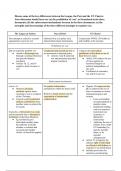
Discuss some of the key differences between the League, the Pact and the UN Charter.
Your discussion should focus on: (a) the prohibition of ‘war’ as formulated in the three
documents; (b) the enforcement mechanisms foreseen in the three documents; (c) the
strengths and shortcomings of the three different attempts to regulate war.
The League of Nations Pact of Paris UN Charter
First attempt at collective security Outlawed war as a policy tool; Created after WWII; UN builds on
organisation to prevent war lacked enforcement mechanisms and modifies LoN structure
Prohibition of ‘war’
Did not explicitly prohibit war Condemned and renounced war as Contains the most radical
● Aimed to discourage war an instrument of national policy prohibition on the threat or use of
through a cooling-off period ● Articles I and II outlawed force between states
and peaceful dispute war and promoted peaceful ● Article 2(4) outlaws the use
resolution dispute resolution of force against the
● Articles 10, 12, and 16 territorial integrity or
sought to limit recourse to political independence of
war any state
● Confirmed in customary
law and ICJ case law
Enforcement mechanisms
Article 16: No explicit enforcement ● Chapter VII empowers the
● Outlined automatic mechanisms within the treaty itself SC to authorise the use of
sanctions against states force to maintain or restore
resorting to war in violation Relied on moral suasion and the international peace and
of the Covenant expectation of international security
● Council could recommend condemnation ○ Issue non-binding
military contributions from recommendations to
member states to protect the member states
Covenant ○ Implement binding
coercive measures
In practice, enforcement was weak (sanctions) (eg
and inconsistent due to interpretive economic or
resolutions weakening obligation diplomatic
● Eg resolutions gave restrictions)
individual member states ○ Authorise the use of
the authority to decide military force under
whether a violation had UN leadership, by
occurred and whether specific member
Article 16 should be applied states, or by
regional
arrangements.
● Article 51 recognizes the
inherent right of individual
or collective self-defense in
response to an armed attack
● Includes provisions for
sanctions, peacekeeping
, operations, and the
establishment of an
international military force
(though the latter has not
been realised)
Strengths
● First attempt at a collective ● Significantly shifted ● Builds on the League of
security system international legal norms Nations and Kellogg-Briand
● Established a permanent towards outlawing war Pact
international organisation ● Reflected growing public ● Provides a more
dedicated to peace opinion against war comprehensive framework
● Introduced the concept of ● Laid the groundwork for the for collective security
collective responsibility for criminalisation of ● Includes a clear prohibition
preventing war aggressive war on the use of force and a
● Achieved some success in system for authorising
resolving minor disputes (eg exceptions
Åland, Espiros, Mosul) ● Has played a role in
deterring interstate war and
promoting peaceful dispute
resolution
Shortcomings
● Ambiguity surrounding the ● Lacked enforcement ● Frequent violations of the
prohibition on the use of mechanisms prohibition on the use of
force → argument that the ● Had limited immediate force (eg Iraq, 2003) → is
act of armed force was not a impact on the frequency of it still valid?
war because of self-defence, conquest (only on the ● Ambiguity in defining key
humanitarian intervention legitimacy) → the lack of a terms like "armed attack"
etc (what exactly was mechanism to enforce the and "threat to the peace"
outlawed by the League?) prohibition on conquest ● SC deadlock due to the veto
● Collective action problems meant states could not be power of permanent
and free-riding: can be compelled to members
provided by anyone and relinquish/hand over ● Challenges in responding to
creates incentives for others illegally seized territories intrastate conflicts and new
to free-ride forms of warfare
● Lack of US membership ○ Inter-state wars has
● Ultimately failed to prevent declined; conflict
major acts of aggression (eg with non-state
Japanese Invasion of actors have risen
Manchuko, Italo-Abyssinian ○ New forms of wars
War) (eg cyberwar)
● Concerns about the
potential for abuse of
humanitarian interventions
Your discussion should focus on: (a) the prohibition of ‘war’ as formulated in the three
documents; (b) the enforcement mechanisms foreseen in the three documents; (c) the
strengths and shortcomings of the three different attempts to regulate war.
The League of Nations Pact of Paris UN Charter
First attempt at collective security Outlawed war as a policy tool; Created after WWII; UN builds on
organisation to prevent war lacked enforcement mechanisms and modifies LoN structure
Prohibition of ‘war’
Did not explicitly prohibit war Condemned and renounced war as Contains the most radical
● Aimed to discourage war an instrument of national policy prohibition on the threat or use of
through a cooling-off period ● Articles I and II outlawed force between states
and peaceful dispute war and promoted peaceful ● Article 2(4) outlaws the use
resolution dispute resolution of force against the
● Articles 10, 12, and 16 territorial integrity or
sought to limit recourse to political independence of
war any state
● Confirmed in customary
law and ICJ case law
Enforcement mechanisms
Article 16: No explicit enforcement ● Chapter VII empowers the
● Outlined automatic mechanisms within the treaty itself SC to authorise the use of
sanctions against states force to maintain or restore
resorting to war in violation Relied on moral suasion and the international peace and
of the Covenant expectation of international security
● Council could recommend condemnation ○ Issue non-binding
military contributions from recommendations to
member states to protect the member states
Covenant ○ Implement binding
coercive measures
In practice, enforcement was weak (sanctions) (eg
and inconsistent due to interpretive economic or
resolutions weakening obligation diplomatic
● Eg resolutions gave restrictions)
individual member states ○ Authorise the use of
the authority to decide military force under
whether a violation had UN leadership, by
occurred and whether specific member
Article 16 should be applied states, or by
regional
arrangements.
● Article 51 recognizes the
inherent right of individual
or collective self-defense in
response to an armed attack
● Includes provisions for
sanctions, peacekeeping
, operations, and the
establishment of an
international military force
(though the latter has not
been realised)
Strengths
● First attempt at a collective ● Significantly shifted ● Builds on the League of
security system international legal norms Nations and Kellogg-Briand
● Established a permanent towards outlawing war Pact
international organisation ● Reflected growing public ● Provides a more
dedicated to peace opinion against war comprehensive framework
● Introduced the concept of ● Laid the groundwork for the for collective security
collective responsibility for criminalisation of ● Includes a clear prohibition
preventing war aggressive war on the use of force and a
● Achieved some success in system for authorising
resolving minor disputes (eg exceptions
Åland, Espiros, Mosul) ● Has played a role in
deterring interstate war and
promoting peaceful dispute
resolution
Shortcomings
● Ambiguity surrounding the ● Lacked enforcement ● Frequent violations of the
prohibition on the use of mechanisms prohibition on the use of
force → argument that the ● Had limited immediate force (eg Iraq, 2003) → is
act of armed force was not a impact on the frequency of it still valid?
war because of self-defence, conquest (only on the ● Ambiguity in defining key
humanitarian intervention legitimacy) → the lack of a terms like "armed attack"
etc (what exactly was mechanism to enforce the and "threat to the peace"
outlawed by the League?) prohibition on conquest ● SC deadlock due to the veto
● Collective action problems meant states could not be power of permanent
and free-riding: can be compelled to members
provided by anyone and relinquish/hand over ● Challenges in responding to
creates incentives for others illegally seized territories intrastate conflicts and new
to free-ride forms of warfare
● Lack of US membership ○ Inter-state wars has
● Ultimately failed to prevent declined; conflict
major acts of aggression (eg with non-state
Japanese Invasion of actors have risen
Manchuko, Italo-Abyssinian ○ New forms of wars
War) (eg cyberwar)
● Concerns about the
potential for abuse of
humanitarian interventions

