Module teaching
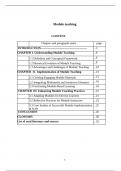
CONTENT
Chapters and paragraphs name page
INTRODUCTION................................................................. ....3
CHAPTER I. Understanding Module Teaching ....6
1.1 Definition and Conceptual Framework ....6
1.2 Historical Evolution of Module Teaching ....8
1.3 Advantages and Challenges of Module Teaching ....10
CHAPTER II. Implementation of Module Teaching ....13
2.1 Creating Engaging Module Materials ....13
2.2 Integrating Multimedia and Interactive Elements ....16
2.3 Facilitating Module-Based Learning ....18
CHAPTER III Enhancing Module Teaching Practices ....21
3.1 Adapting Modules for Diverse Learners ....21
3.2 Reflective Practices for Module Instructors ....23
3.3 Case Studies of Successful Module Implementation ....25
at Scale
CONCLUSION ....26
GLOSSARY ....30
List of used literature and sources ....32
1
,INTRODUCTION
Introduction: In modern educational contexts, language teaching approaches
and methodologies continue to evolve in response to the diverse needs and
preferences of language learners. One such approach that has gained significant
attention in recent years is module teaching. This course work aims to explore the
relevance of module teaching in language education, investigate its impact on
language learning outcomes, and provide practical insights for its effective
implementation.
Relevance of the Topic The topic of module teaching holds substantial
relevance in the field of language education. As language teachers strive to create
engaging and learner-centered classrooms, they seek innovative approaches that
foster a dynamic language learning environment. Module teaching offers a
promising framework that integrates task-based learning, project-based learning,
and communicative language teaching, providing learners with meaningful and
authentic language learning experiences. By examining the relevance of module
teaching, this course work seeks to shed light on its potential benefits and
challenges for language educators.
Purpose of the Research The purpose of this research is twofold: firstly, to
explore the theoretical and methodological foundations of module teaching and its
alignment with current language teaching theories, and secondly, to investigate its
practical implications for language learning outcomes. By examining the principles
and practices of module teaching, this research aims to contribute to the existing
body of knowledge and provide language educators with valuable insights into the
effective implementation of this approach.
Tasks Explore the theoretical foundations of module teaching: This task
involves an in-depth examination of the theoretical underpinnings of module
teaching, including its integration within task-based learning, project-based
2
,learning, and communicative language teaching. It aims to provide a
comprehensive understanding of the theoretical framework that supports module
teaching in language education.
Investigate the methodological foundations of module teaching: This task
focuses on exploring the methodological aspects of module teaching, including
instructional design, task selection, learner engagement, and assessment strategies.
By examining the methodological foundations, this research aims to identify
effective practices and guidelines for implementing module teaching in language
classrooms. Assess the impact of module teaching on language learning outcomes:
This task involves empirical research to examine the impact of module teaching on
language learning outcomes, including learners' linguistic proficiency,
communicative competence, motivation, and engagement. It aims to gather
quantitative and qualitative data to evaluate the effectiveness of module teaching in
facilitating language learning.
Theoretical and Methodological Foundations The theoretical foundations
of this research draw upon established language teaching approaches, such as task-
based learning, project-based learning, and communicative language teaching.
These approaches emphasize the importance of meaningful and authentic language
use, learner engagement, and task-driven instruction. The methodological
foundations encompass instructional design principles, task selection criteria,
assessment strategies, and learner-centered pedagogical practices. These
foundations provide a solid framework for investigating the implementation and
effectiveness of module teaching in language education. By examining the
theoretical and methodological foundations of module teaching and investigating
its impact on language learning outcomes, this research endeavors to contribute to
the advancement of language education practices. The findings of this study aim to
inform language educators, curriculum developers, and policymakers about the
3
, potential benefits and challenges associated with module teaching, ultimately
fostering more effective and engaging language learning experiences for students.
Module teaching refers to an instructional approach in which the curriculum
is organized into self-contained units or modules, each focusing on a specific topic,
theme, or skill. These modules are designed to be coherent and independent
learning units that can be taught in a flexible and modular manner In module
teaching, the curriculum is divided into discrete modules, allowing teachers to
structure their instruction around these modules and provide learners with a series
of interconnected learning experiences. Each module typically consists of a set of
learning objectives, instructional materials, activities, and assessments that are
designed to facilitate learners' understanding and mastery of the targeted content or
skills. Module teaching often incorporates principles from task-based learning,
project-based learning, and communicative language teaching. It emphasizes
learner engagement, active participation, and the application of knowledge and
skills in authentic contexts. The modules are designed to be meaningful and
relevant to learners, providing opportunities for them to develop their language
proficiency, critical thinking, problem-solving, and collaborative skills.
One of the key advantages of module teaching is its flexibility and
adaptability. Teachers can select and sequence modules based on learners' needs,
interests, and proficiency levels. They can also integrate various instructional
approaches, strategies, and resources within each module to create a rich and
varied learning experience. Overall, module teaching offers a comprehensive and
structured approach to curriculum design and delivery, promoting learner-
centeredness, meaningful learning, and the integration of language skills. It
provides a framework for organizing and delivering instruction that is adaptable,
engaging, and aligned with the principles of effective language education.
4
CONTENT
Chapters and paragraphs name page
INTRODUCTION................................................................. ....3
CHAPTER I. Understanding Module Teaching ....6
1.1 Definition and Conceptual Framework ....6
1.2 Historical Evolution of Module Teaching ....8
1.3 Advantages and Challenges of Module Teaching ....10
CHAPTER II. Implementation of Module Teaching ....13
2.1 Creating Engaging Module Materials ....13
2.2 Integrating Multimedia and Interactive Elements ....16
2.3 Facilitating Module-Based Learning ....18
CHAPTER III Enhancing Module Teaching Practices ....21
3.1 Adapting Modules for Diverse Learners ....21
3.2 Reflective Practices for Module Instructors ....23
3.3 Case Studies of Successful Module Implementation ....25
at Scale
CONCLUSION ....26
GLOSSARY ....30
List of used literature and sources ....32
1
,INTRODUCTION
Introduction: In modern educational contexts, language teaching approaches
and methodologies continue to evolve in response to the diverse needs and
preferences of language learners. One such approach that has gained significant
attention in recent years is module teaching. This course work aims to explore the
relevance of module teaching in language education, investigate its impact on
language learning outcomes, and provide practical insights for its effective
implementation.
Relevance of the Topic The topic of module teaching holds substantial
relevance in the field of language education. As language teachers strive to create
engaging and learner-centered classrooms, they seek innovative approaches that
foster a dynamic language learning environment. Module teaching offers a
promising framework that integrates task-based learning, project-based learning,
and communicative language teaching, providing learners with meaningful and
authentic language learning experiences. By examining the relevance of module
teaching, this course work seeks to shed light on its potential benefits and
challenges for language educators.
Purpose of the Research The purpose of this research is twofold: firstly, to
explore the theoretical and methodological foundations of module teaching and its
alignment with current language teaching theories, and secondly, to investigate its
practical implications for language learning outcomes. By examining the principles
and practices of module teaching, this research aims to contribute to the existing
body of knowledge and provide language educators with valuable insights into the
effective implementation of this approach.
Tasks Explore the theoretical foundations of module teaching: This task
involves an in-depth examination of the theoretical underpinnings of module
teaching, including its integration within task-based learning, project-based
2
,learning, and communicative language teaching. It aims to provide a
comprehensive understanding of the theoretical framework that supports module
teaching in language education.
Investigate the methodological foundations of module teaching: This task
focuses on exploring the methodological aspects of module teaching, including
instructional design, task selection, learner engagement, and assessment strategies.
By examining the methodological foundations, this research aims to identify
effective practices and guidelines for implementing module teaching in language
classrooms. Assess the impact of module teaching on language learning outcomes:
This task involves empirical research to examine the impact of module teaching on
language learning outcomes, including learners' linguistic proficiency,
communicative competence, motivation, and engagement. It aims to gather
quantitative and qualitative data to evaluate the effectiveness of module teaching in
facilitating language learning.
Theoretical and Methodological Foundations The theoretical foundations
of this research draw upon established language teaching approaches, such as task-
based learning, project-based learning, and communicative language teaching.
These approaches emphasize the importance of meaningful and authentic language
use, learner engagement, and task-driven instruction. The methodological
foundations encompass instructional design principles, task selection criteria,
assessment strategies, and learner-centered pedagogical practices. These
foundations provide a solid framework for investigating the implementation and
effectiveness of module teaching in language education. By examining the
theoretical and methodological foundations of module teaching and investigating
its impact on language learning outcomes, this research endeavors to contribute to
the advancement of language education practices. The findings of this study aim to
inform language educators, curriculum developers, and policymakers about the
3
, potential benefits and challenges associated with module teaching, ultimately
fostering more effective and engaging language learning experiences for students.
Module teaching refers to an instructional approach in which the curriculum
is organized into self-contained units or modules, each focusing on a specific topic,
theme, or skill. These modules are designed to be coherent and independent
learning units that can be taught in a flexible and modular manner In module
teaching, the curriculum is divided into discrete modules, allowing teachers to
structure their instruction around these modules and provide learners with a series
of interconnected learning experiences. Each module typically consists of a set of
learning objectives, instructional materials, activities, and assessments that are
designed to facilitate learners' understanding and mastery of the targeted content or
skills. Module teaching often incorporates principles from task-based learning,
project-based learning, and communicative language teaching. It emphasizes
learner engagement, active participation, and the application of knowledge and
skills in authentic contexts. The modules are designed to be meaningful and
relevant to learners, providing opportunities for them to develop their language
proficiency, critical thinking, problem-solving, and collaborative skills.
One of the key advantages of module teaching is its flexibility and
adaptability. Teachers can select and sequence modules based on learners' needs,
interests, and proficiency levels. They can also integrate various instructional
approaches, strategies, and resources within each module to create a rich and
varied learning experience. Overall, module teaching offers a comprehensive and
structured approach to curriculum design and delivery, promoting learner-
centeredness, meaningful learning, and the integration of language skills. It
provides a framework for organizing and delivering instruction that is adaptable,
engaging, and aligned with the principles of effective language education.
4