
MODULE 2 EXAM (ANSWER KEY)
Question 1:
How many lobes does the right human lung have
- The right human lung has 3 lobes (Superior, Middle, and Inferior)
Question 2:
Air (and not food) pass in which of the following areas:
A. Esophagus
B. Nasopharynx
C. Oropharynx
D. Both A. and C.
Question 3:
Rings of cartilage line much of the respiratory tract. In which of one the following would
cartilage NOT be found?
A. Trachea
B. Larynx
C. Bronchi
D. Alveoli
Question 4:
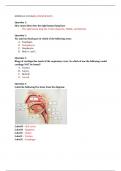
Label the following five items from the diagram:
Label B - Oral cavity
Label D - Epiglottis
Label E - Glottis
Label F - Trachea
Label G - Esophagus
, Question 5:
Note: Essay answers must clearly be in your own words.
Explain what happens to the epiglottis during swallowing. Why?
- When swallowing, the epiglottis covers the trachea preventing food or beverages from
entering the lungs.
Question 6:
Note: Essay answers must clearly be in your own words.
A premature baby is having difficulty producing surfactant. Explain what problems may
occur and why.
- This happens because the baby's lung isn't fully developed yet and they can't yet produce
the surfactant that they need. The surfactant is important for them because without it, they
will have problems breathing.
Question 7:
True/False: Positive pressure is used to move air into the lungs.
● True
● False
Question 8:
True/False: During exhalation the diaphragm contracts to actively push air out of the
lungs.
● True
● False
Question 9:
True/False: During inhalation the rib cage is lowered pull the lungs open.
● True
● False
Question 10:
True/False: As the thoracic cavity expands and lung volume increases, the density of the
gases filling the lungs increases.
● True
● False

