NR667 CEA Module notes
Study online at https://quizlet.com/_ff2kqn
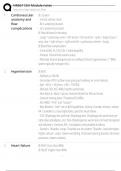
1. Cardiovascular Ø Location
anatomy and - Central anterior chest
flow - RV is anteriorly located
complications - LV is posteriorly located
Ø Flow of blood in the body
- Lungs > pulmonary veins > left atrium > left ventricle > aorta > body tissues >
vena cava > right atrium > right ventricle > pulmonary arteries > lungs.
Ø Blood flow complications
- Contractility: EF, CAD, LVH, Cardiomyopathy
- Preload: Central fluid volume status
- Afterload: Arterial backpressure on outflow (Chronic hypertension). (**RAAS
system typically manages this).
2. Hypertension Ø JNC8
- Defined as 140/90
- Secondary HTN: Up flow issue going up to kidney, ex: renal stenosis.
- Age > 60 or < 60 years. (>60 = 150/90).
- DM and CKD: ACE/ARBs (nephro protective).
- Non-black vs. Black: Calcium channel blocker for African Ascent.
- General starting place: Thiazides/ACE/ARBs.
- ACE/ARBS: "Prils" and "Sartans"
- Beta Blockers: "olol" not on JNC8 guidelines, history of cardiac disease, reduce
HR. Carvedilol is a dual alpha/beta, great for Heart failure.
- CCB: Dihydropyrines and Non-Dihydropyrines. Dihydropyrines work more pe-
ripherally (amlodipine, etc). Non-Dihydropyrines work more on heart (Verapamil
and diltiazem). Common ASE: Constipation and peripheral edema.
- Diuretics: Thiazides, Loops. Thiazides are less potent. Thiazide= Low electrolytes,
Higher calcium. Loops- lowers everything. Potassium-sparing diuretics (Increase
potassium, lowers sodium).
3. Heart failure Ø HFrEF (Less than 40%)
Ø HFpEF (Higher than 40%)
, NR667 CEA Module notes
Study online at https://quizlet.com/_ff2kqn
Ø Systolic heart failure: inability for myocardium to effectively contract.
Ø Diastolic heart failure: inability to myocardium to effectively relax.
Ø Typical patient: elderly with comorbidities of HTN, DM, Smoking.
- Class I: Mild symptoms
- Class II-III: Symptoms with exertion (II), ADL's cause symptoms (III)
- Class IV: Symptoms severe, likely needs hospitalization.
Ø Classic symptoms: SOB, Fatigue, exertional dyspnea, dependent and pul-
monary edema, low activity tolerance, abdominal bloating, orthopnea.
Ø Causes: ischemic heart disease, valve disease, MI, cardiomyopathy.
Ø Treatment: ACE/ARB, ARB/ARNI, BB, Diuretics, nitrates plus hydralazine, Fluid
and salt restriction, daily weights.
4. Lipid manage- Ø AVSCD
ment - Statins
- Hight-intensity statins: Atorvastatin 40-80mg and Rovusatan 20-40mg (Don't
require being taken at bedtime). LDL < 190
- Common ASE: Myalgia. Rhabdomyolysis worse case scenario.
- Statins, Ezetimibe in conjunction. PC9-Inhibitors (injectable Q2 weeks). (Cardi-
ology at consult prior to PC9-Inhibitors).
- Familial homozygous hyperlipidemia= PC9-Inhibitors.
- HDL: "Cleaning agent."
- LDL- "Scrum between glass window in shower"
5. Valve disease Ø Aortic stenosis: Narrowing of outflow to aortic root through aortic valve due
and aneurysms to calcification. Symptoms tend to mirror CAD with addition of syncope/near
syncope.
Ø Aortic Regurgitation/Insufficiency: instability for aortic valve to appropriately
close. Commonly due to aortic root dilation or endocarditis/infection. A direct
contraindication for IABP use (common board exam question).
Ø Mitral stenosis: Narrowing of inflow into LV through the mitral valve due to
calcification.
Ø Mitral regurgitation/Insufficiency: instability for mitral valve leaflets to close.
, NR667 CEA Module notes
Study online at https://quizlet.com/_ff2kqn
Commonly due to mitral root dilation from an MI, CHF, induced LV dilation,
papillary muscle rupture, endocarditis.
Ø Identifying Murmurs (left sternal border, 2nd intercoastal).
- Aortic stenosis: swishing, systole, tends to radiate to neck.
- Mitral stenosis- low-frequency, diastole, tends to radiate to lateral chest.
- Mitral regurgitation: systole,
- Aortic regurgitation, Diastole
Ø Aortic layers
- Tunica externa
- Tunica media
- Tunica intima
Ø Aneurysm
- Stanford A (Ascending before the left subclavian): requires surgery (risk of
dissecting coronary ostia/aortic valve).
- Stanford B (descending after the left subclavian): typically treated with endovas-
cular grafting if anything at all.
- Presentation: asymptomatic, ruptured: classic triad of acute abdominal pain,
abdominal distention, and hemodynamic instability, pulsable mass on abdomen,
tearing feeling in back.
- Congenital concerns: marfan's syndrome, Ehlers's-Danlos syndrome, Bicuspid
aortic valve commonly found.
- Other causes: atherosclerosis, vasculitis, uncontrolled HTN. Tobacco use.
- Supportive management: avoid heavy lifting, BP control, avoidance of fluro-
quinolone antibiotics = weakening vascular tissue.
6. DVT/PE Manage- Ø PE
ment - Saddle emboli commonly require surgery. (will see evidence of right heart strain,
S1Q3T3, TR on 2D echo, enlarged RV.
- Subsegmental not typically requiring emergent surgery (commonly treated
with tPA and/or IV anticoagulation through a direct PA catheter. May use ultra-
sound-assisted technology (EKOs).
- Provoked vs. Unprovoked.
, NR667 CEA Module notes
Study online at https://quizlet.com/_ff2kqn
- Anticoagulation for at least 3 months.
- Unprovoked: at least 3 months, may be lifelong if any reoccurrence.
Ø DVT
- Virchow's triad: Venous stasis, hypercoagulability, endothelial injury.
- Initial diagnostics: CBC, PT/PTT, PT/INR, US with doppler.
- Treatment: Anticoagulation for provoked and unprovoked.
7. PAD and pleural Ø PAD
effusions - Clinical findings: pale, waxy, hairless legs, pain with ambulation that improves
with cessation of ambulation.
- Diagnosed with ABI, confirmatory diagnosis with angiography.
- Treatment: stents or bypass of occluded/near occluded vessels.
- Medications: antiplatelet agents (clopidogrel, cilostazol, aspirin), statins for lipid
management.
- Smoking cessation
- Management of comorbid conditions such as DM.
- Daily ambulation exercise therapy.
Ø Intermittent Claudication
- Not as severe of blockage
- Requires exercise
- Antiplatelet/aspirin regimen
- Treat underlying causes: smoking, HTN, HLD, DM.
Ø Pericardial Effusion and Tamponade
- Fluid around the heart inside the pericardium
- Normally a small volume (<50 ml) present
- If chronic effusion, may drastically increase without consequence.
- Treatment: address underlying causes: malignancy, hypothyroid, hypercoagula-
ble state, trauma.
- If acute tamponade (narrowed pulse pressure, tachycardia, JVD, muffled HTs)
- Pericardiocentesis vs. pericardial window
- Medications: colchicine and NSAIDs (usually indomethacin vs. ibuprofen)
Study online at https://quizlet.com/_ff2kqn
1. Cardiovascular Ø Location
anatomy and - Central anterior chest
flow - RV is anteriorly located
complications - LV is posteriorly located
Ø Flow of blood in the body
- Lungs > pulmonary veins > left atrium > left ventricle > aorta > body tissues >
vena cava > right atrium > right ventricle > pulmonary arteries > lungs.
Ø Blood flow complications
- Contractility: EF, CAD, LVH, Cardiomyopathy
- Preload: Central fluid volume status
- Afterload: Arterial backpressure on outflow (Chronic hypertension). (**RAAS
system typically manages this).
2. Hypertension Ø JNC8
- Defined as 140/90
- Secondary HTN: Up flow issue going up to kidney, ex: renal stenosis.
- Age > 60 or < 60 years. (>60 = 150/90).
- DM and CKD: ACE/ARBs (nephro protective).
- Non-black vs. Black: Calcium channel blocker for African Ascent.
- General starting place: Thiazides/ACE/ARBs.
- ACE/ARBS: "Prils" and "Sartans"
- Beta Blockers: "olol" not on JNC8 guidelines, history of cardiac disease, reduce
HR. Carvedilol is a dual alpha/beta, great for Heart failure.
- CCB: Dihydropyrines and Non-Dihydropyrines. Dihydropyrines work more pe-
ripherally (amlodipine, etc). Non-Dihydropyrines work more on heart (Verapamil
and diltiazem). Common ASE: Constipation and peripheral edema.
- Diuretics: Thiazides, Loops. Thiazides are less potent. Thiazide= Low electrolytes,
Higher calcium. Loops- lowers everything. Potassium-sparing diuretics (Increase
potassium, lowers sodium).
3. Heart failure Ø HFrEF (Less than 40%)
Ø HFpEF (Higher than 40%)
, NR667 CEA Module notes
Study online at https://quizlet.com/_ff2kqn
Ø Systolic heart failure: inability for myocardium to effectively contract.
Ø Diastolic heart failure: inability to myocardium to effectively relax.
Ø Typical patient: elderly with comorbidities of HTN, DM, Smoking.
- Class I: Mild symptoms
- Class II-III: Symptoms with exertion (II), ADL's cause symptoms (III)
- Class IV: Symptoms severe, likely needs hospitalization.
Ø Classic symptoms: SOB, Fatigue, exertional dyspnea, dependent and pul-
monary edema, low activity tolerance, abdominal bloating, orthopnea.
Ø Causes: ischemic heart disease, valve disease, MI, cardiomyopathy.
Ø Treatment: ACE/ARB, ARB/ARNI, BB, Diuretics, nitrates plus hydralazine, Fluid
and salt restriction, daily weights.
4. Lipid manage- Ø AVSCD
ment - Statins
- Hight-intensity statins: Atorvastatin 40-80mg and Rovusatan 20-40mg (Don't
require being taken at bedtime). LDL < 190
- Common ASE: Myalgia. Rhabdomyolysis worse case scenario.
- Statins, Ezetimibe in conjunction. PC9-Inhibitors (injectable Q2 weeks). (Cardi-
ology at consult prior to PC9-Inhibitors).
- Familial homozygous hyperlipidemia= PC9-Inhibitors.
- HDL: "Cleaning agent."
- LDL- "Scrum between glass window in shower"
5. Valve disease Ø Aortic stenosis: Narrowing of outflow to aortic root through aortic valve due
and aneurysms to calcification. Symptoms tend to mirror CAD with addition of syncope/near
syncope.
Ø Aortic Regurgitation/Insufficiency: instability for aortic valve to appropriately
close. Commonly due to aortic root dilation or endocarditis/infection. A direct
contraindication for IABP use (common board exam question).
Ø Mitral stenosis: Narrowing of inflow into LV through the mitral valve due to
calcification.
Ø Mitral regurgitation/Insufficiency: instability for mitral valve leaflets to close.
, NR667 CEA Module notes
Study online at https://quizlet.com/_ff2kqn
Commonly due to mitral root dilation from an MI, CHF, induced LV dilation,
papillary muscle rupture, endocarditis.
Ø Identifying Murmurs (left sternal border, 2nd intercoastal).
- Aortic stenosis: swishing, systole, tends to radiate to neck.
- Mitral stenosis- low-frequency, diastole, tends to radiate to lateral chest.
- Mitral regurgitation: systole,
- Aortic regurgitation, Diastole
Ø Aortic layers
- Tunica externa
- Tunica media
- Tunica intima
Ø Aneurysm
- Stanford A (Ascending before the left subclavian): requires surgery (risk of
dissecting coronary ostia/aortic valve).
- Stanford B (descending after the left subclavian): typically treated with endovas-
cular grafting if anything at all.
- Presentation: asymptomatic, ruptured: classic triad of acute abdominal pain,
abdominal distention, and hemodynamic instability, pulsable mass on abdomen,
tearing feeling in back.
- Congenital concerns: marfan's syndrome, Ehlers's-Danlos syndrome, Bicuspid
aortic valve commonly found.
- Other causes: atherosclerosis, vasculitis, uncontrolled HTN. Tobacco use.
- Supportive management: avoid heavy lifting, BP control, avoidance of fluro-
quinolone antibiotics = weakening vascular tissue.
6. DVT/PE Manage- Ø PE
ment - Saddle emboli commonly require surgery. (will see evidence of right heart strain,
S1Q3T3, TR on 2D echo, enlarged RV.
- Subsegmental not typically requiring emergent surgery (commonly treated
with tPA and/or IV anticoagulation through a direct PA catheter. May use ultra-
sound-assisted technology (EKOs).
- Provoked vs. Unprovoked.
, NR667 CEA Module notes
Study online at https://quizlet.com/_ff2kqn
- Anticoagulation for at least 3 months.
- Unprovoked: at least 3 months, may be lifelong if any reoccurrence.
Ø DVT
- Virchow's triad: Venous stasis, hypercoagulability, endothelial injury.
- Initial diagnostics: CBC, PT/PTT, PT/INR, US with doppler.
- Treatment: Anticoagulation for provoked and unprovoked.
7. PAD and pleural Ø PAD
effusions - Clinical findings: pale, waxy, hairless legs, pain with ambulation that improves
with cessation of ambulation.
- Diagnosed with ABI, confirmatory diagnosis with angiography.
- Treatment: stents or bypass of occluded/near occluded vessels.
- Medications: antiplatelet agents (clopidogrel, cilostazol, aspirin), statins for lipid
management.
- Smoking cessation
- Management of comorbid conditions such as DM.
- Daily ambulation exercise therapy.
Ø Intermittent Claudication
- Not as severe of blockage
- Requires exercise
- Antiplatelet/aspirin regimen
- Treat underlying causes: smoking, HTN, HLD, DM.
Ø Pericardial Effusion and Tamponade
- Fluid around the heart inside the pericardium
- Normally a small volume (<50 ml) present
- If chronic effusion, may drastically increase without consequence.
- Treatment: address underlying causes: malignancy, hypothyroid, hypercoagula-
ble state, trauma.
- If acute tamponade (narrowed pulse pressure, tachycardia, JVD, muffled HTs)
- Pericardiocentesis vs. pericardial window
- Medications: colchicine and NSAIDs (usually indomethacin vs. ibuprofen)