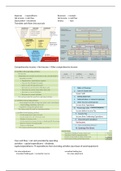
Expenses ≠ expenditures Revenues ≠ receipts
Net income ≠ cash flow Net income ≠ cash flow
Depreciation - investment invoice - loan
Translate cash flows into accruals
Comprehensive income = Net income + Other comprehensive income
= interest expense
Free cash flow = net cash provided by operating
activities – capital expenditures – dividends.
Capital expenditures expenditures from investing activities (purchase of land/equipment)
Fair value adjustment unrealized holding loss
Unrealized holding gain = revaluation reserve fair value adjustment
, Two basic methods of revenue recognition and accounting for long-term construction type projects:
- Percentage-of-completion method (total cash flow – costs = expected gross profit)
exp. gross profit * (cost incurred during year / estimated total cost) = gross profit
(gross profit – gross profit recognized in previous years = gross profit of current year)
- Cost-recovery (Zero-profit) method gross profit = total cash flow – total costs
Gross method assume that customers won’t pay within discount period. Debit whole amount first.
Net method assume that customers pay within the discount period
Two methods to account for uncollectible accounts:
- Direct write off method (bad debt expense to accounts receivable)
- Allowance method (bad debt expense to allowance for doubtful accounts) (allo to acc recei)
Two types of systems for maintain inventory records:
- Perpetual system directly account for the cost of goods sold for each transaction
- Periodic system we do account for the cost of goods sold only in the end of the period
Inventory costs: Product costs: purchase price – import duties and taxes – transportation costs – handling costs
Period costs: selling expenses – admin exp. -
Direct costs incurred to sell shares: underwriting costs – accounting and legal fees – printing costs – taxes
Cost flow methods:
- Specific identification: iedere unit aparte kosten
- FIFO - Average cost
If an exchange lacks commercial substance, there is no gain or loss on the disposal
Residual value = price after the useful life – cost of disposal. Cost – residual value = deprecation base
Methods of depreciation:
cost−residual∨salvage value
- Straight line method depreciation charge=
estimated service life
( cost−residual value )∗hours this year
- Activity method depre ciation charge=
total estimated hours
- Diminishing method:
o Sum-of-the-years digits (expense – residual value) * years / (estimated useful life * (estimated useful life + 1)/2)
cost
o Declining-balance method depre ciation c h arge=
estimated useful life
depreciatie hoog naar laag
Impairment = A long-lived tangible asset is impaired when a company is not able to recover the asset’s carrying
amount (book value) either through using it or by selling it.
Recoverable amount (highest) = (fair value – costs to sell) or (value in use: PV of future cash flows)
recoverable amount, wat je krijgt > carrying amount, wat het waard is = no impairment
recoverable amount < carrying amount = impairment loss on impairment to acc. deprec.
Expensed = only to income statement
Capitalized = go to assets on balance
sheet
Net income ≠ cash flow Net income ≠ cash flow
Depreciation - investment invoice - loan
Translate cash flows into accruals
Comprehensive income = Net income + Other comprehensive income
= interest expense
Free cash flow = net cash provided by operating
activities – capital expenditures – dividends.
Capital expenditures expenditures from investing activities (purchase of land/equipment)
Fair value adjustment unrealized holding loss
Unrealized holding gain = revaluation reserve fair value adjustment
, Two basic methods of revenue recognition and accounting for long-term construction type projects:
- Percentage-of-completion method (total cash flow – costs = expected gross profit)
exp. gross profit * (cost incurred during year / estimated total cost) = gross profit
(gross profit – gross profit recognized in previous years = gross profit of current year)
- Cost-recovery (Zero-profit) method gross profit = total cash flow – total costs
Gross method assume that customers won’t pay within discount period. Debit whole amount first.
Net method assume that customers pay within the discount period
Two methods to account for uncollectible accounts:
- Direct write off method (bad debt expense to accounts receivable)
- Allowance method (bad debt expense to allowance for doubtful accounts) (allo to acc recei)
Two types of systems for maintain inventory records:
- Perpetual system directly account for the cost of goods sold for each transaction
- Periodic system we do account for the cost of goods sold only in the end of the period
Inventory costs: Product costs: purchase price – import duties and taxes – transportation costs – handling costs
Period costs: selling expenses – admin exp. -
Direct costs incurred to sell shares: underwriting costs – accounting and legal fees – printing costs – taxes
Cost flow methods:
- Specific identification: iedere unit aparte kosten
- FIFO - Average cost
If an exchange lacks commercial substance, there is no gain or loss on the disposal
Residual value = price after the useful life – cost of disposal. Cost – residual value = deprecation base
Methods of depreciation:
cost−residual∨salvage value
- Straight line method depreciation charge=
estimated service life
( cost−residual value )∗hours this year
- Activity method depre ciation charge=
total estimated hours
- Diminishing method:
o Sum-of-the-years digits (expense – residual value) * years / (estimated useful life * (estimated useful life + 1)/2)
cost
o Declining-balance method depre ciation c h arge=
estimated useful life
depreciatie hoog naar laag
Impairment = A long-lived tangible asset is impaired when a company is not able to recover the asset’s carrying
amount (book value) either through using it or by selling it.
Recoverable amount (highest) = (fair value – costs to sell) or (value in use: PV of future cash flows)
recoverable amount, wat je krijgt > carrying amount, wat het waard is = no impairment
recoverable amount < carrying amount = impairment loss on impairment to acc. deprec.
Expensed = only to income statement
Capitalized = go to assets on balance
sheet