

Psych A level notes- specialization 2: Organizational psychology
9.1- motivation at work:
9.1.1- need theories
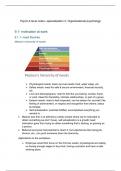
Maslow’s hierarchy of needs-
Physiological needs: basic survival needs; food, water sleep, etc.
Safety needs: need for safe & secure environment; financial security,
etc.
Love and belongingness: need to feel like you belong, society, home,
or work. Need for friendship, intimate relationships, or part of a group.
Esteem needs: need to feel respected, can be esteem for yourself, like
feeling of achievement, or respect and recognition from others; status
& prestige.
Self-actualization: potential fulfilled, accomplished everything you
wanted to.
Maslow saw first 4 as deficiency needs (needs where we’re motivated to
obtain something we don’t have), self-actualization is a growth need;
motivation goes from trying to obtain something that is lacking, to growing as
a person.
Believed everyone had potential to reach it, but experiences like losing job,
divorce, etc., can push someone down the hierarchy.
Applications to the workplace-
Employee would first focus on the first two needs; physiological and safety,
so having enough wages to buy food, having a pension and have a safe
working place.
, If met-> love and belongingness becomes important, feeling accepted, and
having some social interaction. (depends on personality as well).
Then, esteem and self-actualization need to be met, esteem could include
being respected and recognized, promotion, decision making, training, etc.
self-actualization allows employee to grow and challenge themselves,
allows worker to have greater autonomy and freedom from supervision.
If al needs met, workers will be happy and secure within workplace and
have high level of motivation.
Evaluation of Maslow’s theory:
May not be valid, assumes lower needs should be met before moving on, can
be disputed as many people live in poverty but still show love and
belongingness.
Cultural differences- doesn’t take it into account. Collectivist cultures like
china could have different definition of self-actualization than individualistic
cultures like USA.
Application to everyday life- strength, made large contribution to org
psychology, and motivation in the workplace, so employers can use the
theory.
Reductionism vs holism- more holistic, as he states that not only physiological
needs are important, but even psychological needs. It’s a complete theory that
takes many factors into account.
Determinism vs free will- free-will side, its necessary to have free will to be
able to self-actualize, although people have free-will, our behaviour/motivation
is still determined by some external forces like, being unable to find another
job.
SAEEDNIA (2011)-
Aim- to develop a reliable scale to measure basic needs satisfaction in
children.
Methodology- 13 children & their parents and educators interviewed, open-
ended questions used, qualitative data produced, interviewed about basic
need’s satisfaction (wishes and desires, openness of family to allow child’s
independence, supportiveness, etc.) data gained coded and analysed based
on Maslow’s theory. Themes in interview used to make the Basic Needs
Satisfaction Scale (BNSS), based around Maslow’s 5 needs, after pilot, BNSS
distributed to 300 ppts, randomly chosen from sample of 457.
Results- reliability of BNSS for use of children was high (0.83), consistent
measure of the concepts.
, Conclusion- qualitative methods more appropriate for Maslow’s hierarchy, and
to find out people’s desires. (children may unconsciously pretend that need is
met). BNSS is an indicator of life satisfaction, changes depending on culture,
poor nations-> safety, wealthier nations-> love & self esteem. Consistent with
maslow’s theory.
Evaluation-
Strength- qual data may be reliable when researching maslow’s
hierarchy, overcomes criticisms that theory is not scientific, and
concepts cant be tested, increases reliability of theory.
Strength- basis for future research, first attempt to produce
questionnaire to look at basic needs in children, had some success,
future research can be done, weaknesses identified to enable it to be a
reliable tool to assess children’s needs in the future.
Weakness- generalisability low, sample was people in wealthy areas of
Tehran, results cant be applicable to people living in less wealthy
places.
Weakness- age of ppts, although they interviewed family and
educators, limited ability of children to express themselves could have
affected the validity.
MCCLELLAND’S THEORY OF ACHIEVEMENT MOTIVATION (1961)
Built on Maslow’s theory, identified 3 work-related motivation needs:
Achievement
Power
Affiliation
Suggests these needs are universal, regardless of age, gender, etc, we
are all motivated to satisfy them. All three may not be equal, one could be
dominant over others, dominant motivator will shape our behaviour at
work. Specific mix of motivational needs shaped by life experiences and
culture. Learned behaviours.
Need for achievement- urge to achieve something, drives people to work,
person with high achievement will try to succeed by avoiding low
reward/low risk situations, but also avoid difficult to achieve high risk
situations. Low-risk avoided as success too easily obtained, not seen as
‘real achievement’, too high risk, will see results as due to luck. Want
regular feedback to monitor own progress, would rather work alone or with
other high achievers. Low achievement people will avoid responsibility at
work (fear of failure). McClelland believed people with high achievement
make best leaders in workplace.
, Need for affiliation- high affiliation-> want social interaction, want to be
liked, accepted, and part of a group. Conform to group norms, wont
challenge the group, fear rejection. Not risk takers, prefer collaboration,
don’t like being singled out for praise. Perform well in team activities,
customer service.
Need for power- desire to be in control, authority, suited to leadership,
want to make an impact, want prestige and high status, want their
viewpoints to be accepted, 2 types: personal power- need to control
others, social power- need to coordinate and organise a group/team to
reach business goals.
Thematic Apperception Test (TAT)- projective test, person describing
ambiguous stimuli, tests imagination, shown around 20 ambiguous
pictures, asked to make up story, people will project their needs onto story,
stories created will reveal unconscious motives and needs. Devised way to
score people’s stories regarding power, affiliation, and motivation.
Evaluation:
Cultural differences- weakness, doesn’t take gender and cultural differences
into account, constructed using males from individualistic, western societies,
may not be able to apply to collectivist cultures like Japan, and females.
Individual and situational explanations- only considers individual, not
situational, social situation has to be right, not just about individualistic needs,
incomplete theory, and can’t explain all factors in workplace motivation.
Used projective tests, produced scoring system (relatively reliable, can be
statistically analysed), still measuring unobservable personality characteristics
from preconscious mind, results obtained can’t be disproven
Strength- can be used to find needs of potential and current employees,
allows organizations to place people in areas they’re most suited, and screen
employees so that they can employee best people as per the job advertised.
Can improve factors like productivity and staff retention.
9.1.2- cognitive theories of motivation-
1- Latham & Locke’s goal setting theory-
Locke (1968)
9.1- motivation at work:
9.1.1- need theories
Maslow’s hierarchy of needs-
Physiological needs: basic survival needs; food, water sleep, etc.
Safety needs: need for safe & secure environment; financial security,
etc.
Love and belongingness: need to feel like you belong, society, home,
or work. Need for friendship, intimate relationships, or part of a group.
Esteem needs: need to feel respected, can be esteem for yourself, like
feeling of achievement, or respect and recognition from others; status
& prestige.
Self-actualization: potential fulfilled, accomplished everything you
wanted to.
Maslow saw first 4 as deficiency needs (needs where we’re motivated to
obtain something we don’t have), self-actualization is a growth need;
motivation goes from trying to obtain something that is lacking, to growing as
a person.
Believed everyone had potential to reach it, but experiences like losing job,
divorce, etc., can push someone down the hierarchy.
Applications to the workplace-
Employee would first focus on the first two needs; physiological and safety,
so having enough wages to buy food, having a pension and have a safe
working place.
, If met-> love and belongingness becomes important, feeling accepted, and
having some social interaction. (depends on personality as well).
Then, esteem and self-actualization need to be met, esteem could include
being respected and recognized, promotion, decision making, training, etc.
self-actualization allows employee to grow and challenge themselves,
allows worker to have greater autonomy and freedom from supervision.
If al needs met, workers will be happy and secure within workplace and
have high level of motivation.
Evaluation of Maslow’s theory:
May not be valid, assumes lower needs should be met before moving on, can
be disputed as many people live in poverty but still show love and
belongingness.
Cultural differences- doesn’t take it into account. Collectivist cultures like
china could have different definition of self-actualization than individualistic
cultures like USA.
Application to everyday life- strength, made large contribution to org
psychology, and motivation in the workplace, so employers can use the
theory.
Reductionism vs holism- more holistic, as he states that not only physiological
needs are important, but even psychological needs. It’s a complete theory that
takes many factors into account.
Determinism vs free will- free-will side, its necessary to have free will to be
able to self-actualize, although people have free-will, our behaviour/motivation
is still determined by some external forces like, being unable to find another
job.
SAEEDNIA (2011)-
Aim- to develop a reliable scale to measure basic needs satisfaction in
children.
Methodology- 13 children & their parents and educators interviewed, open-
ended questions used, qualitative data produced, interviewed about basic
need’s satisfaction (wishes and desires, openness of family to allow child’s
independence, supportiveness, etc.) data gained coded and analysed based
on Maslow’s theory. Themes in interview used to make the Basic Needs
Satisfaction Scale (BNSS), based around Maslow’s 5 needs, after pilot, BNSS
distributed to 300 ppts, randomly chosen from sample of 457.
Results- reliability of BNSS for use of children was high (0.83), consistent
measure of the concepts.
, Conclusion- qualitative methods more appropriate for Maslow’s hierarchy, and
to find out people’s desires. (children may unconsciously pretend that need is
met). BNSS is an indicator of life satisfaction, changes depending on culture,
poor nations-> safety, wealthier nations-> love & self esteem. Consistent with
maslow’s theory.
Evaluation-
Strength- qual data may be reliable when researching maslow’s
hierarchy, overcomes criticisms that theory is not scientific, and
concepts cant be tested, increases reliability of theory.
Strength- basis for future research, first attempt to produce
questionnaire to look at basic needs in children, had some success,
future research can be done, weaknesses identified to enable it to be a
reliable tool to assess children’s needs in the future.
Weakness- generalisability low, sample was people in wealthy areas of
Tehran, results cant be applicable to people living in less wealthy
places.
Weakness- age of ppts, although they interviewed family and
educators, limited ability of children to express themselves could have
affected the validity.
MCCLELLAND’S THEORY OF ACHIEVEMENT MOTIVATION (1961)
Built on Maslow’s theory, identified 3 work-related motivation needs:
Achievement
Power
Affiliation
Suggests these needs are universal, regardless of age, gender, etc, we
are all motivated to satisfy them. All three may not be equal, one could be
dominant over others, dominant motivator will shape our behaviour at
work. Specific mix of motivational needs shaped by life experiences and
culture. Learned behaviours.
Need for achievement- urge to achieve something, drives people to work,
person with high achievement will try to succeed by avoiding low
reward/low risk situations, but also avoid difficult to achieve high risk
situations. Low-risk avoided as success too easily obtained, not seen as
‘real achievement’, too high risk, will see results as due to luck. Want
regular feedback to monitor own progress, would rather work alone or with
other high achievers. Low achievement people will avoid responsibility at
work (fear of failure). McClelland believed people with high achievement
make best leaders in workplace.
, Need for affiliation- high affiliation-> want social interaction, want to be
liked, accepted, and part of a group. Conform to group norms, wont
challenge the group, fear rejection. Not risk takers, prefer collaboration,
don’t like being singled out for praise. Perform well in team activities,
customer service.
Need for power- desire to be in control, authority, suited to leadership,
want to make an impact, want prestige and high status, want their
viewpoints to be accepted, 2 types: personal power- need to control
others, social power- need to coordinate and organise a group/team to
reach business goals.
Thematic Apperception Test (TAT)- projective test, person describing
ambiguous stimuli, tests imagination, shown around 20 ambiguous
pictures, asked to make up story, people will project their needs onto story,
stories created will reveal unconscious motives and needs. Devised way to
score people’s stories regarding power, affiliation, and motivation.
Evaluation:
Cultural differences- weakness, doesn’t take gender and cultural differences
into account, constructed using males from individualistic, western societies,
may not be able to apply to collectivist cultures like Japan, and females.
Individual and situational explanations- only considers individual, not
situational, social situation has to be right, not just about individualistic needs,
incomplete theory, and can’t explain all factors in workplace motivation.
Used projective tests, produced scoring system (relatively reliable, can be
statistically analysed), still measuring unobservable personality characteristics
from preconscious mind, results obtained can’t be disproven
Strength- can be used to find needs of potential and current employees,
allows organizations to place people in areas they’re most suited, and screen
employees so that they can employee best people as per the job advertised.
Can improve factors like productivity and staff retention.
9.1.2- cognitive theories of motivation-
1- Latham & Locke’s goal setting theory-
Locke (1968)

