
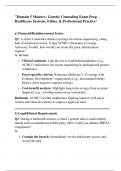
"Domain 5 Mastery: Genetic Counseling Exam Prep –
Healthcare Systems, Ethics, & Professional Practice"
a) Financial/Reimbursement Issues
Q1: A client’s insurance denies coverage for exome sequencing, citing
lack of medical necessity. Using ACMG’s Insurance Coverage
Advocacy Toolkit, how would you revise the prior authorization
request?
A: Include:
Clinical rationale: Link the test to established guidelines (e.g.,
ACMG’s indications for exome sequencing in undiagnosed genetic
conditions).
Payer-specific criteria: Reference Medicare’s “Coverage with
Evidence Development” requirements (e.g., documented family
history, prior negative targeted testing).
Cost-benefit analysis: Highlight long-term savings from accurate
diagnosis (e.g., avoiding unnecessary treatments).
Rationale: ACMG’s toolkit emphasizes aligning requests with payer
criteria and clinical evidence to improve approval rates .
b) Legal/Ethical Requirements
Q2: During a telehealth session, a client’s genetic data is inadvertently
shared with an unauthorized third party. How would you address HIPAA
compliance?
A:
1. Contain the breach: Immediately revoke third-party access and
secure the data.
, 2. Notify the client: Explain the breach and steps taken to mitigate
harm.
3. Report to authorities: File a HIPAA breach report with HHS if
>500 records are affected.
4. Review policies: Update telehealth protocols to include encryption
and consent forms for data sharing.
Rationale: HIPAA mandates breach containment, client notification,
and organizational accountability, particularly in telehealth .
c) Professional Frameworks
Q3: A genetic counselor expands their role to include pharmacogenomic
testing. How does ACGC’s 2025 Scope of Practice Amendments
support this?
A: The amendments explicitly include pharmacogenomics as a core
competency, allowing counselors to:
Interpret drug-metabolism variants (e.g., CYP450) to guide
personalized medicine.
Collaborate with prescribers to adjust medications based on genetic
results.
Educate patients on pharmacogenomic implications for chronic
disease management.
Rationale: ACGC’s updates reflect evolving genomic roles, ensuring
counselors can integrate pharmacogenomics into clinical practice .
Additional Questions
,Q4: A client requests a lab-developed test (LDT) for a rare condition.
How do FDA’s 2024 LDT regulations apply?
A: Counselors must verify:
The LDT is FDA-approved or used under an Emergency Use
Authorization (EUA).
Labs comply with CLIA (Clinical Laboratory Improvement
Amendments) standards.
Clients are informed of test limitations (e.g., lack of FDA
validation).
Rationale: FDA’s 2024 revisions加强对LDTs的监管,prioritizing
patient safety while allowing access to novel tests .
Q5: How would you apply NSGC’s JEDI (Justice, Equity, Diversity,
Inclusion) competencies to mitigate implicit bias in a counseling
session?
A:
1. Self-awareness: Acknowledge personal biases (e.g., assumptions
about client adherence).
2. Client-centered care: Use open-ended questions to understand
cultural/financial barriers.
3. Advocacy: Address systemic inequities (e.g., insurance disparities)
by connecting clients to resources.
Rationale: NSGC’s JEDI framework emphasizes equity in access and
outcomes, aligning with 2024 Genetic Information Privacy Act revisions
.
a) Financial/Reimbursement Issues
Q1: A client’s insurance denies coverage for exome sequencing, citing
lack of medical necessity. Using ACMG’s Insurance Coverage
, Advocacy Toolkit, how would you revise the prior authorization
request?
A: Include:
Clinical rationale: Link the test to established guidelines (e.g.,
ACMG’s indications for exome sequencing in undiagnosed genetic
conditions).
Payer-specific criteria: Reference Medicare’s “Coverage with
Evidence Development” requirements (e.g., documented family
history, prior negative targeted testing).
Cost-benefit analysis: Highlight long-term savings from accurate
diagnosis (e.g., avoiding unnecessary treatments).
Rationale: ACMG’s toolkit emphasizes aligning requests with payer
criteria and clinical evidence to improve approval rates .
b) Legal/Ethical Requirements
Q2: During a telehealth session, a client’s genetic data is inadvertently
shared with an unauthorized third party. How would you address HIPAA
compliance?
A:
1. Contain the breach: Immediately revoke third-party access and
secure the data.
2. Notify the client: Explain the breach and steps taken to mitigate
harm.
3. Report to authorities: File a HIPAA breach report with HHS if
>500 records are affected.
4. Review policies: Update telehealth protocols to include encryption
and consent forms for data sharing.
Healthcare Systems, Ethics, & Professional Practice"
a) Financial/Reimbursement Issues
Q1: A client’s insurance denies coverage for exome sequencing, citing
lack of medical necessity. Using ACMG’s Insurance Coverage
Advocacy Toolkit, how would you revise the prior authorization
request?
A: Include:
Clinical rationale: Link the test to established guidelines (e.g.,
ACMG’s indications for exome sequencing in undiagnosed genetic
conditions).
Payer-specific criteria: Reference Medicare’s “Coverage with
Evidence Development” requirements (e.g., documented family
history, prior negative targeted testing).
Cost-benefit analysis: Highlight long-term savings from accurate
diagnosis (e.g., avoiding unnecessary treatments).
Rationale: ACMG’s toolkit emphasizes aligning requests with payer
criteria and clinical evidence to improve approval rates .
b) Legal/Ethical Requirements
Q2: During a telehealth session, a client’s genetic data is inadvertently
shared with an unauthorized third party. How would you address HIPAA
compliance?
A:
1. Contain the breach: Immediately revoke third-party access and
secure the data.
, 2. Notify the client: Explain the breach and steps taken to mitigate
harm.
3. Report to authorities: File a HIPAA breach report with HHS if
>500 records are affected.
4. Review policies: Update telehealth protocols to include encryption
and consent forms for data sharing.
Rationale: HIPAA mandates breach containment, client notification,
and organizational accountability, particularly in telehealth .
c) Professional Frameworks
Q3: A genetic counselor expands their role to include pharmacogenomic
testing. How does ACGC’s 2025 Scope of Practice Amendments
support this?
A: The amendments explicitly include pharmacogenomics as a core
competency, allowing counselors to:
Interpret drug-metabolism variants (e.g., CYP450) to guide
personalized medicine.
Collaborate with prescribers to adjust medications based on genetic
results.
Educate patients on pharmacogenomic implications for chronic
disease management.
Rationale: ACGC’s updates reflect evolving genomic roles, ensuring
counselors can integrate pharmacogenomics into clinical practice .
Additional Questions
,Q4: A client requests a lab-developed test (LDT) for a rare condition.
How do FDA’s 2024 LDT regulations apply?
A: Counselors must verify:
The LDT is FDA-approved or used under an Emergency Use
Authorization (EUA).
Labs comply with CLIA (Clinical Laboratory Improvement
Amendments) standards.
Clients are informed of test limitations (e.g., lack of FDA
validation).
Rationale: FDA’s 2024 revisions加强对LDTs的监管,prioritizing
patient safety while allowing access to novel tests .
Q5: How would you apply NSGC’s JEDI (Justice, Equity, Diversity,
Inclusion) competencies to mitigate implicit bias in a counseling
session?
A:
1. Self-awareness: Acknowledge personal biases (e.g., assumptions
about client adherence).
2. Client-centered care: Use open-ended questions to understand
cultural/financial barriers.
3. Advocacy: Address systemic inequities (e.g., insurance disparities)
by connecting clients to resources.
Rationale: NSGC’s JEDI framework emphasizes equity in access and
outcomes, aligning with 2024 Genetic Information Privacy Act revisions
.
a) Financial/Reimbursement Issues
Q1: A client’s insurance denies coverage for exome sequencing, citing
lack of medical necessity. Using ACMG’s Insurance Coverage
, Advocacy Toolkit, how would you revise the prior authorization
request?
A: Include:
Clinical rationale: Link the test to established guidelines (e.g.,
ACMG’s indications for exome sequencing in undiagnosed genetic
conditions).
Payer-specific criteria: Reference Medicare’s “Coverage with
Evidence Development” requirements (e.g., documented family
history, prior negative targeted testing).
Cost-benefit analysis: Highlight long-term savings from accurate
diagnosis (e.g., avoiding unnecessary treatments).
Rationale: ACMG’s toolkit emphasizes aligning requests with payer
criteria and clinical evidence to improve approval rates .
b) Legal/Ethical Requirements
Q2: During a telehealth session, a client’s genetic data is inadvertently
shared with an unauthorized third party. How would you address HIPAA
compliance?
A:
1. Contain the breach: Immediately revoke third-party access and
secure the data.
2. Notify the client: Explain the breach and steps taken to mitigate
harm.
3. Report to authorities: File a HIPAA breach report with HHS if
>500 records are affected.
4. Review policies: Update telehealth protocols to include encryption
and consent forms for data sharing.

