

CHAPTER - 10
THE HUMAN EYE AND THE COLOURFUL WORLD
THE HUMAN EYE
The human eye is one of the most valuable and sensitive sense
organs in the human body. it enables us to see the wonderful world
and colour around us. It consists of a lens which is made up of living
tissues.
The main part of human eye are :
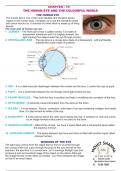
1. CORNEA :- The front part of eye is called cornea. it is made of
transparent substance and it is bulging outward. the
light coming from object enter the eye through cornea.
2. CRYSTALLINE LENS :- The eye lens is a convex lens made of a transparent , soft and flexible
material like a jelly made of proteins.
3. IRIS :- It is a dark muscular diaphragm between the cornea and the lens. it control the size of pupil.
4. PUPIL :- It is a small hole between the iris through which light enters the eye.
5. CILIARY MUSCLES :- They hold the lens in position and help in modifying the curvature of the lens.
6. OPTIC NERVE :- It transmits visual information from the retina to the brain.
7. SCLERA :- It is an opaque , fibrous , protective ,outer layer of an eye containing collagen and elastic
fibre. It is also known as white of the eye.
8. BLIND SPOT :- It is the point at which the optic nerve leaves the eye. It contains no rods and cones ,
so an image formed at this point is not send to the brain.
9. AQUEOUS HUMOUR :- Behind the cornea , we have a space filled with a transparent liquid called
the aqueous humour.
10. VITREOUS HUMOUR :- The space between eye lens and retina is filled with another liquid called
vitreous humour.
WORKING OF THE EYE
The light rays coming from the object kept in front of us enter through
the cornea of the eye ,pass through the pupil of the eye and fall on the
eye-lens. the eye-lens is a convex lens , so it converge thelight rays and
produce a real and inverted image of the object on the retina. Although
the image formed on the retina is inverted , our mind interprets the image
as that of an erect object.
, Q. :- Write the function of iris and pupil in the human eye ?
Ans. The iris controls the amount of light entering the eyes. the iris automatically adjusts the size of the
according to the intensity of light received by the eye.
If the amount of light received by the eye is large ( as during the day time ) , then the iris contracts the
pupil (make the pupil small ) and reduces the amount of light entering the eye.
On the other hand ,if the amount of light received by the eye is small ( as in a dark room or during light)
the iris expands the pupil ( makes the pupil large ) so that more light may enter the eyes.
Thus , the iris regulates ( or controls ) the amount of light entering the eye by changing the size of the
pupil.
Q. :- What are rods and cones in the retina of an eye ?
Ans. The retina of our eye has a large number of light-sensitive cells. There are two kinds of light-
sensitive cells on the retina : rods and cones
Rods Cones
Rods are the rod-shaped cells present in the Cones are the cone-shaped cells present in the
retina of an eye which are sensitive to dim retina of an eye which are sensitive to bright light
light. We can see things to some extent in a ( or normal light ). The cone cells of our retina
dark room due to the presence of rods cells also respond to colours. In other words , cone
in the retina of our eyes. cells cause the sensation of colour of objects in
our eyes.
Example :- Example :-
An owl has very large number of ‘rod’ cells in We can see the various colours in this picture due
the retina of its eyes. these help the owl to to the presence of ‘cone’ cells in the retina of our
see properly even in dim light during the night. eyes.
Q. - Why sometimes when we enter into a dark room from bright sunlight we are unable to see
objects clearly?
Ans. This is because in bright sunshine the pupil of our eye is
small and when we just enter the dim room, very little light enters
our eye due to which we cannot see properly. After a while, when the
pupil of our eye expands, more light enters our eye and we can see
clearly.
THE HUMAN EYE AND THE COLOURFUL WORLD
THE HUMAN EYE
The human eye is one of the most valuable and sensitive sense
organs in the human body. it enables us to see the wonderful world
and colour around us. It consists of a lens which is made up of living
tissues.
The main part of human eye are :
1. CORNEA :- The front part of eye is called cornea. it is made of
transparent substance and it is bulging outward. the
light coming from object enter the eye through cornea.
2. CRYSTALLINE LENS :- The eye lens is a convex lens made of a transparent , soft and flexible
material like a jelly made of proteins.
3. IRIS :- It is a dark muscular diaphragm between the cornea and the lens. it control the size of pupil.
4. PUPIL :- It is a small hole between the iris through which light enters the eye.
5. CILIARY MUSCLES :- They hold the lens in position and help in modifying the curvature of the lens.
6. OPTIC NERVE :- It transmits visual information from the retina to the brain.
7. SCLERA :- It is an opaque , fibrous , protective ,outer layer of an eye containing collagen and elastic
fibre. It is also known as white of the eye.
8. BLIND SPOT :- It is the point at which the optic nerve leaves the eye. It contains no rods and cones ,
so an image formed at this point is not send to the brain.
9. AQUEOUS HUMOUR :- Behind the cornea , we have a space filled with a transparent liquid called
the aqueous humour.
10. VITREOUS HUMOUR :- The space between eye lens and retina is filled with another liquid called
vitreous humour.
WORKING OF THE EYE
The light rays coming from the object kept in front of us enter through
the cornea of the eye ,pass through the pupil of the eye and fall on the
eye-lens. the eye-lens is a convex lens , so it converge thelight rays and
produce a real and inverted image of the object on the retina. Although
the image formed on the retina is inverted , our mind interprets the image
as that of an erect object.
, Q. :- Write the function of iris and pupil in the human eye ?
Ans. The iris controls the amount of light entering the eyes. the iris automatically adjusts the size of the
according to the intensity of light received by the eye.
If the amount of light received by the eye is large ( as during the day time ) , then the iris contracts the
pupil (make the pupil small ) and reduces the amount of light entering the eye.
On the other hand ,if the amount of light received by the eye is small ( as in a dark room or during light)
the iris expands the pupil ( makes the pupil large ) so that more light may enter the eyes.
Thus , the iris regulates ( or controls ) the amount of light entering the eye by changing the size of the
pupil.
Q. :- What are rods and cones in the retina of an eye ?
Ans. The retina of our eye has a large number of light-sensitive cells. There are two kinds of light-
sensitive cells on the retina : rods and cones
Rods Cones
Rods are the rod-shaped cells present in the Cones are the cone-shaped cells present in the
retina of an eye which are sensitive to dim retina of an eye which are sensitive to bright light
light. We can see things to some extent in a ( or normal light ). The cone cells of our retina
dark room due to the presence of rods cells also respond to colours. In other words , cone
in the retina of our eyes. cells cause the sensation of colour of objects in
our eyes.
Example :- Example :-
An owl has very large number of ‘rod’ cells in We can see the various colours in this picture due
the retina of its eyes. these help the owl to to the presence of ‘cone’ cells in the retina of our
see properly even in dim light during the night. eyes.
Q. - Why sometimes when we enter into a dark room from bright sunlight we are unable to see
objects clearly?
Ans. This is because in bright sunshine the pupil of our eye is
small and when we just enter the dim room, very little light enters
our eye due to which we cannot see properly. After a while, when the
pupil of our eye expands, more light enters our eye and we can see
clearly.


