
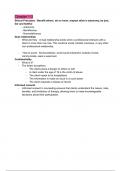
Chapter 1-3
Ethical Principles - Benefit others, do no harm, respect other’s autonomy, be just,
fair and faithful
- Autonomy
- Beneficence
- Nonmaleficence
Dual relationships
- What are they - A dual relationship exists when a professional interacts with a
client in more than one role. This could be social, familial, business, or any other
non-professional relationship.
- How to avoid - Set boundaries, avoid social interaction outside of work,
communicate, seek a supervisor
Confidentiality
- What is it?
- The limits/ exceptions:
- The client poses a danger to others or self
- A client under the age of 16 is the victim of abuse
- The client needs to be hospitalized
- The information is made an issue in a court action
- The client requests a release of record
Informed consent
- Informed consent in counseling ensures that clients understand the nature, risks,
benefits, and limitations of therapy, allowing them to make knowledgeable
decisions about their participation.
, Psychodynamic Chapter 4
Defense mechanisms
- Reaction Formation: Pushing away threatening impulses by overemphasizing the
opposite thoughts or actions.
- Denial: Refusing to acknowledge anxiety-provoking stimuli, keeping them out of
conscious awareness.
- Projection: Attributing one's own anxiety-arousing impulses to others.
- Displacement: Shifting unconscious fears or desires onto a safer target (e.g.,
anger at boss displaced onto family).
- Sublimation: Transforming dangerous urges into positive, socially acceptable
motivations (e.g., redirecting sexual energy into art).
- Regression: Returning to earlier, safer stages of life, especially under stress.
- Rationalization: Offering logical but false explanations for behavior driven by
unconscious motives.
- Repression: Unconsciously blocking out unacceptable thoughts, feelings, or
impulses from awareness.
Erikson stages of human development
1. Trust vs Mistrust (infancy)
a. Virtue: Hope
b. Maldevelopment: Withdrawal
c. Concomitant Freudian stage: oral stage
d. Example: Secure environment provided by the caregiver, with regular
access to affection and food
*Kids who have been neglected in this stage will probably always struggle with trust and
connecting to others
2. Autonomy vs Shame (early childhood)
a. Virtue: Will
b. Maldevelopment: Compulsion
Ethical Principles - Benefit others, do no harm, respect other’s autonomy, be just,
fair and faithful
- Autonomy
- Beneficence
- Nonmaleficence
Dual relationships
- What are they - A dual relationship exists when a professional interacts with a
client in more than one role. This could be social, familial, business, or any other
non-professional relationship.
- How to avoid - Set boundaries, avoid social interaction outside of work,
communicate, seek a supervisor
Confidentiality
- What is it?
- The limits/ exceptions:
- The client poses a danger to others or self
- A client under the age of 16 is the victim of abuse
- The client needs to be hospitalized
- The information is made an issue in a court action
- The client requests a release of record
Informed consent
- Informed consent in counseling ensures that clients understand the nature, risks,
benefits, and limitations of therapy, allowing them to make knowledgeable
decisions about their participation.
, Psychodynamic Chapter 4
Defense mechanisms
- Reaction Formation: Pushing away threatening impulses by overemphasizing the
opposite thoughts or actions.
- Denial: Refusing to acknowledge anxiety-provoking stimuli, keeping them out of
conscious awareness.
- Projection: Attributing one's own anxiety-arousing impulses to others.
- Displacement: Shifting unconscious fears or desires onto a safer target (e.g.,
anger at boss displaced onto family).
- Sublimation: Transforming dangerous urges into positive, socially acceptable
motivations (e.g., redirecting sexual energy into art).
- Regression: Returning to earlier, safer stages of life, especially under stress.
- Rationalization: Offering logical but false explanations for behavior driven by
unconscious motives.
- Repression: Unconsciously blocking out unacceptable thoughts, feelings, or
impulses from awareness.
Erikson stages of human development
1. Trust vs Mistrust (infancy)
a. Virtue: Hope
b. Maldevelopment: Withdrawal
c. Concomitant Freudian stage: oral stage
d. Example: Secure environment provided by the caregiver, with regular
access to affection and food
*Kids who have been neglected in this stage will probably always struggle with trust and
connecting to others
2. Autonomy vs Shame (early childhood)
a. Virtue: Will
b. Maldevelopment: Compulsion

