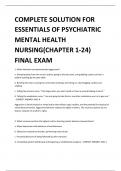
COMPLETE SOLUTION FOR
ESSENTIALS OF PSYCHIATRIC
MENTAL HEALTH
NURSING(CHAPTER 1-24)
FINAL EXAM
1. Which behavior best demonstrates aggression?
a. Stomping away from the nurses' station, going to the day room, and grabbing a pool cue from a
patient standing by the pool table.
b. Bursting into tears, leaving the community meeting, and sitting on a bed hugging a pillow and
sobbing.
c. Telling the primary nurse, "I felt angry when you said I could not have a second helping at lunch."
d. Telling the medication nurse, "I am not going to take that or any other medication you try to give me."
- CORRECT ANSWER -ANS: A
Aggression is harsh physical or verbal action that reflects rage, hostility, and the potential for physical or
verbal destructiveness. Aggressive behavior violates the rights of others. The incorrect options do not
feature violation of another's rights.
2. Which scenario predicts the highest risk for directing violent behavior toward others?
a. Major depression with delusions of worthlessness
b. Obsessive-compulsive disorder; performing many rituals
c. Paranoid delusions of being followed by alien monsters
d. Completing alcohol withdrawal and beginning a rehabilitation program - CORRECT ANSWER -ANS: C
, The correct answer illustrates the greatest disruption of ability to perceive reality accurately. People
who feel persecuted may strike out against those believed to be persecutors. The patients identified in
the distracters have better reality-testing ability.
3. A patient is hospitalized after an arrest for breaking windows in the home of a former domestic
partner. The history reveals childhood abuse by a punitive parent, torturing family pets, and an arrest
for disorderly conduct. Which nursing diagnosis has priority?
a. Risk for injury
b. Posttrauma response
c. Disturbed thought processes
d. Risk for other-directed violence - CORRECT ANSWER -ANS: D
The defining characteristics for Risk for other-directed violence include a history of being abused as a
child, having committed other violent acts, and demonstrating poor impulse control. The defining
characteristics for the other diagnoses are not present in this scenario.
4. A confused older adult patient in a skilled care facility is in bed sleeping. The nurse enters the room
quietly and touches the bed to see if it is wet. The patient awakens and hits the nurse in the face. Which
statement best explains the patient's action?
a. Older adult patients often demonstrate exaggerations of behaviors used earlier in life.
b. Crowding in skilled care facilities increases individual tendencies toward violence.
c. The patient interpreted the health care worker's behavior as potentially harmful.
d. This patient learned violent behavior by watching other patients act out. - CORRECT ANSWER -ANS: C
Confused patients are not always able to evaluate accurately the actions of others. This patient behaved
as though provoked by the intrusive actions of the staff member.
5. A patient is pacing the hall near the nurses' station, swearing loudly. An appropriate initial
intervention for the nurse would be to address the patient by name and say:
a. "Hey, what's going on?"
b. "Please quiet down immediately."
ESSENTIALS OF PSYCHIATRIC
MENTAL HEALTH
NURSING(CHAPTER 1-24)
FINAL EXAM
1. Which behavior best demonstrates aggression?
a. Stomping away from the nurses' station, going to the day room, and grabbing a pool cue from a
patient standing by the pool table.
b. Bursting into tears, leaving the community meeting, and sitting on a bed hugging a pillow and
sobbing.
c. Telling the primary nurse, "I felt angry when you said I could not have a second helping at lunch."
d. Telling the medication nurse, "I am not going to take that or any other medication you try to give me."
- CORRECT ANSWER -ANS: A
Aggression is harsh physical or verbal action that reflects rage, hostility, and the potential for physical or
verbal destructiveness. Aggressive behavior violates the rights of others. The incorrect options do not
feature violation of another's rights.
2. Which scenario predicts the highest risk for directing violent behavior toward others?
a. Major depression with delusions of worthlessness
b. Obsessive-compulsive disorder; performing many rituals
c. Paranoid delusions of being followed by alien monsters
d. Completing alcohol withdrawal and beginning a rehabilitation program - CORRECT ANSWER -ANS: C
, The correct answer illustrates the greatest disruption of ability to perceive reality accurately. People
who feel persecuted may strike out against those believed to be persecutors. The patients identified in
the distracters have better reality-testing ability.
3. A patient is hospitalized after an arrest for breaking windows in the home of a former domestic
partner. The history reveals childhood abuse by a punitive parent, torturing family pets, and an arrest
for disorderly conduct. Which nursing diagnosis has priority?
a. Risk for injury
b. Posttrauma response
c. Disturbed thought processes
d. Risk for other-directed violence - CORRECT ANSWER -ANS: D
The defining characteristics for Risk for other-directed violence include a history of being abused as a
child, having committed other violent acts, and demonstrating poor impulse control. The defining
characteristics for the other diagnoses are not present in this scenario.
4. A confused older adult patient in a skilled care facility is in bed sleeping. The nurse enters the room
quietly and touches the bed to see if it is wet. The patient awakens and hits the nurse in the face. Which
statement best explains the patient's action?
a. Older adult patients often demonstrate exaggerations of behaviors used earlier in life.
b. Crowding in skilled care facilities increases individual tendencies toward violence.
c. The patient interpreted the health care worker's behavior as potentially harmful.
d. This patient learned violent behavior by watching other patients act out. - CORRECT ANSWER -ANS: C
Confused patients are not always able to evaluate accurately the actions of others. This patient behaved
as though provoked by the intrusive actions of the staff member.
5. A patient is pacing the hall near the nurses' station, swearing loudly. An appropriate initial
intervention for the nurse would be to address the patient by name and say:
a. "Hey, what's going on?"
b. "Please quiet down immediately."