

Red Cross Youth
Exam
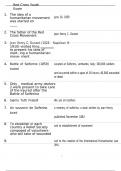
1. The idea of a
humanitarian movement June 24, 1859
was started on
2. The father of the Red
Cross Movement Jean Henry C. Dunant
3. Jean Henry C. Dunant (1828 - Napolean III
1910) visited King
to present his idea of
start- ing a humanitarian
move- ment
4. Battle of Solferino (1859) Located at Solferino, Lombardo, Italy; 300,000 soldiers
involved
and occurred within a span of 16 hours; 40,000 wounded
or dead
5. Only _ medical army doctors
2 were present to take care
of the injured after the
Battle of Solferino
6. Siamo Tutti Fratelli We are all brothers
7. Un souvenir de Solferino a memory of solferino; a book written by jean Henry
dunant
published November 1862
8. To establish in each
country a Relief Society Led to establishment of movement
composed of volunteers
who will take of wounded
9. Led to the creation of the International Humanitarian Law
(IHL)
1/
10
, Red Cross Youth
Exam
To promote an agreement to
protect the wounded and
those who care for them
10. Committee of Five of the Red Gen. Guillame Henri Dutoun (President)
Cross Jean Henry C. Dunant (Secretary) Atty.
Gustave Moynier
Dr. Louis Appia
Dr. Theodore Maunoir
11. International Committee
of the Red Cross (ICRC) -Provides assistance to victims of armed conflict
-Promote the International Humanitarian Law
12. International Federation -Recognizes National Societies
of Red Cross and Red
Crescent Societies (IFRC) -Directs and coordinates international assistance to
13. National Red Cross and victims of natural and technical disasters
Red Crescent Societies -Promotes and supports the development of national
(NS) societies
-Provides assistance to victims of conflict and disaster
14. International -Activities in favor of the most vulnerable
Humanitarian Law (IHL) -Cooperates with ICRC and IFRC
-Renders health services and social activities
-Protects those not participating in hostilities
-Restricts use of weapons and warfare
-Protects human dignity, reduce suttering
-Applies to all parties of a conflict regardless of who started
it and regardless of formal declaration
15. How does the IHL protect? - Distinguishes between fighters and civilians
-Prohibits attacks on civilians; prohibits indiscriminate
attacks
-Requires care for wounded and sick and protects medical
per-
2/
10
Exam
1. The idea of a
humanitarian movement June 24, 1859
was started on
2. The father of the Red
Cross Movement Jean Henry C. Dunant
3. Jean Henry C. Dunant (1828 - Napolean III
1910) visited King
to present his idea of
start- ing a humanitarian
move- ment
4. Battle of Solferino (1859) Located at Solferino, Lombardo, Italy; 300,000 soldiers
involved
and occurred within a span of 16 hours; 40,000 wounded
or dead
5. Only _ medical army doctors
2 were present to take care
of the injured after the
Battle of Solferino
6. Siamo Tutti Fratelli We are all brothers
7. Un souvenir de Solferino a memory of solferino; a book written by jean Henry
dunant
published November 1862
8. To establish in each
country a Relief Society Led to establishment of movement
composed of volunteers
who will take of wounded
9. Led to the creation of the International Humanitarian Law
(IHL)
1/
10
, Red Cross Youth
Exam
To promote an agreement to
protect the wounded and
those who care for them
10. Committee of Five of the Red Gen. Guillame Henri Dutoun (President)
Cross Jean Henry C. Dunant (Secretary) Atty.
Gustave Moynier
Dr. Louis Appia
Dr. Theodore Maunoir
11. International Committee
of the Red Cross (ICRC) -Provides assistance to victims of armed conflict
-Promote the International Humanitarian Law
12. International Federation -Recognizes National Societies
of Red Cross and Red
Crescent Societies (IFRC) -Directs and coordinates international assistance to
13. National Red Cross and victims of natural and technical disasters
Red Crescent Societies -Promotes and supports the development of national
(NS) societies
-Provides assistance to victims of conflict and disaster
14. International -Activities in favor of the most vulnerable
Humanitarian Law (IHL) -Cooperates with ICRC and IFRC
-Renders health services and social activities
-Protects those not participating in hostilities
-Restricts use of weapons and warfare
-Protects human dignity, reduce suttering
-Applies to all parties of a conflict regardless of who started
it and regardless of formal declaration
15. How does the IHL protect? - Distinguishes between fighters and civilians
-Prohibits attacks on civilians; prohibits indiscriminate
attacks
-Requires care for wounded and sick and protects medical
per-
2/
10

