

Topic → Introduction to basic concepts and techniques in the field of management
accounting and control:
• Make + assess calculations on the basis of opportunity costs.
• Describe, explain, and critically reflect on the association between management
accounting, organisational economics, and business administration.
• Distinguish between various categories of control.
• Describe, design, and evaluate modern forms of performance management (i.e.
balanced score-cards).
• Describe and explain the how and why of cost allocation.
• Apply responsibility accounting, budgeting, and transfer pricing to real-life cases and
reflect on such applications.
Written exam about book (excluding chapters 3, 13, and 14) + 10 articles + content of
lectures.
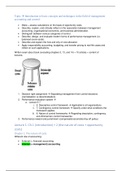
1. Decision right assignment → Separating management from control decisions
(centralisation vs decentralisation)
2. Performance evaluation system →
a. Lecture 5-7.
i. 5: Descriptive control framework → Applicable to all organisations.
ii. 7: Contingency control framework → Specify under what conditions the
framework applies.
iii. 6: Nature of control frameworks → Regarding descriptive, contingency,
and Zimmerman control frameworks.
3. Performance reward and punishment (compensation/promotion/lay-off policy)
Lecture 1: Ch.1 (introduction) + 2 (the nature of costs + opportunity
costs)
Chapter 1: The nature of costs
Different role of accounting:
• External (= financial) accounting
• Internal (= management) accounting
, • Accounting reports are used for multiple purposes.
External report:
• Users
o Shareholders, bondholders, banks, and analysts.
▪ Securities and exchange commission (SEC).
▪ Financial + International accounting standards board (FASB; IASB).
▪ European central bank (ECB).
o Taxing + regulatory authorities.
o Board of directors.
o Suppliers, employees, and other stakeholders.
• Objectives
o Comparability between firms.
o Historical accounting.
o Auditors can verify reports.
Internal report:
• Users → Managers at all levels.
• Objectives
o Useful for decision-making about future activities.
o Measure performance relevant to the firm.
o Focus on projects or processes within a firm.
Why is managerial accounting important?
• Economic Darwinism: Over the long-term, systems survive in competitive markets
when the benefits exceed or equal the cost of maintaining those systems (i.e.
bankruptcies).
o However, there are exceptions:
▪ Bankruptcies
▪ Entrepreneurial stigmata (= you as an entrepreneur may not succeed,
even if you try very hard and are very efficient).
▪ ‘Too big to fail’
• Survival does not imply optimality → Better systems may exist, but have not yet been
discovered.
, o Monopolies, intangibles, government subsidies etc.
• Even though there is a tendency of specialisation in the profession (internal or
external; managerial or financial), the knowledge of both reporting techniques is more
complementary than substitute.
o This shows in the sense that the corporate controller is responsible for both
internal and external accounting reports.
Controller – Main task to identify relevant costs for the firm.
• Tasks:
o Administers internal and external accounting
o Budget planning
o Controls financial data collection and reporting
• Reports to Chief Financial Officer (CFO).
• Has the task of balancing (1) providing information to other managers for decision-
making and (2) providing monitoring information used to control behaviour of lower-
level managers.
Average cost (fallacy) example:
• The average cost per unit at current production volume is usually not an accurate
estimate of the cost per unit at other levels of production.
o This is because average costs contain fixed costs which don’t change with
volume.
▪ Cost per unit may even increase when production volume is near or
above normal operating capacity.
Opportunity cost – Measures what the firm (or an individual) gives up when it chooses a
specific action.
• Example: My decision to study a Bachelor at the university:
o My opportunity costs: €78,000
1. Salary: €2000 (monthly) * 12 * 3 (years) = €72,000
2. Tuition fees: €2000 (yearly) * 3 (years) = €6,000
o With this money, you can also go around the world (i.e.) 3 times.
• If you consider the opportunity costs as a concept, it might help you in making better
decisions.
, Chapter 2: Opportunity costs
Opportunity set – Set of alternative actions available to the decision maker.
Opportunity cost – Benefits given up by choosing one alternative from the opportunity set
(i.e. B) rather than the best non-selected alternative (i.e. A) → The value you give up from
option #2 whenever you have chosen option #1.
• Example:
•
o A is the option you choose because benefits are the greatest ($108,000). The
second best option, B, is your best alternative, and make up your opportunity
costs ($107,000).
o Had you chosen for option B or C, then the opportunity costs are the #1
valued alternative A.
Opportunity costs:
• Include tangible and intangible benefits (i.e. work environment).
• Measured in cash equivalents.
• Rely on estimates of future benefits.
• Useful for decision making.
Accounting expenses:
• Costs consumed to generate revenues.
• Rely on historical costs of resources actually paid.
• Designed to match expenses to revenues.
• Useful for control.
Sunk costs – Costs incurred in the past which can’t be changed (no matter what future
action is taken).
• Totally irrelevant for decision making and excluded from opportunity costs.
o May be useful for control purposes.
• Example in poker: “I have already invested €300,- into this pot, I need to get it back!”
o Reality is that the second the money is in the pot, it’s not yours anymore.
However, this is hard to realise at that moment.
Sarbanes-Oxley Act = Accounting act to counter a lot of big scandals going on, with new
requirements for all U.S. public company boards, accounting firms and management.
• Increased burden to the corporation → Responsibilities for the corporation’s board
with criminal penalties for misconduct, as well as regulations.
o Direct costs of compliance (= expenses for a firm to adhere to regulations)
rose sharp.
o Other costs: Increases in director’s fees and premiums; insurance policies.
• The government estimated the costs and benefits from doing nothing (keep scandals
present) and actively intervening with this act. The latter at the end had higher
benefits.
accounting and control:
• Make + assess calculations on the basis of opportunity costs.
• Describe, explain, and critically reflect on the association between management
accounting, organisational economics, and business administration.
• Distinguish between various categories of control.
• Describe, design, and evaluate modern forms of performance management (i.e.
balanced score-cards).
• Describe and explain the how and why of cost allocation.
• Apply responsibility accounting, budgeting, and transfer pricing to real-life cases and
reflect on such applications.
Written exam about book (excluding chapters 3, 13, and 14) + 10 articles + content of
lectures.
1. Decision right assignment → Separating management from control decisions
(centralisation vs decentralisation)
2. Performance evaluation system →
a. Lecture 5-7.
i. 5: Descriptive control framework → Applicable to all organisations.
ii. 7: Contingency control framework → Specify under what conditions the
framework applies.
iii. 6: Nature of control frameworks → Regarding descriptive, contingency,
and Zimmerman control frameworks.
3. Performance reward and punishment (compensation/promotion/lay-off policy)
Lecture 1: Ch.1 (introduction) + 2 (the nature of costs + opportunity
costs)
Chapter 1: The nature of costs
Different role of accounting:
• External (= financial) accounting
• Internal (= management) accounting
, • Accounting reports are used for multiple purposes.
External report:
• Users
o Shareholders, bondholders, banks, and analysts.
▪ Securities and exchange commission (SEC).
▪ Financial + International accounting standards board (FASB; IASB).
▪ European central bank (ECB).
o Taxing + regulatory authorities.
o Board of directors.
o Suppliers, employees, and other stakeholders.
• Objectives
o Comparability between firms.
o Historical accounting.
o Auditors can verify reports.
Internal report:
• Users → Managers at all levels.
• Objectives
o Useful for decision-making about future activities.
o Measure performance relevant to the firm.
o Focus on projects or processes within a firm.
Why is managerial accounting important?
• Economic Darwinism: Over the long-term, systems survive in competitive markets
when the benefits exceed or equal the cost of maintaining those systems (i.e.
bankruptcies).
o However, there are exceptions:
▪ Bankruptcies
▪ Entrepreneurial stigmata (= you as an entrepreneur may not succeed,
even if you try very hard and are very efficient).
▪ ‘Too big to fail’
• Survival does not imply optimality → Better systems may exist, but have not yet been
discovered.
, o Monopolies, intangibles, government subsidies etc.
• Even though there is a tendency of specialisation in the profession (internal or
external; managerial or financial), the knowledge of both reporting techniques is more
complementary than substitute.
o This shows in the sense that the corporate controller is responsible for both
internal and external accounting reports.
Controller – Main task to identify relevant costs for the firm.
• Tasks:
o Administers internal and external accounting
o Budget planning
o Controls financial data collection and reporting
• Reports to Chief Financial Officer (CFO).
• Has the task of balancing (1) providing information to other managers for decision-
making and (2) providing monitoring information used to control behaviour of lower-
level managers.
Average cost (fallacy) example:
• The average cost per unit at current production volume is usually not an accurate
estimate of the cost per unit at other levels of production.
o This is because average costs contain fixed costs which don’t change with
volume.
▪ Cost per unit may even increase when production volume is near or
above normal operating capacity.
Opportunity cost – Measures what the firm (or an individual) gives up when it chooses a
specific action.
• Example: My decision to study a Bachelor at the university:
o My opportunity costs: €78,000
1. Salary: €2000 (monthly) * 12 * 3 (years) = €72,000
2. Tuition fees: €2000 (yearly) * 3 (years) = €6,000
o With this money, you can also go around the world (i.e.) 3 times.
• If you consider the opportunity costs as a concept, it might help you in making better
decisions.
, Chapter 2: Opportunity costs
Opportunity set – Set of alternative actions available to the decision maker.
Opportunity cost – Benefits given up by choosing one alternative from the opportunity set
(i.e. B) rather than the best non-selected alternative (i.e. A) → The value you give up from
option #2 whenever you have chosen option #1.
• Example:
•
o A is the option you choose because benefits are the greatest ($108,000). The
second best option, B, is your best alternative, and make up your opportunity
costs ($107,000).
o Had you chosen for option B or C, then the opportunity costs are the #1
valued alternative A.
Opportunity costs:
• Include tangible and intangible benefits (i.e. work environment).
• Measured in cash equivalents.
• Rely on estimates of future benefits.
• Useful for decision making.
Accounting expenses:
• Costs consumed to generate revenues.
• Rely on historical costs of resources actually paid.
• Designed to match expenses to revenues.
• Useful for control.
Sunk costs – Costs incurred in the past which can’t be changed (no matter what future
action is taken).
• Totally irrelevant for decision making and excluded from opportunity costs.
o May be useful for control purposes.
• Example in poker: “I have already invested €300,- into this pot, I need to get it back!”
o Reality is that the second the money is in the pot, it’s not yours anymore.
However, this is hard to realise at that moment.
Sarbanes-Oxley Act = Accounting act to counter a lot of big scandals going on, with new
requirements for all U.S. public company boards, accounting firms and management.
• Increased burden to the corporation → Responsibilities for the corporation’s board
with criminal penalties for misconduct, as well as regulations.
o Direct costs of compliance (= expenses for a firm to adhere to regulations)
rose sharp.
o Other costs: Increases in director’s fees and premiums; insurance policies.
• The government estimated the costs and benefits from doing nothing (keep scandals
present) and actively intervening with this act. The latter at the end had higher
benefits.


