

Escrito por estudiantes que aprobaron Inmediatamente disponible después del pago Leer en línea o como PDF ¿Documento equivocado? Cámbialo gratis 4,6 TrustPilot
logo-home
Document preview thumbnail
Vista previa 3 fuera de 16 páginas
Examen

BA 3305 Exam 1 | Questions with Verified Answers

Document preview thumbnail
Vista previa 3 fuera de 16 páginas

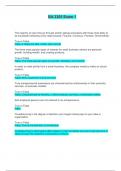
BA 3305 Exam 1 | Questions with Verified Answers The majority of new firms go through similar startup processes with those most likely to be successful following a four-step process: Finance, Construct, Promote, Demonstrate. True or False False; 4 Steps are feel, check, plan and do The three most popular types of rewards for small business owners are personal growth, building wealth, and creating products. True or False False; The most popular types are growth, flexibility, and income. In order to make profits from a small business, the company needs to make an actual product. True or False False; 90% industries involve services Truly entrepreneurial businesses are characterized by imitativeness in their products, services, or business models. True or False False; Characterized by Novelty, in their products, services, or business models Self-employed persons are not referred to as entrepreneurs. True or False False Crowdsourcing is the degree of attention your target market pays to your idea or organization. True or False False; This is the definition of mindshare. Crowdsourcing is techniques often based on Internet-based services to get opinions or ideas through the collective involvement of others. Small business start small but are intended to grow rapidly, often requiring a team of partners. True or False False; High-growth ventures start small but intend to grow rapidly, often requiring a team of partners or managers to handle the growth. Lifestyle or part-time firms typically provide enough profit or salary to supplement an income but usually not enough on which to live. True or False True If you don't succeed the first time, try, try again. This is called the strategy of self-efficacy. True or False False; Called the Strategy of Perseverance High-growth ventures are also known as main street businesses True or False False; Main street businesses include the lifestyle firms, the traditional small businesses, and the high-performing small businesses. Flexibility rewards refer to the money made from owning a business True or False False; Income rewards refer to the money made from owning your own business. Flexibility rewards are the most rapidly growing type of reward. True or False True Using low-cost or free techniques to minimize cost of doing business is referred to as bootstrapping. True or False True Ninety percent of all new businesses fail within two years. True or False False; This is a myth about small-scale businesses. This statement is wrong in two major ways. First, the percentage is wrong. Studies show that 69 percent of businesses are still going after two years, 51 percent are still going at 5 years, 34 percent make it past 10 years and 25 percent survive 15 years. Second, looking at the businesses that close, the vast majority close but don't fail. The most frequently occurring element of the BRIE model is intention. True or False True In the BRIE model, exchange refers to moving resources, goods, or services to others, in exchange for money or other resources. True or False True The disadvantage of the BRIE model is that it does not mention the management of resources. True or False False; In order to start a business, you need four elements to come together—boundary, resources, intention, and exchange. This is referred to as the BRIE model. One of the seven key strategies of the entrepreneurial way involves effectuation or an approach used to create alternatives in uncertain environments. True or False True High-growth ventures and big businesses generally do not succeed without small businesses offering supporting services. True or False True Entrepreneurship levels are very high in efficiency-driven economies. True or False False; Entrepreneurship levels in efficiency-driven economies are in the middle range. The primary focus of corporate entrepreneurship is creating new civic organizations which are financially self-sufficient. True or False False; Social entrepreneurship involves creating new charitable and civic organizations which are financially self-sufficient. The _____ is a U.S. government agency that helps people start a business and also provides them support and advocacy. A. Small Business Administration B. U.S. Department of Business Development C. U.S. Department of Commerce D. U.S. Entrepreneurial Administration Truly entrepreneurial businesses are characterized by: A. the franchise they are associated with. B. the degree to which their products are imitative. C. the novelty in their products, services, or business models. D. the ease with which their product is accepted by the buyers. Truly entrepreneurial businesses are characterized by novelty, in their products, services, or business models. Small businesses are usually: A. imitative in nature. B. characterized by the novelty of their products. C. the same as high-growth ventures. D. not affected by market fluctuations. Small businesses are imitative in nature, with most small firms doing what other firms do, with only slight variations. Which of the following is true of a franchise? A. It is the international term for all small businesses. B. It is a type of novelty organization. C. It is an organization that provides loans to start small businesses. D. It is a prepackaged business bought, rented, or leased from a company. It is a prepackaged business bought, rented, or leased from a company. A person who becomes an owner by inheriting or getting a stake in a family business is known as _____. A. a founder B. a franchisor C. an heir D. a serial entrepreneur Heirs are those who inherit or are given a stake in the family business. A business owned by an individual or a small group is referred to as a(n): A. corporate chain. B. conglomerate. C. concern. D. independent small business. Independent small business is a business owned by an individual or small group. A business run by the individual who owns it is referred to as a(n) _____. A. franchise B. owner-managed firm C. professionally-owned business D. novelty firm A business run by the individual who owns it is referred to as an owner-managed firm. Which of the following is true of a small business? A. Its preferred funding source is other people's money. B. It sells more when it is facing bankruptcy. C. It considers sales as more important than marketing. D. It focuses more on effectiveness than on efficiency. For a small business, sales are more important than marketing. Small businesses differ from high-growth ventures in that in small businesses: A. the focus is on effectiveness rather than efficiency. B. the preferred source of funding is the owner's own money rather than other people's money. C. the delegation of responsibilities is easy and necessary rather than difficult. D. the meta strategy is for novelty rather than imitation. In small businesses, the preferred source of funding is the owner's own money rather than other people's money. High-growth ventures differ from small businesses in that in high-growth ventures: A. the focus is on efficiency rather than effectiveness. B. the preferred source of funding is the owner's own money rather than other people's money. C. the human resource system is personalized rather than professionalized. D. the limitation of growth is dictated by market response rather than the owner's loss of control. According to the text, the definition of a ________ is one that involves 1-56 people and has its owner managing the business on a day-to-day basis. A. franchise B. small business C. unicorn D. high-growth venture Which of the following is true of a high-growth venture? A. It considers sales as more important than marketing. B. Its metastrategy is novelty. C. It focuses more on efficiency than on effectiveness. D. It does not allow for easy delegation of work or responsibilities. A person's belief in his or her ability to achieve a goal is called: A. growth rewards. B. bootstrapping. C. novelty. D. self-efficacy. Which of the following is a difference between a small business and a high-growth venture? A. For a small business, the preferred funding source is other people's money, whereas for a high-growth venture, it is the owner's own money. B. For a small business, the personal control preference is to involve others, whereas a high-growth venture prefers to retain autonomy. C. A small business focuses on effectiveness, whereas a high-growth venture focuses on efficiency. D. A small business grows when necessary, whereas a high-growth venture grows when possible. High-growth ventures: A. use imitation as their metastrategy. B. start small but are intended to grow rapidly. C. cannot include a team of partners. D. do not delegate tasks. Which of the following describes the significance of an overall growth strategy? A. It represents a driver of the variety of entrepreneurship. B. It allows for one small business enterprise to incorporate in multiple states at the same time. C. It provides the owner a stake in the family business. D. It helps buyers to get familiar with new products. Which of the following is a characteristic of a lifestyle firm? A. It starts small and grows very rapidly to become a big business. B. It represents about 20 percent of all businesses. C. It typically has sales of $25,000 a year or less. D. It aims to achieve growth rates of 25 percent or more a year. Which of the following is true of a part-time firm? A. It starts small and stays very small. B. It has a continuous growth. C. Its success is defined by annual profits of $1,000,000. D. It aims to achieve growth rates of 25 percent or more a year. The text defines an entrepreneur as: A. a person who purchases an existing business. B. working for yourself. C. characterized by being different or new. D. a person who owns or starts an organization, such as a business. Which of the following categories does the majority of small businesses fall under? A. High-growth ventures B. High-performing small businesses C. Lifetime/Part-time firms D. Traditional small business _____ are the smallest full-time business. A. High-performing small businesses B. Traditional small businesses C. High-growth ventures D. Lifestyle businesses Which of the following is true of a traditional small business? A. It is usually a multi-site business. B. It generally has sales between $100,000 and $1,000,000 depending on the industry. C. It defines its schedules based on customer needs. D. It follows a continuous growth curve. Which of the following terms is not one of the four steps in the successful entrepreneurial process? A. Seek. B. Do. C. Plan. D. Check. The four steps in the entrepreneurial process are feel, check, plan, and do. Seek is not one of the four steps. Smart entrepreneurs check the likelihood for success of their idea through feasibility analyses or customer development processes, repeating these until they have a winning and saleable idea. This is done during the ______ step of the entrepreneurial process. A. Plan B. Do C. Check D. Feel Which of the following is true of the growth of a typical traditional small business? A. It tends to quickly level off after the owners operate long enough to learn the basics of making money. B. It levels off after operations settle into a consistent, money-making pattern generating income to provide a living for the owner. C. It grows at rates between 5 to 15 percent a year. D. It grows at rates of 25 percent or more a year. _____ tend to level off after success defined by sales of between $100,000 and $1,000,000, depending on the industry. A. Lifestyle firms B. Traditional small businesses C. High-performing small businesses D. High-growth ventures Which of the following is true of a high-performing small business? A. It often grows through multiple locations. B. It aims to achieve growth rates of 25 percent or more a year. C. It has sales of more than $1 million.

Vista previa del contenido

BA 3305 Exam 1


The majority of new firms go through similar startup processes with those most likely to
be successful following a four-step process: Finance, Construct, Promote, Demonstrate.

True or False
False; 4 Steps are feel, check, plan and do

The three most popular types of rewards for small business owners are personal
growth, building wealth, and creating products.

True or False
False; The most popular types are growth, flexibility, and income.

In order to make profits from a small business, the company needs to make an actual
product.

True or False
False; 90% industries involve services

Truly entrepreneurial businesses are characterized by imitativeness in their products,
services, or business models.

True or False
False; Characterized by Novelty, in their products, services, or business models

Self-employed persons are not referred to as entrepreneurs.

True or False
False

Crowdsourcing is the degree of attention your target market pays to your idea or
organization.

True or False
False; This is the definition of mindshare.

Crowdsourcing is techniques often based on Internet-based services to get opinions or
ideas through the collective involvement of others.

,Small business start small but are intended to grow rapidly, often requiring a team of
partners.
True or False

False;
High-growth ventures start small but intend to grow rapidly, often requiring a team of
partners or managers to handle the growth.

Lifestyle or part-time firms typically provide enough profit or salary to supplement an
income but usually not enough on which to live.

True or False
True

If you don't succeed the first time, try, try again. This is called the strategy of self-
efficacy.

True or False
False;

Called the Strategy of Perseverance

High-growth ventures are also known as main street businesses

True or False
False;

Main street businesses include the lifestyle firms, the traditional small businesses, and
the high-performing small businesses.

Flexibility rewards refer to the money made from owning a business

True or False
False;
Income rewards refer to the money made from owning your own business.

Flexibility rewards are the most rapidly growing type of reward.

True or False
True

Using low-cost or free techniques to minimize cost of doing business is referred to as
bootstrapping.

True or False
True

, Ninety percent of all new businesses fail within two years.

True or False
False;

This is a myth about small-scale businesses. This statement is wrong in two major
ways. First, the percentage is wrong. Studies show that 69 percent of businesses are
still going after two years, 51 percent are still going at 5 years, 34 percent make it past
10 years and 25 percent survive 15 years. Second, looking at the businesses that close,
the vast majority close but don't fail.

The most frequently occurring element of the BRIE model is intention.

True or False
True

In the BRIE model, exchange refers to moving resources, goods, or services to others,
in exchange for money or other resources.

True or False
True

The disadvantage of the BRIE model is that it does not mention the management of
resources.

True or False
False;

In order to start a business, you need four elements to come together—boundary,
resources, intention, and exchange. This is referred to as the BRIE model.

One of the seven key strategies of the entrepreneurial way involves effectuation or an
approach used to create alternatives in uncertain environments.

True or False
True

High-growth ventures and big businesses generally do not succeed without small
businesses offering supporting services.

True or False
True

Entrepreneurship levels are very high in efficiency-driven economies.

True or False

Información del documento

Subido en
31 de enero de 2025
Número de páginas
16
Escrito en
2024/2025
Tipo
Examen
Contiene
Preguntas y respuestas
$19.49

¿Documento equivocado? Cámbialo gratis Dentro de los 14 días posteriores a la compra y antes de descargarlo, puedes elegir otro documento. Puedes gastar el importe de nuevo.
Escrito por estudiantes que aprobaron
Inmediatamente disponible después del pago
Leer en línea o como PDF

Seller avatar
Los indicadores de reputación están sujetos a la cantidad de artículos vendidos por una tarifa y las reseñas que ha recibido por esos documentos. Hay tres niveles: Bronce, Plata y Oro. Cuanto mayor reputación, más podrás confiar en la calidad del trabajo del vendedor.
Jumuja
3.9
(121)
Vendido
589
Seguidores
417
Artículos
2856
Última venta
3 días hace


Por qué los estudiantes eligen Stuvia

Creado por compañeros estudiantes, verificado por reseñas

Calidad en la que puedes confiar: escrito por estudiantes que aprobaron y evaluado por otros que han usado estos resúmenes.

¿No estás satisfecho? Elige otro documento

¡No te preocupes! Puedes elegir directamente otro documento que se ajuste mejor a lo que buscas.

Paga como quieras, empieza a estudiar al instante

Sin suscripción, sin compromisos. Paga como estés acostumbrado con tarjeta de crédito y descarga tu documento PDF inmediatamente.

Student with book image

“Comprado, descargado y aprobado. Así de fácil puede ser.”

Alisha Student

Preguntas frecuentes