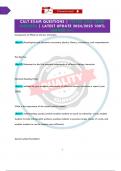
CALT EXAM QUESTIONS | TESTED AND TRIED
ANSWERS | LATEST UPDATE 2024/2025 100%
(GRADE A+)
Components of Effective Literacy Instruction
Ans>> phonological and phonemic awareness, phonics, fluency, vocabulary, and comprehension
The Big Five
Ans>> Nickname for the five essential components of effective literacy instruction
National Reading Panel
Ans>> outlined the give essential components of effective literacy instruction in report (year
2000)
What is the importance of the sound/symbol system?
Ans>> understanding sounds/symbols enables students to sound out unfamiliar words, enables
students to build orthographic patterns, enables students to perceive larger chunks of words, and
enables students to use the context more efficiently
Sound/symbol foundation
1
,Ans>> phonemic awareness and instant letter recognition
Alphabetic Principle
Ans>> a phoneme is represented by a grapheme
phoneme
Ans>> smallest unit of sound in a word which effects meaning
grapheme
Ans>> letter or group of letters used to represent one sound
Reading and Written Expressive Language
Ans>> the two components of Literacy Instruction
Decoding and Comprehension
Ans>> the two components of reading
Mechanics and Composition/Creativity
2
,Ans>> the two components of Written Expressive Language
Opportunities and Direct Instruction
Ans>> the two components of instruction
Decoding
Ans>> instant word recognition, phonemic awareness, sound/symbol association (instant letter
recognition), structural analysis, context
Listening Comprehension
Ans>> oral language (most important!), world knowledge, strategic thinking, inference making
Fluency
Ans>> bridge between decoding and comprehension
Comprehension
Ans>> the ultimate goal of reading
3
, Instant Word Recognition
Ans>> acquired through repeated exposure to the word and from over learning the patterns of
language
Mechanics
Ans>> sentence structure, paragraph structure, spelling, handwriting (writer should be
comfortable with spelling and handwriting)
composition/creativity
Ans>> oral language, world knowledge, strategic thinking, inference making
Direct instruction components
Ans>> Multisensory teaching and discovery teaching
Domains of language
Ans>> phonology, pragmatics, orthography, semantics, syntax, morphology
Interactive components of language
4
ANSWERS | LATEST UPDATE 2024/2025 100%
(GRADE A+)
Components of Effective Literacy Instruction
Ans>> phonological and phonemic awareness, phonics, fluency, vocabulary, and comprehension
The Big Five
Ans>> Nickname for the five essential components of effective literacy instruction
National Reading Panel
Ans>> outlined the give essential components of effective literacy instruction in report (year
2000)
What is the importance of the sound/symbol system?
Ans>> understanding sounds/symbols enables students to sound out unfamiliar words, enables
students to build orthographic patterns, enables students to perceive larger chunks of words, and
enables students to use the context more efficiently
Sound/symbol foundation
1
,Ans>> phonemic awareness and instant letter recognition
Alphabetic Principle
Ans>> a phoneme is represented by a grapheme
phoneme
Ans>> smallest unit of sound in a word which effects meaning
grapheme
Ans>> letter or group of letters used to represent one sound
Reading and Written Expressive Language
Ans>> the two components of Literacy Instruction
Decoding and Comprehension
Ans>> the two components of reading
Mechanics and Composition/Creativity
2
,Ans>> the two components of Written Expressive Language
Opportunities and Direct Instruction
Ans>> the two components of instruction
Decoding
Ans>> instant word recognition, phonemic awareness, sound/symbol association (instant letter
recognition), structural analysis, context
Listening Comprehension
Ans>> oral language (most important!), world knowledge, strategic thinking, inference making
Fluency
Ans>> bridge between decoding and comprehension
Comprehension
Ans>> the ultimate goal of reading
3
, Instant Word Recognition
Ans>> acquired through repeated exposure to the word and from over learning the patterns of
language
Mechanics
Ans>> sentence structure, paragraph structure, spelling, handwriting (writer should be
comfortable with spelling and handwriting)
composition/creativity
Ans>> oral language, world knowledge, strategic thinking, inference making
Direct instruction components
Ans>> Multisensory teaching and discovery teaching
Domains of language
Ans>> phonology, pragmatics, orthography, semantics, syntax, morphology
Interactive components of language
4