NC BLET Domestic Violence Test Questions with Verified Answers
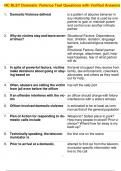
1. Domestic Violence defined is a pattern of abusive behavior in
any relationship that is used by one
partner to gain or maintain power
and control over another intimate
partner
2. Why do victims stay and leave sever- Situational Factors: Dependence,
al times? fear, children, isolation, language
barriers, cultural/religious restraints,
age
Emotional Factors: Belief partner
will change, attachment, guilt, help-
less/hopeless, fear of what partner
will do
3. In spite of powerful factors, victims the level of support they receive from
make decisions about going or stay- family, law enforcement, coworkers,
ing based on advocates, and others as they reach
out for help.
4. Often, abusers are calling the victim has left the sally port
from jail even before the officer
5. If an offender interferes with the vic- an officer should charge with felony
tim interference with a state's witness
6. Officer-involved domestic violence is estimated to be at least as com-
mon as that of the general population
7. Plan of Action for responding to do- Weapons? Safest place to park?
mestic calls include How many people involved? Prior vi-
olence? Where/how far away is my
back-up?
8. Technically speaking, the telecom- the first one on the scene
municator is
9. Prior to arrival at a domestic, attempt to find out from the telecom-
municator specific information rela-
tive to the call
1/7
, NC BLET Domestic Violence Test Questions with Verified Answers
10. When responding to a domestic, you don't pass the residence; park your
must make a tactical approach which patrol vehicle where it will least likely
includes be seen; don't slam the door; tactical
approach on foot.
11. At all points during a domestic call you are assessing the situation
12. Time lag between a complaint and is 5-10 minutes, and the disturbance
when the first officer arrives continues, often intensifying, some-
times resulting in a shooting before
the first officer arrives.
13. 41% of officers killed during domes- arrival/approach phase; many of
tics were killed in the which were ambushes
14. The Cover officer's two primary roles Observe suspect(s) and protect the
Contact Officer
15. Contact officer Initiates ALL activity, conducts inter-
views, takes notes, conducts radio
transmissions, initiates arrest proce-
dures
16. Position the Cover officer and Con- Triangulation position
tact officer should be in with the sus-
pect
17. When approaching front door, uti- good initial contact procedures
lize contact and cover tactics; listen
before you knock; don't "knock like
a cop"; have someone inside open
door for you;
all of these are
18. The officer furthest inside the resi- good tactical departure procedures
dence should leave first; no parting
remarks such as "if I have to come
back I'll arrest you"; listen as you
walk away; watch your back as you
2/7
1. Domestic Violence defined is a pattern of abusive behavior in
any relationship that is used by one
partner to gain or maintain power
and control over another intimate
partner
2. Why do victims stay and leave sever- Situational Factors: Dependence,
al times? fear, children, isolation, language
barriers, cultural/religious restraints,
age
Emotional Factors: Belief partner
will change, attachment, guilt, help-
less/hopeless, fear of what partner
will do
3. In spite of powerful factors, victims the level of support they receive from
make decisions about going or stay- family, law enforcement, coworkers,
ing based on advocates, and others as they reach
out for help.
4. Often, abusers are calling the victim has left the sally port
from jail even before the officer
5. If an offender interferes with the vic- an officer should charge with felony
tim interference with a state's witness
6. Officer-involved domestic violence is estimated to be at least as com-
mon as that of the general population
7. Plan of Action for responding to do- Weapons? Safest place to park?
mestic calls include How many people involved? Prior vi-
olence? Where/how far away is my
back-up?
8. Technically speaking, the telecom- the first one on the scene
municator is
9. Prior to arrival at a domestic, attempt to find out from the telecom-
municator specific information rela-
tive to the call
1/7
, NC BLET Domestic Violence Test Questions with Verified Answers
10. When responding to a domestic, you don't pass the residence; park your
must make a tactical approach which patrol vehicle where it will least likely
includes be seen; don't slam the door; tactical
approach on foot.
11. At all points during a domestic call you are assessing the situation
12. Time lag between a complaint and is 5-10 minutes, and the disturbance
when the first officer arrives continues, often intensifying, some-
times resulting in a shooting before
the first officer arrives.
13. 41% of officers killed during domes- arrival/approach phase; many of
tics were killed in the which were ambushes
14. The Cover officer's two primary roles Observe suspect(s) and protect the
Contact Officer
15. Contact officer Initiates ALL activity, conducts inter-
views, takes notes, conducts radio
transmissions, initiates arrest proce-
dures
16. Position the Cover officer and Con- Triangulation position
tact officer should be in with the sus-
pect
17. When approaching front door, uti- good initial contact procedures
lize contact and cover tactics; listen
before you knock; don't "knock like
a cop"; have someone inside open
door for you;
all of these are
18. The officer furthest inside the resi- good tactical departure procedures
dence should leave first; no parting
remarks such as "if I have to come
back I'll arrest you"; listen as you
walk away; watch your back as you
2/7