
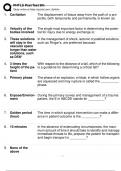
PHTLS Post Test 9th
Study online at https://quizlet.com/_9yhbhx
1. Cavitation The displacement of tissue away from the path of a pro-
jectile, both temporarily and permanently, is known as:
2. Velocity of the The single most important factor in determining the poten-
bodies involved tial for injury due to energy exchange is:
3. These solutions In the management of shock, isotonic crystalloid solutions,
will stay in the such as Ringer's, are preferred because:
vascular space
longer than water
solutions, such
as D5W
4. 3 times the With respect to the distance of a fall, which of the following
height of the pa- is a guideline for determining a critical fall?
tient
5. Primary phase The phase of an explosion, or blast, in which hollow organs
are squeezed and may rupture is called the __________
phase.
6. Expose/Environ- During the primary survey and management of a trauma
ment patient, the E in ABCDE stands for _________?
7. Golden period The time in which surgical intervention can make a differ-
(hour) ence in patient outcome is the __________?
8. 10 minutes In the absence of extenuating circumstances, the maxi-
mum amount of time it should take to identify and manage
immediate threats to life, prepare the patient for transport
and begin transport is _________?
9. None of the
above
, PHTLS Post Test 9th
Study online at https://quizlet.com/_9yhbhx
In which of the following situations is the use of a short
spinal immobilization device indicated?
10. Prior to being re- Your patient is a 32 year old man, restrained driver of a
moved from the vehicle that has been involved in a frontal impact with a
vehicle concrete bridge abutment. The patient is awake, but has
difficulty answering questions due to shortness of breath.
His ventilatory rate is 30 per minute. Of the following
choices, when is the first time the patient's breath sounds
should be checked?
11. Tidal volume 600 Which of the following represents adequate spontaneous
mL, ventilatory ventilation in an adult?
rate 12/minute
12. None of the Which of the following is 100% accurate in verifying endo-
above tracheal tube placement?
13. 1:4 When utilizing percutaneous transtracheal ventilation, the
correct ration of lung inflation to lung inflation time, in
seconds, is:
14. All of the above Which of the following is a possible complication of using
a manually triggered oxygen powered device for ventila-
tion?
15. Insertion of Which of the following procedures is considered an essen-
an oropharyn- tial airway
geal airway
16. Stab wound to Pericardial tamponade is most likely to occur in which of
the chest the following situations?
17.
Study online at https://quizlet.com/_9yhbhx
1. Cavitation The displacement of tissue away from the path of a pro-
jectile, both temporarily and permanently, is known as:
2. Velocity of the The single most important factor in determining the poten-
bodies involved tial for injury due to energy exchange is:
3. These solutions In the management of shock, isotonic crystalloid solutions,
will stay in the such as Ringer's, are preferred because:
vascular space
longer than water
solutions, such
as D5W
4. 3 times the With respect to the distance of a fall, which of the following
height of the pa- is a guideline for determining a critical fall?
tient
5. Primary phase The phase of an explosion, or blast, in which hollow organs
are squeezed and may rupture is called the __________
phase.
6. Expose/Environ- During the primary survey and management of a trauma
ment patient, the E in ABCDE stands for _________?
7. Golden period The time in which surgical intervention can make a differ-
(hour) ence in patient outcome is the __________?
8. 10 minutes In the absence of extenuating circumstances, the maxi-
mum amount of time it should take to identify and manage
immediate threats to life, prepare the patient for transport
and begin transport is _________?
9. None of the
above
, PHTLS Post Test 9th
Study online at https://quizlet.com/_9yhbhx
In which of the following situations is the use of a short
spinal immobilization device indicated?
10. Prior to being re- Your patient is a 32 year old man, restrained driver of a
moved from the vehicle that has been involved in a frontal impact with a
vehicle concrete bridge abutment. The patient is awake, but has
difficulty answering questions due to shortness of breath.
His ventilatory rate is 30 per minute. Of the following
choices, when is the first time the patient's breath sounds
should be checked?
11. Tidal volume 600 Which of the following represents adequate spontaneous
mL, ventilatory ventilation in an adult?
rate 12/minute
12. None of the Which of the following is 100% accurate in verifying endo-
above tracheal tube placement?
13. 1:4 When utilizing percutaneous transtracheal ventilation, the
correct ration of lung inflation to lung inflation time, in
seconds, is:
14. All of the above Which of the following is a possible complication of using
a manually triggered oxygen powered device for ventila-
tion?
15. Insertion of Which of the following procedures is considered an essen-
an oropharyn- tial airway
geal airway
16. Stab wound to Pericardial tamponade is most likely to occur in which of
the chest the following situations?
17.

