1
The Natural Exponential Function
Since 𝑓(𝑥) = ln 𝑥 is a strictly increasing function (if 𝑥2 > 𝑥1 , then 𝑓(𝑥2 ) > 𝑓(𝑥1 ))
it is one-to-one and hence has an inverse function. We call that function
𝑓 −1 (𝑥) = exp(𝑥) or 𝑒 𝑥 .
Because exp(𝑥) is the inverse function of 𝑓(𝑥) = ln 𝑥, we have:
exp(𝑥 ) = 𝑦 ⇔ ln 𝑦 = 𝑥
𝑥
𝑒 =𝑦 ⇔ ln 𝑦 = 𝑥
𝑓(𝑥 ) = ln 𝑥 ⇔ 𝑓 −1 (𝑥 ) = exp(𝑥 ) = 𝑒 𝑥
𝑓(𝑓 −1 (𝑥 )) = 𝑓(exp(𝑥 )) = ln(exp(𝑥 )) = 𝑥
𝑓 −1 (𝑓 (𝑥 )) = 𝑓 −1 (ln 𝑥 ) = exp(ln 𝑥 ) = 𝑥.
When we use the notation exp(𝑥 ) = 𝑒 𝑥 we can write:
ln(𝑒 𝑥 ) = 𝑥
𝑒 (ln 𝑥) = 𝑥.
Since 𝑓 (𝑥 ) = ln 𝑥 and 𝑓 −1 (𝑥 ) = 𝑒 𝑥 are inverse functions, we have:
Domain Range
𝑓(𝑥 ) = ln 𝑥 𝑥>0 𝑦∈ℝ
𝑓 −1 (𝑥 ) = 𝑒 𝑥 𝑥∈ℝ 𝑦>0
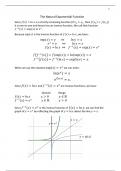
Since 𝑓 −1 (𝑥 ) = 𝑒 𝑥 is the inverse function of 𝑓 (𝑥 ) = ln 𝑥, we can find the
graph of 𝑦 = 𝑒 𝑥 by reflecting the graph of 𝑦 = ln 𝑥 about the line 𝑦 = 𝑥.
𝑦=𝑥
𝑥
𝑦=𝑒
𝑦 = ln(𝑥)
, 2
Notice that:
lim 𝑒 𝑥 = ∞ , lim 𝑒 𝑥 = 0.
𝑥→∞ 𝑥→−∞
Since 𝑥 = 0 is a vertical asymptote for 𝑦 = ln 𝑥 , 𝑦 = 0 is a horizontal asymptote
of 𝑦 = 𝑒 𝑥 .
The relationships 𝑒 ln 𝑥 = 𝑥 and ln(𝑒 𝑥 ) = 𝑥 can be very useful to solve certain
kinds of equations.
Ex. Solve for 𝑥.
a) 𝑒 2𝑥−3 = 8
b) ln(𝑥 + 1) + ln(𝑥 − 1) = 7.
a) 𝑒 2𝑥−3 = 8
ln(𝑒 (2𝑥−3) ) = ln 8
2𝑥 − 3 = ln 8
2𝑥 = 3 + ln 8
1
𝑥 = (3 + ln 8)
2
b) ln(𝑥 + 1) + ln(𝑥 − 1) = 7
ln[(𝑥 + 1)(𝑥 − 1)] = 7
ln(𝑥 2 − 1) = 7
2
𝑒 ln(𝑥 −1) = 𝑒 7
𝑥2 − 1 = 𝑒7
𝑥2 = 𝑒7 + 1
𝑥 = ±√𝑒 7 + 1
Only 𝑥 = √𝑒 7 − 1 solves the equation as 𝑥 − 1 = −√𝑒 7 − 1 − 1 < 0, because
we can’t take the ln(𝑥 − 1) if 𝑥 − 1 < 0.
The Natural Exponential Function
Since 𝑓(𝑥) = ln 𝑥 is a strictly increasing function (if 𝑥2 > 𝑥1 , then 𝑓(𝑥2 ) > 𝑓(𝑥1 ))
it is one-to-one and hence has an inverse function. We call that function
𝑓 −1 (𝑥) = exp(𝑥) or 𝑒 𝑥 .
Because exp(𝑥) is the inverse function of 𝑓(𝑥) = ln 𝑥, we have:
exp(𝑥 ) = 𝑦 ⇔ ln 𝑦 = 𝑥
𝑥
𝑒 =𝑦 ⇔ ln 𝑦 = 𝑥
𝑓(𝑥 ) = ln 𝑥 ⇔ 𝑓 −1 (𝑥 ) = exp(𝑥 ) = 𝑒 𝑥
𝑓(𝑓 −1 (𝑥 )) = 𝑓(exp(𝑥 )) = ln(exp(𝑥 )) = 𝑥
𝑓 −1 (𝑓 (𝑥 )) = 𝑓 −1 (ln 𝑥 ) = exp(ln 𝑥 ) = 𝑥.
When we use the notation exp(𝑥 ) = 𝑒 𝑥 we can write:
ln(𝑒 𝑥 ) = 𝑥
𝑒 (ln 𝑥) = 𝑥.
Since 𝑓 (𝑥 ) = ln 𝑥 and 𝑓 −1 (𝑥 ) = 𝑒 𝑥 are inverse functions, we have:
Domain Range
𝑓(𝑥 ) = ln 𝑥 𝑥>0 𝑦∈ℝ
𝑓 −1 (𝑥 ) = 𝑒 𝑥 𝑥∈ℝ 𝑦>0
Since 𝑓 −1 (𝑥 ) = 𝑒 𝑥 is the inverse function of 𝑓 (𝑥 ) = ln 𝑥, we can find the
graph of 𝑦 = 𝑒 𝑥 by reflecting the graph of 𝑦 = ln 𝑥 about the line 𝑦 = 𝑥.
𝑦=𝑥
𝑥
𝑦=𝑒
𝑦 = ln(𝑥)
, 2
Notice that:
lim 𝑒 𝑥 = ∞ , lim 𝑒 𝑥 = 0.
𝑥→∞ 𝑥→−∞
Since 𝑥 = 0 is a vertical asymptote for 𝑦 = ln 𝑥 , 𝑦 = 0 is a horizontal asymptote
of 𝑦 = 𝑒 𝑥 .
The relationships 𝑒 ln 𝑥 = 𝑥 and ln(𝑒 𝑥 ) = 𝑥 can be very useful to solve certain
kinds of equations.
Ex. Solve for 𝑥.
a) 𝑒 2𝑥−3 = 8
b) ln(𝑥 + 1) + ln(𝑥 − 1) = 7.
a) 𝑒 2𝑥−3 = 8
ln(𝑒 (2𝑥−3) ) = ln 8
2𝑥 − 3 = ln 8
2𝑥 = 3 + ln 8
1
𝑥 = (3 + ln 8)
2
b) ln(𝑥 + 1) + ln(𝑥 − 1) = 7
ln[(𝑥 + 1)(𝑥 − 1)] = 7
ln(𝑥 2 − 1) = 7
2
𝑒 ln(𝑥 −1) = 𝑒 7
𝑥2 − 1 = 𝑒7
𝑥2 = 𝑒7 + 1
𝑥 = ±√𝑒 7 + 1
Only 𝑥 = √𝑒 7 − 1 solves the equation as 𝑥 − 1 = −√𝑒 7 − 1 − 1 < 0, because
we can’t take the ln(𝑥 − 1) if 𝑥 − 1 < 0.