1
Volumes: Cylindrical Shells
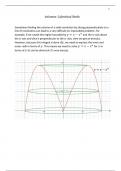
Sometimes finding the volume of a solid revolution by slicing perpendicularly to a
line of revolutions can lead to a very difficult (or impossible) problem. For
example, if we rotate the region bounded by 𝑦 = 𝑥 − 𝑥 4 and the 𝑥 -axis about
the 𝑦-axis and slice it perpendicular to the 𝑦-axis, then we get an annulus.
However, because this integral is done 𝑑𝑦, we need to express the inner and
outer radii in terms of 𝑦. This means we need to solve 𝑦 = 𝑥 − 𝑥 4 for 𝑥 in
terms of 𝑦 (it can be done but it’s very messy).
𝑦 = 𝑥 − 𝑥4
𝑥
, 2
But what happens if we slice the region being rotated with a line parallel to the
line of revolution and then rotate that line? The result will be a cylinder instead of
a disk or annulus. So the “cross-sectional” area will be the lateral surface area (not
including the disks on the top and the bottom of the cylinder). The formula for the
lateral surface area of a cylinder is
𝐴 = 2𝜋𝑟ℎ.
ℎ
𝑟
Thus, in each problem we have to find 𝑟 and ℎ in terms of 𝑥 if we are slicing
parallel to the 𝑦-axis and in terms of 𝑦 if we are slicing parallel to the 𝑥 -axis.
As before:
𝒙=𝒃 𝒚=𝒅
𝑽=∫ 𝟐𝝅𝒓𝒉 𝒅𝒙 𝐨𝐫 𝑽=∫ 𝟐𝝅𝒓𝒉 𝒅𝒚
𝒙=𝒂 𝒚=𝒄
This method is called the method of cylindrical shells.
Volumes: Cylindrical Shells
Sometimes finding the volume of a solid revolution by slicing perpendicularly to a
line of revolutions can lead to a very difficult (or impossible) problem. For
example, if we rotate the region bounded by 𝑦 = 𝑥 − 𝑥 4 and the 𝑥 -axis about
the 𝑦-axis and slice it perpendicular to the 𝑦-axis, then we get an annulus.
However, because this integral is done 𝑑𝑦, we need to express the inner and
outer radii in terms of 𝑦. This means we need to solve 𝑦 = 𝑥 − 𝑥 4 for 𝑥 in
terms of 𝑦 (it can be done but it’s very messy).
𝑦 = 𝑥 − 𝑥4
𝑥
, 2
But what happens if we slice the region being rotated with a line parallel to the
line of revolution and then rotate that line? The result will be a cylinder instead of
a disk or annulus. So the “cross-sectional” area will be the lateral surface area (not
including the disks on the top and the bottom of the cylinder). The formula for the
lateral surface area of a cylinder is
𝐴 = 2𝜋𝑟ℎ.
ℎ
𝑟
Thus, in each problem we have to find 𝑟 and ℎ in terms of 𝑥 if we are slicing
parallel to the 𝑦-axis and in terms of 𝑦 if we are slicing parallel to the 𝑥 -axis.
As before:
𝒙=𝒃 𝒚=𝒅
𝑽=∫ 𝟐𝝅𝒓𝒉 𝒅𝒙 𝐨𝐫 𝑽=∫ 𝟐𝝅𝒓𝒉 𝒅𝒚
𝒙=𝒂 𝒚=𝒄
This method is called the method of cylindrical shells.