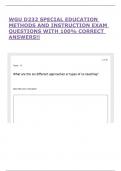
WGU D232 SPECIAL EDUCATION
METHODS AND INSTRUCTION EXAM
QUESTIONS WITH 100% CORRECT
ANSWERS!!
,station teaching. Students are divided into three or more groups. Each
teacher delivers part of the lesson at the station. Independent work occurs
in third station. Students rotate through all the stations so both teachers
work with every student in the class.
parallel teaching. Students are divided into two groups and each teacher
works with a group sometimes the teacher to identical work, such as test
and review, and sometimes they present instruction in two different ways,
for example, using content a different reading levels or offering different
ways to learn multiplication.
Alternative teaching. Smoke student remain with one teacher while the
other teacher instructs a small group for Re-teaching, enrichment,
assessment, pre-teaching, or another purpose.
Teaming. Students remain in a single group and the teachers: co-instruct,
integrating their contributions throughout the lesson.
One teach, one assist. Students remain in a single group. One teacher
Leeds instruction as the other briefly interact with students individually,
answering the questions, reach them and concepts, focusing attention, and
so on.
One teach, one observe. One teacher leads instruction while the other
gather is observational data on one student, a group of students, or the
entire class.
,Here are the four key components of explicit instruction:
1. Clear and Focused Modeling:
Explicitly stating learning objectives: Clearly articulate the specific knowledge or
skills students will acquire by the end of the lesson.
Demonstrating or modeling: Provide clear and concise demonstrations of the
skill or concept being taught, breaking it down into manageable steps and using
visuals or examples to enhance understanding.
Think-alouds: Verbalize your thought processes as you model, making thinking
visible and helping students grasp the reasoning behind steps or strategies.
2. Guided Practice with Scaffolding:
Structured practice opportunities: Offer students multiple chances to practice
the skill or apply the concept under teacher guidance and support.
Scaffolding: Adjust the level of support based on individual needs, gradually
withdrawing as students demonstrate mastery.
Feedback and error correction: Provide immediate and specific feedback,
identifying mistakes and guiding students towards correct responses. This helps
prevent the reinforcement of errors.
3. Frequent Checking for Understanding:
Questioning techniques: Consistently check for understanding using a variety of
questioning techniques, including open-ended, probing, and clarifying
questions.
Informal assessments: Use observation, quizzes, exit tickets, or other informal
assessments to gauge student comprehension and identify areas for further
instruction.
Reteaching and differentiation: Reassess and adapt instruction based on student
understanding, providing additional practice or differentiation for those who
need it.
4. Independent Practice and Application:
Gradual release of responsibility: Shift from guided to independent practice as
students demonstrate proficiency.
Varied opportunities for application: Provide diverse opportunities for studen
, 1. Progress monitoring is conducted in all tiers of instruction
2. Progress monitoring measures are based on and directly relevant to the
curriculum, as well as the grade level and tier level of response to intervention
3. In order to facilitate data collection measures must be easy to administer and
effective
4. Results should be displayed in a manner that makes interpretation simple and
efficient, for example, in charts or line graphs
5. Rules for decision-making must be determined for all aspects of progress
monitoring data, including cut scores for level or performance score, slope or
change in performance overtime, and percentage of mastery
6. Cut scores in decision rules must have a clear rationale
7. Progress monitoring measures must be collected frequently enough to
informed instructional and placement decisions. Frequency of administration may
differ across different tiers, and guidelines for these should be specified.
8. Results of progress monitoring, although important should be considered only
one of several sources that inform instructional decision making
1. Validated Intervention Program:
This step involves selecting an evidence-based intervention program that has
been proven effective for students with similar needs. The program should be
aligned with the identified learning gaps or challenges.
2. Progress Monitoring:
Regular and systematic assessment is crucial to track student progress and the
effectiveness of the chosen intervention. This allows for data-driven adjustments
and decisions about the next steps.
3. Diagnostic Data:
In-depth data collection beyond standard assessments helps pinpoint specific
areas of difficulty and understand the underlying reasons for student struggles.
This may involve diagnostic tests, error analysis, or observations.
4. Adaptation to Validated Intervention:
Based on the progress monitoring data and diagnostic information, the chosen
intervention program may be adapted to meet the specific needs of the
individual student. This could involve adjusting the difficulty level,changing the
delivery method, or incorporating additional supports.
5. Continued Progress Monitoring:
Ongoing monitoring remains essential to ensure the adapted intervention is
effective and continues to meet the student's needs. Data from this step informs
further adjustments or decisions about moving to different tiers of support or
ending the intervention.
Don't know?
METHODS AND INSTRUCTION EXAM
QUESTIONS WITH 100% CORRECT
ANSWERS!!
,station teaching. Students are divided into three or more groups. Each
teacher delivers part of the lesson at the station. Independent work occurs
in third station. Students rotate through all the stations so both teachers
work with every student in the class.
parallel teaching. Students are divided into two groups and each teacher
works with a group sometimes the teacher to identical work, such as test
and review, and sometimes they present instruction in two different ways,
for example, using content a different reading levels or offering different
ways to learn multiplication.
Alternative teaching. Smoke student remain with one teacher while the
other teacher instructs a small group for Re-teaching, enrichment,
assessment, pre-teaching, or another purpose.
Teaming. Students remain in a single group and the teachers: co-instruct,
integrating their contributions throughout the lesson.
One teach, one assist. Students remain in a single group. One teacher
Leeds instruction as the other briefly interact with students individually,
answering the questions, reach them and concepts, focusing attention, and
so on.
One teach, one observe. One teacher leads instruction while the other
gather is observational data on one student, a group of students, or the
entire class.
,Here are the four key components of explicit instruction:
1. Clear and Focused Modeling:
Explicitly stating learning objectives: Clearly articulate the specific knowledge or
skills students will acquire by the end of the lesson.
Demonstrating or modeling: Provide clear and concise demonstrations of the
skill or concept being taught, breaking it down into manageable steps and using
visuals or examples to enhance understanding.
Think-alouds: Verbalize your thought processes as you model, making thinking
visible and helping students grasp the reasoning behind steps or strategies.
2. Guided Practice with Scaffolding:
Structured practice opportunities: Offer students multiple chances to practice
the skill or apply the concept under teacher guidance and support.
Scaffolding: Adjust the level of support based on individual needs, gradually
withdrawing as students demonstrate mastery.
Feedback and error correction: Provide immediate and specific feedback,
identifying mistakes and guiding students towards correct responses. This helps
prevent the reinforcement of errors.
3. Frequent Checking for Understanding:
Questioning techniques: Consistently check for understanding using a variety of
questioning techniques, including open-ended, probing, and clarifying
questions.
Informal assessments: Use observation, quizzes, exit tickets, or other informal
assessments to gauge student comprehension and identify areas for further
instruction.
Reteaching and differentiation: Reassess and adapt instruction based on student
understanding, providing additional practice or differentiation for those who
need it.
4. Independent Practice and Application:
Gradual release of responsibility: Shift from guided to independent practice as
students demonstrate proficiency.
Varied opportunities for application: Provide diverse opportunities for studen
, 1. Progress monitoring is conducted in all tiers of instruction
2. Progress monitoring measures are based on and directly relevant to the
curriculum, as well as the grade level and tier level of response to intervention
3. In order to facilitate data collection measures must be easy to administer and
effective
4. Results should be displayed in a manner that makes interpretation simple and
efficient, for example, in charts or line graphs
5. Rules for decision-making must be determined for all aspects of progress
monitoring data, including cut scores for level or performance score, slope or
change in performance overtime, and percentage of mastery
6. Cut scores in decision rules must have a clear rationale
7. Progress monitoring measures must be collected frequently enough to
informed instructional and placement decisions. Frequency of administration may
differ across different tiers, and guidelines for these should be specified.
8. Results of progress monitoring, although important should be considered only
one of several sources that inform instructional decision making
1. Validated Intervention Program:
This step involves selecting an evidence-based intervention program that has
been proven effective for students with similar needs. The program should be
aligned with the identified learning gaps or challenges.
2. Progress Monitoring:
Regular and systematic assessment is crucial to track student progress and the
effectiveness of the chosen intervention. This allows for data-driven adjustments
and decisions about the next steps.
3. Diagnostic Data:
In-depth data collection beyond standard assessments helps pinpoint specific
areas of difficulty and understand the underlying reasons for student struggles.
This may involve diagnostic tests, error analysis, or observations.
4. Adaptation to Validated Intervention:
Based on the progress monitoring data and diagnostic information, the chosen
intervention program may be adapted to meet the specific needs of the
individual student. This could involve adjusting the difficulty level,changing the
delivery method, or incorporating additional supports.
5. Continued Progress Monitoring:
Ongoing monitoring remains essential to ensure the adapted intervention is
effective and continues to meet the student's needs. Data from this step informs
further adjustments or decisions about moving to different tiers of support or
ending the intervention.
Don't know?