
Polynomial and Its Types
By now you are aware of the polynomial equation in one variable and
their degrees. In this article, we will look at the various types of
polynomials to establish a foundation for further studies into them.
Introduction to Polynomial Equation
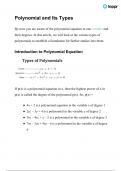
If p(x) is a polynomial equation in x, then the highest power of x in
p(x) is called the degree of the polynomial p(x). So, p(x) =
● 4x + 2 is a polynomial equation in the variable x of degree 1
● 2y2 – 3y + 4 is a polynomial in the variable y of degree 2
● 5x3 – 4x2 + x – 2 is a polynomial in the variable x of degree 3
● 7u6 – 3u4 + 4u2 – 6 is a polynomial in the variable u of degree
6
,Further, it is important to note that the following expressions are NOT
polynomials:
● 1 / (x – 1)
● √x + 2
● 1 / (x2 + 2x + 3)
Types of Polynomials
Let’s look at the different types of polynomials that you will come
across while studying them.
Linear Polynomials
Any polynomial with a variable of degree one is a Linear Polynomial.
Some examples of the linear polynomial equation are as follows:
● 2x – 3
● y + √2
● x √3 + 5
● x + 5/11
, ● 2/3y – 5
Any polynomial where the degree of the variable is greater than 1 is
not a linear polynomial.
Download NCERT Solutions for Class 10 Maths
Quadratic Polynomials
Any polynomial with a variable of degree two is a Quadratic
Polynomial. The name ‘quadratic’ is derived from the word ‘quadrate’
which means square. Some examples of the quadratic polynomial
equation are as follows:
● 2x2 + 3x – 5
● y2 – 1
● 2 – x2 + x√3
● u/3 – 2u2 + 5
● v2√5 + 2/3v – 6
● 4z2 + 1/7
, To generalize, most quadratic polynomials in x are expressed as, ax2 +
bx + c … where a, b, and c are real numbers where a ≠ 0.
Cubic Polynomials
Any polynomial with a variable of degree three is a Cubic Polynomial.
Some examples of the cubic polynomial equation are as follows:
● x3
● 2 – x3
● x3√2
● x3 – x2 + 3
● 3x3 – 2x2 + x – 1
To generalize, most quadratic polynomials in x are expressed as, ax3 +
bx2 + cx + d … where a, b, c, and d are real numbers. Also, a ≠ 0.
Some more concepts
To begin with, let’s look at the following polynomial p(x),
p(x) = x2 – 3x – 4

