
AH3 Exam 2
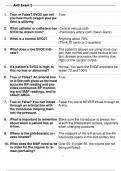
1. True or False? SVO2 can tell True.
you how much oxygen your pa-
tient is utilizing.
2. What catheter or catheters can -Central venous cath
SVO2 be drawn from? -Pulmonary artery cath (Swan-Ganz)
3. What is a normal SVO2? Anything about 70%
(Think 75 cents or 3 quarters)
4. What does a low SVO2 indi- The patient's tissues are using more oxy-
cate? gen than normal and could be due to cer-
tain disease processes like anemia (low
Hgb) or low cardiac output.
5. If a patient's SVO2 is high, is Normal. You want the SVO2 anywhere be-
this normal or abnormal? tween 70 and 100%
6. True or False? An arterial line True.
or A-line cath gives us the most
accurate BP reading and pro-
vides continuous BP monitor-
ing and MAP readings, and to
obtain ABGs.
7. True or False? You can infuse False! You are to NEVER infuse through an
through an arterial line with A-line.
the transducer helping main-
tain the pressure.
8. What is important to remember Make sure the transducer is always lev-
about when a patient has an el with the phlebostatic access, especially
A-line. when changing positions.
9. Where is the phlebostatic ac- The midpoint of the left atrium at the 4th
cess located? intercostal space in the mid-axillary line.
10. What does the MAP need to be Over 65; If under 60, the organs are not
in order for the organs to re- being perfused.
main perfusing?
, AH3 Exam 2
11. Describe pulses paradoxus. It is an exaggerated blood pressure vari-
ation with the respiratory cycle. It can be
caused by COPD, asthma, and cardiac
tamponade.
12. True or False? Central Venous True.
Pressure (CVP) provides infor-
mation about the right side of
the heart and can be an indirect
way to measure preload. This is
taken through the distal port of
a central line.
13. What is a normal CVP? Anywhere between 2 and 6. (Think a nickel-
5 is a good number)
14. What does a low CVP indicate? The patient is "dry" and is in fluid volume
deficit.
15. What does a high CVP indi- The patient is in fluid volume overload.
cate?
16. True or False? A pulmonary False. It provides information about both
catheter provides information sides of the heart.
about the left side of the heart.
17. When a patient has a PA cath, It can tell us the BP in the pulmonary artery,
what does the right side tell known as pulmonary artery pressure or
us? PAP.
18. What is the normal range for 25/10 mmHg (Think a quarter over a dime)
PAP?
19. When a patient has a It can tell us an indirect measurement of
Swan-Ganz (PA) cath, what left arterial pressure known as pulmonary
does the left side tell us? artery occlusion pressure/wedge pressure
(PAOP/PAWP).
20. 10 mmHg (Think 1 dime)
1. True or False? SVO2 can tell True.
you how much oxygen your pa-
tient is utilizing.
2. What catheter or catheters can -Central venous cath
SVO2 be drawn from? -Pulmonary artery cath (Swan-Ganz)
3. What is a normal SVO2? Anything about 70%
(Think 75 cents or 3 quarters)
4. What does a low SVO2 indi- The patient's tissues are using more oxy-
cate? gen than normal and could be due to cer-
tain disease processes like anemia (low
Hgb) or low cardiac output.
5. If a patient's SVO2 is high, is Normal. You want the SVO2 anywhere be-
this normal or abnormal? tween 70 and 100%
6. True or False? An arterial line True.
or A-line cath gives us the most
accurate BP reading and pro-
vides continuous BP monitor-
ing and MAP readings, and to
obtain ABGs.
7. True or False? You can infuse False! You are to NEVER infuse through an
through an arterial line with A-line.
the transducer helping main-
tain the pressure.
8. What is important to remember Make sure the transducer is always lev-
about when a patient has an el with the phlebostatic access, especially
A-line. when changing positions.
9. Where is the phlebostatic ac- The midpoint of the left atrium at the 4th
cess located? intercostal space in the mid-axillary line.
10. What does the MAP need to be Over 65; If under 60, the organs are not
in order for the organs to re- being perfused.
main perfusing?
, AH3 Exam 2
11. Describe pulses paradoxus. It is an exaggerated blood pressure vari-
ation with the respiratory cycle. It can be
caused by COPD, asthma, and cardiac
tamponade.
12. True or False? Central Venous True.
Pressure (CVP) provides infor-
mation about the right side of
the heart and can be an indirect
way to measure preload. This is
taken through the distal port of
a central line.
13. What is a normal CVP? Anywhere between 2 and 6. (Think a nickel-
5 is a good number)
14. What does a low CVP indicate? The patient is "dry" and is in fluid volume
deficit.
15. What does a high CVP indi- The patient is in fluid volume overload.
cate?
16. True or False? A pulmonary False. It provides information about both
catheter provides information sides of the heart.
about the left side of the heart.
17. When a patient has a PA cath, It can tell us the BP in the pulmonary artery,
what does the right side tell known as pulmonary artery pressure or
us? PAP.
18. What is the normal range for 25/10 mmHg (Think a quarter over a dime)
PAP?
19. When a patient has a It can tell us an indirect measurement of
Swan-Ganz (PA) cath, what left arterial pressure known as pulmonary
does the left side tell us? artery occlusion pressure/wedge pressure
(PAOP/PAWP).
20. 10 mmHg (Think 1 dime)

