
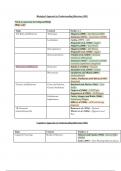
Biological Approach to Understanding Behaviour (HL)
*Need to memorize for SAQ and ERQ’s
ERQ’s only*
Topic Content Studies x 2
The Brain and Behaviour Techniques Maguire (2000) – Taxi Drivers (MRI)
Antonova (2011) – Acetylcholine (fMRI)
Localization Corkin (1997) – HM
Draganski et al. (2004) – Jugglers
Maguire (2000) – Taxi Drivers
Neuroplasticity Maguire (2000) – Taxi Drivers
Draganski et al. (2004) – Jugglers
Neurotransmitters Crockett et al. (2010) – Serotonin
(inhibitory; SSRI:agonist)
Antonova (2011) – Acetylcholine (fMRI)
(excitatory; scopolamine: antagonist)
Hormones and Behaviour Hormones Scheele et al (2012) – Oxytocin
Newcomer et al. (1999) – Cortisol
Pheromones Lundstrom and Olsson (2005) –
Androstadienone
Cutler, Friedmann and McCoy (1998) –
Sociosexual
Genetics and Behaviour Genes and behavior, Bouchard and McGue (1981) – Twin
Genetic Similarities Studies
Caspi et al (2003) – 5-HTT gene
Fergusson et al (2011) – MAOA gene
Evolutionary Curtis, Aunger and Rabie (2004) –
Explanations Evolutionary Disgust
Hillis et al (2004) – ACEs and teenage
pregnancy
HL Extension Romero et al. (2014) – Oxytocin
(Animal Research) Weaver et al. (2004) – Epigenetics and
Rats
Cognitive Approach to Understanding Behaviour (HL)
Topic Content Studies x 2
Cognitive Processing Models of Memory Glanzer and Cunitz (1966) – Recency Effect
(MSM)
Sacks (2007) – Clive Wearing (Memory Stores)
, Baddeley, Lewis and Vallar (1984) –
(WMM)
Corkin (1997) – HM
Schema Theory Bransford and Johnson (1972) – Encoding
Anderson and Pichert (1978) – Retrieval
Thinking and decision-making Albarracin et al. (2001) – Theory of reasoned
(Models) action (TRA), Theory of Planned Behaviour
(TPB)
Luce, Bettman and Payne (1997) – Adaptive
Decision Framework
Reliability of Cognitive Processes Reconstructive Memory Loftus and Palmer (1974) – Reconstructive
Memory
Loftus, Miller, Burns (1978) – Misleading
Information
McClosky and Zaragoza (1985) – Alternative
Explanation
Biases in thinking and Huber, Payne and Puto (1982) – Asymmetric
decision-making Tversky and Kahneman (1981) – Heuristics
Framing Effect
Emotion and Cognition The influences of emotion on Brown and Kulik (1977) – Flashbulb Memory
cognitive processes (FBM)
Neisser and Harsch (1992) – Against FBM
Cognitive Processes in a Digital Rosser et al (2007) – Visuospatial skills (positive
World (HL Extension) influence)
Sanchez (2012) – Video games on science
learning
Rosen et al (2011) – Metacognitive strategies
Sociocultural Approach to Understanding Behaviour (HL)
Topic Content Studies x 2
The Individual and the Group Social Identity Tajfel (1971) – Ingroup vs. outgroups
Theory Experiments #1 and #2
Social Cognitive Bandura, Ross and Ross (1961) – Observational Learning
Theory (Bobo)
Perry, Perry and Rasmussen (1986) – Aggression and
self-efficacy in children
Formations of Hamilton and Gifford (1976) – Illusory Correlation
Stereotypes Johnson et al. (2000) – Social categorization
Steele and Aronson (1995) – Stereotype Threat
Rosenthal and Jacobson) – Self-fulfilling Prophecy
Effects of Stereotypes
,Cultural Origins of behaviour and Culture and its Chiu (1972) – Cognitive styles US and Chinese students
Cognition influence on (cognition)
behaviour and Briley, Morris and Simonson (2005) – Decision Making
cognition (cognition)
Berry and Katz (1967) – Conformity (behaviour)
Dov Cohen (1996) – Culture of Honour (behaviour)
Cultural Dimensions Hofstede (1973) – Multinational Survey (various cultural
dimensions)
Berry and Katz (1967) – Individualism and Collectivism
Finkelstein (2010)—the effect of individualism and
collectivism on volunteer behaviour
Cultural influences on individual Enculturation Odden and Rochat (2004) – Observational Learning
attitudes, identity and behaviours (enculturation)
Kim and Omizo (2006) – Enculturation, Acculturation
and Identity
Acculturation Kim and Omizo (2006) – Enculturation, Acculturation
and Identity
Shah et al (2015) – Obesity Culture
Ishizawa and Jones (2016) – Obesity Asian Migrants in the
USA
Human Relationships (HL)
Topic Content Studies
Group Dynamics Cooperation and Competition Sherif et al. (1961) - the Robber’s Cave Studies
Tajfel (1971) – (In-groups vs. Out-groups)
Prejudice and Discrimination Levinson, Cai and Young (2010) - (Implicit
Bias)
Columb and Plant (2011) Obama
Origins of Conflict and Conflict Sherif et al. (1961) - the Robber’s Cave Studies
Resolution Pettigrew and Tropp (2006) – Contact
Hypothesis
, Abnormal Psychology (HL)
Treatment of Disorders Biological TADS (2004) – Antidepressants and psychotherapy
Treatment Hollon et al (2005) – Relapse Rate
Psychological TADS (2004) – Antidepressants and psychotherapy
Treatment Hollon et al (2005) – Relapse Rates
The Role of Kinzie et al (1987) – Compliance
Culture in Naeem et al (2012) - culturally inclusive cbt
Treatment
Assessing the Jacobson et al (1996) – Dismantling Design
Effectiveness of (Eysenck 1952, Smith and Glass 1977, Wampold 2007)
Treatments
Possible Saqs and Erqs
Biological approach:
SAQs
1. Explain one technique used to study the brain in relation to behaviour.
2. Explain one study of localization of function.
3. Explain one study of neuroplasticity.
4. Explain neuroplasticity, making use of one study.
5. Explain one effect of neurotransmission in human behaviour, making use of one study.
6. Explain the formation of neural networks using one study.
7. Explain the role of one agonist, making use of one study.
8. Explain the role of one antagonist, making use of one study.
9. Explain neural pruning, making use of one study.
10. Explain how excitatory or inhibitory synapses play a role in one behaviour, making use of one study.
11. Explain the role of one hormone in human behaviour, making use of one study.
12. Explain one study of the role of pheromones in human behaviour.
13. Explain the role of one gene in human behaviour.
14. Explain one evolutionary explanation of one behaviour.
15. Explain the use of twin studies and/or kinship studies using one study.
16. Explain the use of one research method in one study using the biological approach to understanding
human behaviour.
17. Explain the use of one research method in one study of the brain and behaviour.
18. Explain the use of one research method in one study of hormones or pheromones and behaviour. 4.
Explain the use of one research method in one study of genetics and behaviour.
19. Explain one ethical consideration relevant to one study using a biological approach to understanding
human behaviour.
20. Explain one ethical consideration relevant to one study of the brain and behaviour.
21. Explain one ethical consideration relevant to one study of hormones or pheromones and behaviour.
22. Explain one ethical consideration relevant to one study of genetics and behaviour.
ERQ
1. Discuss techniques used to study the brain in relation to behaviour.

