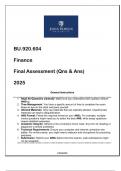
BU.920.604
Finance
Final Assessment (Qns & Ans)
2025
General Instructions
1. Read All Questions Carefully: Make sure you understand each question before
ANSing.
2. Time Management: You have a specific amount of time to complete the exam.
Keep an eye on the clock and pace yourself.
3. Allowed Materials: Only use materials that are explicitly allowed. Unauthorized
materials can lead to disqualification.
4. ANS Format: Follow the required format for your ANSs. For example, multiple-
choice questions might need you to select the best ANS, while essay questions
require detailed responses.
5. Academic Integrity: Adhere to the university's honor code. Any form of cheating or
plagiarism is strictly prohibited.
6. Technical Requirements: Ensure your computer and internet connection are
stable. For online exams, you might need a webcam and microphone for proctoring
purposes.
7. Submission: Submit your ANSs before the time expires. Late submissions might
not be accepted.
©2024/2025
,1. Which of the following is NOT a characteristic of preferred
stock?
- A) Fixed dividend payments
- B) No voting rights
- C) Convertibility to common stock
- D) Callable feature
- ANS: C) Convertibility to common stock
Rationale: Preferred stock may have a convertible feature, but
it is not universally applicable to all preferred stock.
2. What does the Capital Asset Pricing Model (CAPM) primarily
measure?
- A) Systematic risk
- B) Total risk
- C) Irreducible risk
- D) Idiosyncratic risk
- ANS: A) Systematic risk
Rationale: CAPM is used to determine the expected return on
an asset based on its systematic risk (beta).
©2024/2025
, 3. In the context of options, what does 'in-the-money' refer to?
- A) The option has no intrinsic value
- B) The option has intrinsic value
- C) The option is nearing expiration
- D) The option has a strike price above the market price
- ANS: B) The option has intrinsic value
Rationale: An 'in-the-money' option has a positive intrinsic
value; a call option has a market price above the strike price,
while a put option has a market price below the strike price.
4. Which of the following measures is used to evaluate the
profitability of an investment relative to its risk?
- A) Return on Equity (ROE)
- B) Sharpe Ratio
- C) Current Ratio
- D) Debt-to-Equity Ratio
- ANS: B) Sharpe Ratio
Rationale: The Sharpe Ratio measures the excess return per
unit of risk, providing insight into the risk-adjusted return of an
investment.
©2024/2025
Finance
Final Assessment (Qns & Ans)
2025
General Instructions
1. Read All Questions Carefully: Make sure you understand each question before
ANSing.
2. Time Management: You have a specific amount of time to complete the exam.
Keep an eye on the clock and pace yourself.
3. Allowed Materials: Only use materials that are explicitly allowed. Unauthorized
materials can lead to disqualification.
4. ANS Format: Follow the required format for your ANSs. For example, multiple-
choice questions might need you to select the best ANS, while essay questions
require detailed responses.
5. Academic Integrity: Adhere to the university's honor code. Any form of cheating or
plagiarism is strictly prohibited.
6. Technical Requirements: Ensure your computer and internet connection are
stable. For online exams, you might need a webcam and microphone for proctoring
purposes.
7. Submission: Submit your ANSs before the time expires. Late submissions might
not be accepted.
©2024/2025
,1. Which of the following is NOT a characteristic of preferred
stock?
- A) Fixed dividend payments
- B) No voting rights
- C) Convertibility to common stock
- D) Callable feature
- ANS: C) Convertibility to common stock
Rationale: Preferred stock may have a convertible feature, but
it is not universally applicable to all preferred stock.
2. What does the Capital Asset Pricing Model (CAPM) primarily
measure?
- A) Systematic risk
- B) Total risk
- C) Irreducible risk
- D) Idiosyncratic risk
- ANS: A) Systematic risk
Rationale: CAPM is used to determine the expected return on
an asset based on its systematic risk (beta).
©2024/2025
, 3. In the context of options, what does 'in-the-money' refer to?
- A) The option has no intrinsic value
- B) The option has intrinsic value
- C) The option is nearing expiration
- D) The option has a strike price above the market price
- ANS: B) The option has intrinsic value
Rationale: An 'in-the-money' option has a positive intrinsic
value; a call option has a market price above the strike price,
while a put option has a market price below the strike price.
4. Which of the following measures is used to evaluate the
profitability of an investment relative to its risk?
- A) Return on Equity (ROE)
- B) Sharpe Ratio
- C) Current Ratio
- D) Debt-to-Equity Ratio
- ANS: B) Sharpe Ratio
Rationale: The Sharpe Ratio measures the excess return per
unit of risk, providing insight into the risk-adjusted return of an
investment.
©2024/2025