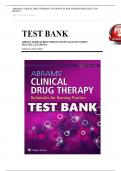
ABRAMS' CLINICAL DRUG THERAPY: RATIONALES FOR NURSING PRACTICE 12TH
EDITON
GERALYN FRANDSEN
,ABRAMS' CLINICAL DRUG THERAPY: RATIONALES FOR NURSING PRACTICE
,ABRAMS' CLINICAL DRUG THERAPY: RATIONALES FOR NURSING PRACTICE
, ABRAMS' CLINICAL DRUG THERAPY: RATIONALES FOR NURSING PRACTICE
Chapter 1, The Foundation of Pharmacology: Quality and Safety
1. A woman diagnosed with obsessive–compulsive disorder has been prescribed oral
paroxetine hydrochloride. What is the expected effect for this prescription?
A. Curative effect on symptoms
B. Systemic effect on symptoms
C. Local effect on symptoms
D. Parenteral effect on symptoms
ANS: B
Rationale: Drugs that produce systemic effects are taken into the body, circulated through
the bloodstream to their sites of action in various body tissues, and eventually eliminated
from the body. Curative agents are given to cure a disease process. In this case, paroxetine
hydrochloride will control the symptoms but not cure the disorder. Drugs with local effects,
such as sunscreen and local anesthetics, act mainly at the site of application. Paroxetine
hydrochloride is not administered parenterally. Parenteral agents are administered
subcutaneously, intramuscularly, or intravenously.
PTS: 1 REF: p. 3, Introduction OBJ: 1
NAT: Client Needs: Physiological Integrity: Pharmacological and Parenteral Therapies
TOP: Chapter: 1: The Foundation of Pharmacology: Quality and Safety
KEY: Integrated Process: Nursing Process
BLM: Cognitive Level: Understand NOT: Multiple Choice
2. A client has been prescribed an antibiotic. This medication is a naturally occurring
substance that has been cheGmR
icA
alDlyEm
SoBdOifOieSd.TWhaOt M
.C is another name for this type of
medication?
A. Synthetic drug
B. Semisynthetic drug
C. Biotechnology drug
D. Prototype drug
ANS: B
Rationale: Semisynthetic drugs (e.g., many antibiotics) are naturally occurring substances that
have been chemically modified. Synthetic drugs are more standardized in their chemical
characteristics, more consistent in their effects, and less likely to produce allergic reactions.
Biotechnology drugs involve manipulating DNA and RNA and recombining genes into hybrid
molecules that can be inserted into living organisms. Prototype drugs are the first drug of a
particular group to be developed.
PTS: 1 REF: p. 3, Drug Sources OBJ: 1
NAT: Client Needs: Physiological Integrity: Pharmacological and Parenteral Therapies
TOP: Chapter: 1: The Foundation of Pharmacology: Quality and Safety
KEY: Integrated Process: Nursing Process
BLM: Cognitive Level: Understand NOT: Multiple Choice
3. Which classification applies to morphine?
A. Central nervous system depressant
B. Central nervous system stimulant
ABRAMS' CLINICAL DRUG THERAPY: RATIONALES FOR NURSING PRACTICE
EDITON
GERALYN FRANDSEN
,ABRAMS' CLINICAL DRUG THERAPY: RATIONALES FOR NURSING PRACTICE
,ABRAMS' CLINICAL DRUG THERAPY: RATIONALES FOR NURSING PRACTICE
, ABRAMS' CLINICAL DRUG THERAPY: RATIONALES FOR NURSING PRACTICE
Chapter 1, The Foundation of Pharmacology: Quality and Safety
1. A woman diagnosed with obsessive–compulsive disorder has been prescribed oral
paroxetine hydrochloride. What is the expected effect for this prescription?
A. Curative effect on symptoms
B. Systemic effect on symptoms
C. Local effect on symptoms
D. Parenteral effect on symptoms
ANS: B
Rationale: Drugs that produce systemic effects are taken into the body, circulated through
the bloodstream to their sites of action in various body tissues, and eventually eliminated
from the body. Curative agents are given to cure a disease process. In this case, paroxetine
hydrochloride will control the symptoms but not cure the disorder. Drugs with local effects,
such as sunscreen and local anesthetics, act mainly at the site of application. Paroxetine
hydrochloride is not administered parenterally. Parenteral agents are administered
subcutaneously, intramuscularly, or intravenously.
PTS: 1 REF: p. 3, Introduction OBJ: 1
NAT: Client Needs: Physiological Integrity: Pharmacological and Parenteral Therapies
TOP: Chapter: 1: The Foundation of Pharmacology: Quality and Safety
KEY: Integrated Process: Nursing Process
BLM: Cognitive Level: Understand NOT: Multiple Choice
2. A client has been prescribed an antibiotic. This medication is a naturally occurring
substance that has been cheGmR
icA
alDlyEm
SoBdOifOieSd.TWhaOt M
.C is another name for this type of
medication?
A. Synthetic drug
B. Semisynthetic drug
C. Biotechnology drug
D. Prototype drug
ANS: B
Rationale: Semisynthetic drugs (e.g., many antibiotics) are naturally occurring substances that
have been chemically modified. Synthetic drugs are more standardized in their chemical
characteristics, more consistent in their effects, and less likely to produce allergic reactions.
Biotechnology drugs involve manipulating DNA and RNA and recombining genes into hybrid
molecules that can be inserted into living organisms. Prototype drugs are the first drug of a
particular group to be developed.
PTS: 1 REF: p. 3, Drug Sources OBJ: 1
NAT: Client Needs: Physiological Integrity: Pharmacological and Parenteral Therapies
TOP: Chapter: 1: The Foundation of Pharmacology: Quality and Safety
KEY: Integrated Process: Nursing Process
BLM: Cognitive Level: Understand NOT: Multiple Choice
3. Which classification applies to morphine?
A. Central nervous system depressant
B. Central nervous system stimulant
ABRAMS' CLINICAL DRUG THERAPY: RATIONALES FOR NURSING PRACTICE