
• ¿Documento equivocado? Cámbialo gratis
  • Escrito por estudiantes que aprobaron
  • Inmediatamente disponible después del pago
  • Leer en línea o como PDF
Vender
¿Dónde estudias?
Tu idioma
Document preview thumbnail
Vista previa 1 fuera de 4 páginas
Otro

AIMC final exam

Document preview thumbnail
Vista previa 1 fuera de 4 páginas

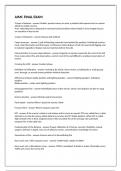
2 types of defense - answer-Mobile- permits enemy to enter a position that exposes him to counter attack by mobile reserve Area- defending forces disposed on selected tactical positions where battle is to be fought focuses on retention of key terrain 2 types of obstacles - answer-Natural and artificial Camp measures - answer-1 pull all blending materials from behind the position 2 individual marines must camp themselves and there gear. Continuous action dispose of soil not used avoid digging next to isolated vegetation. Replace natural materials before they die. Characteristics of reverse slope defense - answer-Organize on terrain massed by the crest of the hill from enemy direct fire and observation, control crest of fire and difficult to maintain observation of enemy Crossing the LOD - answer-Conduct phase Definition of infiltration - answer-Technique by which a force moves as individuals or small groups over, through, or around enemy positions without detection Difference between battle position and fighting position - answer-Fighting position= individual position Battle position = entire units fighting position Disengagement line - answer-Identifiable piece of key terrain, where unit displaces to alter or supp positions Enemy situation - answer-Dictates patrol movement Flank attack - answer-When I attack the enemy's flank Forward limit - answer-Where weapons open fire FPF - answer-If the enemy's attack is not broken and he starts to assault, FPFs are called this is a final attempt to to stop the enemy attack before he reaches the PLT battle position. When FPF is called SQD members fire in their assigned sectors rifles and 203s fire at the average rate automatic weapons fire st the rapid rate Fundamentals of the defense - answer-Proper utilization of of terrain, security, flexibility, mutual support, defense in depth, max use of offensive action, concentration, knowledge of enemy Geometries of fire - answer-Science and art of deconflicting fire How much can a rifle company cover - answer-1500M with a depth of 200M How much can a rifle platoon cover - answer-750M in woodland, 2 blocks in urban. Physically covers 450M and covers the rest by fire Linear defense - answer-Most common type of area defense, requires a maximum employment of forces forward with a small reserve, and has a strong mutual support between forward units, limited depth and minimum flexibility. Has interlocking and overlapping observation and fields of fire along the FEBA to preclude penetration. The bulk of the maneuver units is forward to gain interlocking small arms fire within and between companies. The Amin effort is assigned to the most likely avenue of enemy approach. The reserve is usually small and used to reinforce forward units to give depth to the defense to block penetrations or to counterattack to regain key terrain. If available, tanks form the basis of a counterattack force. Movement to contact units - answer-Point of advanced guard, rear point, point of flank guard, flank patrol, main body Obscuration/deception - answer-Can be used to to deceive Perimeter defense - answer-This defense disposes a unit to meet an attack from all directions simultaneously. It is a suitable defense for use by the rifle company. The rifle company prepares a perimeter defense when there are no friendly units adjacent to it. A perimeter defense may be used in a reserve position, in an assembly area or PB, on a semi-independent, operation, during re-supply, or when the company is isolated. Reserve plt has a primary function of blocking and counter attacking penetrations Phases of offensive combat - answer-Preparation conduct and exploration Preferred way to move through an urban area - answer-Double column Principal of war - answer-MOOSEMUSS Mass Objective Offense Security economy of forces Maneuver Unity of command Surprise Simplicity Principals of clearing fields of fire - answer-Don't excessively clear, start near your position and work towards limit of effective small arms fire, leave thin natural screen, remove lower branches, remove thin dense brush, cut weeds only when they block your view, move cut brush to position where it won't conceal enemy or expose your position, cut or burn grain crops hay fields or tall grass if necessary. Ensure overhead clearance for 203 Priorities of fire for automatic weapons - answer-Enemy automatic weapons, rocket teams and other crew served weapons Purpose of breach team - answer-Proof and exploit Purpose of night patrols - answer-Gain surprise, maintain pressure, to exploit success of daylight operations, seize terrain for subsequent operations, avoid heavy losses by using the concealment of darkness, compensate for inferior combat power. Purpose of obstacles - answer-Stops enemy entry into position, delays enemy approach, canalizes enemy, forces enemy troops to deploy prematurly Purpose of the defense - answer-To retain or control terrain gain time economize forces to allow the the concentration of forces else where and to develop more favorable conditions for offensive actions Relief in place - answer-A unit is replaced by an incoming unit who assumes responsibility for mission of relived unit Reverse slope - answer-An alternative to defending on the forward slope of a hill or a ridge is to defend of a reverse slope. In such a defense, the company is organized on the portion of a terrain feature that is masked by the crest of a hill from enemy direct fire and ground observation. Although some units and weapons may be positioned on forward edge of slope, the crest, or the counter slope(a forward slope of a hill to the rear of the reverse slope) most of them are on the reverse slope. The key to this defense is control of the crest by fire. Security patrol - answer-Gain info disorganize deceive and delay Sequence of defense - answer-Enemy predatory bombardment, opening fire and fire control, FPF, enemy reaches sqd fighting position Structural classification - answer-Framed/Framess Two types of residential buildings - answer-Urban. Rural Types of bounding - answer-Successive and alternate Types of defense - answer-Mobile, Area, Linear, reverse slope, and perimeter Types of Offensive Operations - answer-Day/Night Types of wire - answer-Tactical supplementary protective Us backing off - answer-Retro grading What do you do when the enemy reaches small arms range - answer-Open fire and control rates of fire What info is needed prior to infiltration - answer-1. Release point 2. Time of release 3. Point of departure 4. Time of infiltartion 5. Infil lane 6. R

Vista previa del contenido

AIMC FINAL EXAM
2 types of defense - answer-Mobile- permits enemy to enter a position that exposes him to counter
attack by mobile reserve
Area- defending forces disposed on selected tactical positions where battle is to be fought focuses
on retention of key terrain

2 types of obstacles - answer-Natural and artificial

Camp measures - answer-1 pull all blending materials from behind the position 2 individual marines
must camp themselves and there gear. Continuous action dispose of soil not used avoid digging next
to isolated vegetation. Replace natural materials before they die.

Characteristics of reverse slope defense - answer-Organize on terrain massed by the crest of the hill
from enemy direct fire and observation, control crest of fire and difficult to maintain observation of
enemy

Crossing the LOD - answer-Conduct phase

Definition of infiltration - answer-Technique by which a force moves as individuals or small groups
over, through, or around enemy positions without detection

Difference between battle position and fighting position - answer-Fighting position= individual
position
Battle position = entire units fighting position

Disengagement line - answer-Identifiable piece of key terrain, where unit displaces to alter or supp
positions

Enemy situation - answer-Dictates patrol movement

Flank attack - answer-When I attack the enemy's flank

Forward limit - answer-Where weapons open fire

FPF - answer-If the enemy's attack is not broken and he starts to assault, FPFs are called this is a final
attempt to to stop the enemy attack before he reaches the PLT battle position. When FPF is called
SQD members fire in their assigned sectors rifles and 203s fire at the average rate automatic
weapons fire st the rapid rate

Fundamentals of the defense - answer-Proper utilization of of terrain, security, flexibility, mutual
support, defense in depth, max use of offensive action, concentration, knowledge of enemy

Geometries of fire - answer-Science and art of deconflicting fire

How much can a rifle company cover - answer-1500M with a depth of 200M

How much can a rifle platoon cover - answer-750M in woodland, 2 blocks in urban. Physically covers
450M and covers the rest by fire


Información del documento

Subido en
21 de noviembre de 2024
Número de páginas
4
Escrito en
2024/2025
Tipo
Otro
Personaje
Desconocido
$10.99

¿Documento equivocado? Cámbialo gratis Dentro de los 14 días posteriores a la compra y antes de descargarlo, puedes elegir otro documento. Puedes gastar el importe de nuevo.
Escrito por estudiantes que aprobaron
Inmediatamente disponible después del pago
Leer en línea o como PDF

Seller avatar
Los indicadores de reputación están sujetos a la cantidad de artículos vendidos por una tarifa y las reseñas que ha recibido por esos documentos. Hay tres niveles: Bronce, Plata y Oro. Cuanto mayor reputación, más podrás confiar en la calidad del trabajo del vendedor.
TOPDOCTOR
5.0
(1)
Vendido
10
Seguidores
5
Artículos
3387
Última venta
1 año hace


Por qué los estudiantes eligen Stuvia

Creado por compañeros estudiantes, verificado por reseñas

Calidad en la que puedes confiar: escrito por estudiantes que aprobaron y evaluado por otros que han usado estos resúmenes.

¿No estás satisfecho? Elige otro documento

¡No te preocupes! Puedes elegir directamente otro documento que se ajuste mejor a lo que buscas.

Paga como quieras, empieza a estudiar al instante

Sin suscripción, sin compromisos. Paga como estés acostumbrado con tarjeta de crédito y descarga tu documento PDF inmediatamente.

Student with book image

“Comprado, descargado y aprobado. Así de fácil puede ser.”

Alisha Student

Preguntas frecuentes