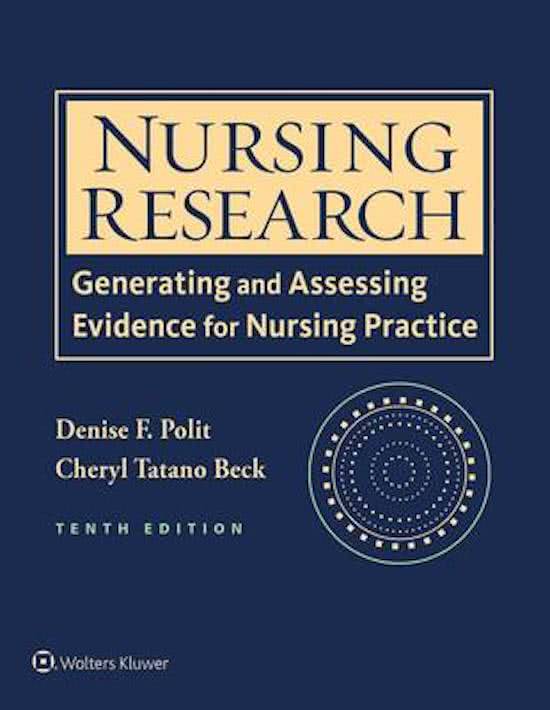
TEST BANK FOR UNDERSTANDING NURSINGRESEARCH,
7TH EDITION By Susan Grove/Jennifer Gray New
Update 2023 ALL Chapters
Accuracy - ANSWER: Addresses the extent to which the instrument measures what it
is supposed to in a study; comparable to validity.
Accuracy of a screening test - ANSWER: screening tests used to confirm a diagnosis
are evaluated in terms of their ability to assess the presence or absence of a disease
or condition correctly as compared with a gold standard
Administrative data - ANSWER: data collected within clinical agencies; obtained by
national, state, and local professional organizations and collected by federal, state,
and local governmental agencies
Alternate forms reliability - ANSWER: degree of equivalence of two versions of the
same paper and pencil instrument
Construct validity - ANSWER: a measure of how well the conceptual and operational
definitions of variables match each other; determines whether the instrument
measures the theoretical construct that it purports to measure
Content validity - ANSWER: Extent to which the method of measurement includes all
the major elements relevant to the construct being measured
Data collection - ANSWER: Identification of subjects and the precise, systematic
gathering of information (data) relevant to the research purpose or the specific
objectives, questions, or hypotheses of a study.
Direct measures - ANSWER: Concrete variables that can be measured objectively
with a specific measurement strategy, such as using a scale to measure weight
Equivalence - ANSWER: Part of reliability testing. The comparison of two versions of
the same paper and pencil instrument or of two observers measuring the same
event.
Error in physiological measures - ANSWER: error caused by environmental factors,
variations in operation of equipment, machine instability and calibration, or
misinterpreted electrical signals
Evidence of validity from contrasting groups - ANSWER: Tested by identifying groups
that are expected to have contrasting scores on the instrument.
Evidence of validity from convergence - ANSWER: Determined when a relatively new
instrument is compared with an existing instrument(s) that measure the same
construct.
, Evidence of validity from divergence - ANSWER: Correlational procedures performed
with the measures of two opposite concepts. If the divergent measure (despair
scale) is negatively correlational with the other instrument (hope scale), validity for
each of the instruments is strengthened.
False negative - ANSWER: Outcome of a screening test indicating that a disease is not
present when it is present
False positive - ANSWER: outcome of a screening test indicating that a disease is
present when it is not present
Gold standard - ANSWER: Most accurate means of currently diagnosing a particular
disease and serves as a basis for comparison with newly developed diagnostic or
screening tests.
Highly sensitive test - ANSWER: a screening test that indicates a true positive test
result for a large proportion of patients with the disease
Highly specific test - ANSWER: a screening test that indicates a true-negative test
result for a large proportion of patients without the disease
Homogeneity - ANSWER: Type of reliability testing used primarily with paper-and-
pencil instruments or scales to address the correlation of each question to the other
questions within the instrument.
Indirect measures, or indicators - ANSWER: Methods used with abstract concepts
that are not measured directly; rather, indicators or attributes of the concepts are
used to represent the abstraction and are measured in the study
Internal consistency - ANSWER: measures the extent to which all the items in an
instrument consistently measure the construct
Interrater reliability - ANSWER: Comparison of two observers or two judges in a
study.
Interval-level measurement - ANSWER: Measurement that uses interval scales,
which have equal numerical distances between intervals and also follows the rules of
mutually exclusive categories, exhaustive categories, and rank ordering, such as
temperature
Interview - ANSWER: Structured or unstructured oral communication between the
researcher and subject or study participant during which information is obtained for
a study
7TH EDITION By Susan Grove/Jennifer Gray New
Update 2023 ALL Chapters
Accuracy - ANSWER: Addresses the extent to which the instrument measures what it
is supposed to in a study; comparable to validity.
Accuracy of a screening test - ANSWER: screening tests used to confirm a diagnosis
are evaluated in terms of their ability to assess the presence or absence of a disease
or condition correctly as compared with a gold standard
Administrative data - ANSWER: data collected within clinical agencies; obtained by
national, state, and local professional organizations and collected by federal, state,
and local governmental agencies
Alternate forms reliability - ANSWER: degree of equivalence of two versions of the
same paper and pencil instrument
Construct validity - ANSWER: a measure of how well the conceptual and operational
definitions of variables match each other; determines whether the instrument
measures the theoretical construct that it purports to measure
Content validity - ANSWER: Extent to which the method of measurement includes all
the major elements relevant to the construct being measured
Data collection - ANSWER: Identification of subjects and the precise, systematic
gathering of information (data) relevant to the research purpose or the specific
objectives, questions, or hypotheses of a study.
Direct measures - ANSWER: Concrete variables that can be measured objectively
with a specific measurement strategy, such as using a scale to measure weight
Equivalence - ANSWER: Part of reliability testing. The comparison of two versions of
the same paper and pencil instrument or of two observers measuring the same
event.
Error in physiological measures - ANSWER: error caused by environmental factors,
variations in operation of equipment, machine instability and calibration, or
misinterpreted electrical signals
Evidence of validity from contrasting groups - ANSWER: Tested by identifying groups
that are expected to have contrasting scores on the instrument.
Evidence of validity from convergence - ANSWER: Determined when a relatively new
instrument is compared with an existing instrument(s) that measure the same
construct.
, Evidence of validity from divergence - ANSWER: Correlational procedures performed
with the measures of two opposite concepts. If the divergent measure (despair
scale) is negatively correlational with the other instrument (hope scale), validity for
each of the instruments is strengthened.
False negative - ANSWER: Outcome of a screening test indicating that a disease is not
present when it is present
False positive - ANSWER: outcome of a screening test indicating that a disease is
present when it is not present
Gold standard - ANSWER: Most accurate means of currently diagnosing a particular
disease and serves as a basis for comparison with newly developed diagnostic or
screening tests.
Highly sensitive test - ANSWER: a screening test that indicates a true positive test
result for a large proportion of patients with the disease
Highly specific test - ANSWER: a screening test that indicates a true-negative test
result for a large proportion of patients without the disease
Homogeneity - ANSWER: Type of reliability testing used primarily with paper-and-
pencil instruments or scales to address the correlation of each question to the other
questions within the instrument.
Indirect measures, or indicators - ANSWER: Methods used with abstract concepts
that are not measured directly; rather, indicators or attributes of the concepts are
used to represent the abstraction and are measured in the study
Internal consistency - ANSWER: measures the extent to which all the items in an
instrument consistently measure the construct
Interrater reliability - ANSWER: Comparison of two observers or two judges in a
study.
Interval-level measurement - ANSWER: Measurement that uses interval scales,
which have equal numerical distances between intervals and also follows the rules of
mutually exclusive categories, exhaustive categories, and rank ordering, such as
temperature
Interview - ANSWER: Structured or unstructured oral communication between the
researcher and subject or study participant during which information is obtained for
a study