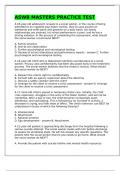
ASWB MASTERS PRACTICE TEST
A 16-year-old adolescent reveals to a social worker, in the course of being
admitted to an inpatient psychiatric facility, that he uses alcohol on
weekends and sniffs paint and gasoline on a daily basis. His family
relationships are strained, his school performance is poor, and he has a
driving violation. In the process of completing the assessment, what should
the social worker recommend NEXT?
A. Family sessions
B. One-to-one observation
C. Further psychological and neurological testing
D. Review of school attendance and performance reports - answer-C. Further
psychological and neurological testing
A 16-year-old client who is depressed mentions suicidal plans to a social
worker. Privacy and confidentiality had been discussed early in the treatment
process. The social worker believes that the threat is serious. What should
the social worker do NEXT?
A. Respect the clients right to confidentiality
B. Consult with an agency supervisor about the dilemma
C. Discuss a safety contract with the client
D. Arrange for the client to receive a crisis assessment - answer-D. Arrange
for the client to receive a crisis assessment
A 17-mont-old child is placed in temporary foster care. Initially, the child
cries vigorously, struggles in the arms of the foster mother, and will not be
comforted. After a day or two, the child becomes increasingly quiet,
withdrawn, and sad-looking. This is followed by an increase in activity, a
decrease in crying, but little show of affect. The childʻs behavior can BEST be
understood in terms of which the following theories?
A. Interpersonal
B. Attachment
C. Rational-emotive
D. Ego development - answer-B. Attachment
A 21-year-old patient is approaching discharge form the hospital following a
serious suicide attempt. The social worker meets with him before discharge
to assess his emotional state. He will not answer any specific questions. The
patient tells the social worker that he just needs to go home. What should
the social worker do NEXT?
A. Provide the patient with suicide hotline and mental health resources
,B. Contact the appropriate staff to explore involuntary commitment
C. Chart the conversation before approving the discharge plan
D. Explain to the patient the seriousness of the suicide attempt - answer-B.
Contact the appropriate staff to explore involuntary commitment
A child protective services social worker meets with a parent who has
allegedly been neglectful. The parents talks about being overwhelmed by the
needs of her child. She describes having trouble sleeping because she needs
to stay alert for messages from a favorite talk show host. The parents also
shares beliefs that the childʻs teacher is against her. What should the social
worker do NEXT?
A. Refer the parent to a physician
B. Encourage the parent to discuss her anxiety
C. Initiate a mental status examination
D. Plan a collaborative meeting with the school - answer-C. Initiate a mental
status examination
A client begins services with a social worker. The client has multiple
problems, including substance abuse and post-traumatic stress. The client
recently became employed, and a close friend died two weeks earlier. What
should the social worker do NEXT?
A. Ask the client what is most troubling now
B. Refer the client to substance abuse treatment
C. Encourage the client to find employment
D. Begin client-centered bereavement counseling - answer-A. Ask the client
what is most troubling now
A client informs a social worker that despite a court mandate the client does
not intend to attend future sessions. What should the social worker do FIRST?
A. Inform the client of the consequences of that decision
B. Advise the judge of the clientʻs decision
C. Assist the client in identifying and clarifying goals
D. Express disappointment in the clientʻs decision - answer-A. Inform the
client of the consequences of that decision
A client is discharged from inpatient treatment for alcohol and prescription
drug abuse. A mental health social worker meets for a follow-up session with
family members and observes that they avoid discussing the problem. What
should the social worker do FIRST?
A. Confront family members about the long-term nature of the problem
B. Assist the family in understanding the harm of alcohol and drug abuse
C. Determine the extent of denial within the family ssystem
,D. Advise the family members that relapse is a realistic possibility - answer-
C. Determine the extent of denial within the family system
The sw should FIRST follow-up on the observation
A client is in treatment with a social worker in a fee-for-service setting. After
paying in full and on time for the first ten sessions, the client begins to make
either partial payments or no payments at all. Assessment of risk indicates
that the client poses no danger to self or others. According to ethical
standards of social work practice, what is the social workers BEST response?
A. Continue services after negotiating a non-monetary compensation system
B. suspend services until the client has caught up on all financial obligations
C. Terminate services after the third incident of insufficient or nonpayment
D. Terminate services if debt persists after a discussion of financial
obligations - answer-D. Terminate services if debt persists after a discussion
of financial obligations
A client meets with a social worker to discuss parenting a rebellious
adolescent. After several sessions, the client shares religious beliefs that
support physical punishment. What should the social worker do FIRST?
A. Inform the client that physical punishment psychologically harms children
B. Validate the client for openly sharing the physical punishment viewpoint
C. Request that the client describe the physical punishment practices
D. Explore the clientʻs own history of physical punishment during childhood -
answer-C. Request that the client describe the physical punishment practices
Clarifying the clientʻs basic understanding of physical punishment practices
is a necessary FIRST step before any other action
A client requests mental health services to manage chronic and escalating
anger. During the initial session, the client tells the social worker of instances
where she was verbally abusive to an individual in her care who uses a
wheelchair. The client is remorseful and says that the incidents have
occurred on only two or three occasions. What should the social worker do
NEXT?
A. Collect collateral information from the care recipient
B. Explain the need to report the incidents to the proper authorities
C. Discuss the incidents further to determine the appropriate action
D. Develop a personalized anger management program for the client -
answer-C. Discuss the incidents further to determine the appropriate action
A client who experienced severe neglect by his biological parents during
infancy is brought to a social work agency for evaluation. According to
, records, the client lived with several foster families before being adopted at
the age of five. Despite receiving consistent nurturance from his adoptive
family, the client has failed to bond with them. Upon initial assessment, a
social worker notes that the clientʻs inhibitions and ambivalence toward
others could indicate the presence of:
A. Rett syndrom
B. Selective mutism
C. Separation anxiety disorder
D. Reactive attachment disorder - answer-D. Reactive attachment disorder
A client who is a college student expresses ambivalence about his sexual
orientation, during a session with a social worker. Despite having always
dated women, the client now feels attracted to men. He is distressed and
wants to better understand these feelings. What should the social worker do?
A. Refer the client to a social worker who specializes in sexual orientation
issues
B. Explain the homosexuality is not a choice
C. Examine the relationship between the clientʻs concerns and his sexual
identity
D. Explore with the client how his family would react to his same-sex
attraction - answer-C. Examine the relationship between the clientʻs
concerns and his sexual identity
A client who is trying to become pregnant uses marijuana consistently and
has questions about the effects on the fetus. The social worker tells the
client that the marijuana use could possibly harm the fetus. What should the
social worker do NEXT?
A. Offer substance abuse treatment options to the client
B. Refer the case for possible criminal prosecution
C. Inform the client that the drug use will be reported to the child protection
agency
D. Ask the clientʻs health care provider to drug test the client at her
appointment. - answer-A. Offer substance abuse treatment options to the
client
A couple identify strongly with the deaf culture. A social worker is helping
them to obtain educational services for their child, who has experienced
hearing loss. What communication strategy should the social worker consider
during planning?
A. Total immersion in the use of sign language
B. Cochlear implant surgery to improve hearing
C. Mainstreaming with children who do not have hearing loss
A 16-year-old adolescent reveals to a social worker, in the course of being
admitted to an inpatient psychiatric facility, that he uses alcohol on
weekends and sniffs paint and gasoline on a daily basis. His family
relationships are strained, his school performance is poor, and he has a
driving violation. In the process of completing the assessment, what should
the social worker recommend NEXT?
A. Family sessions
B. One-to-one observation
C. Further psychological and neurological testing
D. Review of school attendance and performance reports - answer-C. Further
psychological and neurological testing
A 16-year-old client who is depressed mentions suicidal plans to a social
worker. Privacy and confidentiality had been discussed early in the treatment
process. The social worker believes that the threat is serious. What should
the social worker do NEXT?
A. Respect the clients right to confidentiality
B. Consult with an agency supervisor about the dilemma
C. Discuss a safety contract with the client
D. Arrange for the client to receive a crisis assessment - answer-D. Arrange
for the client to receive a crisis assessment
A 17-mont-old child is placed in temporary foster care. Initially, the child
cries vigorously, struggles in the arms of the foster mother, and will not be
comforted. After a day or two, the child becomes increasingly quiet,
withdrawn, and sad-looking. This is followed by an increase in activity, a
decrease in crying, but little show of affect. The childʻs behavior can BEST be
understood in terms of which the following theories?
A. Interpersonal
B. Attachment
C. Rational-emotive
D. Ego development - answer-B. Attachment
A 21-year-old patient is approaching discharge form the hospital following a
serious suicide attempt. The social worker meets with him before discharge
to assess his emotional state. He will not answer any specific questions. The
patient tells the social worker that he just needs to go home. What should
the social worker do NEXT?
A. Provide the patient with suicide hotline and mental health resources
,B. Contact the appropriate staff to explore involuntary commitment
C. Chart the conversation before approving the discharge plan
D. Explain to the patient the seriousness of the suicide attempt - answer-B.
Contact the appropriate staff to explore involuntary commitment
A child protective services social worker meets with a parent who has
allegedly been neglectful. The parents talks about being overwhelmed by the
needs of her child. She describes having trouble sleeping because she needs
to stay alert for messages from a favorite talk show host. The parents also
shares beliefs that the childʻs teacher is against her. What should the social
worker do NEXT?
A. Refer the parent to a physician
B. Encourage the parent to discuss her anxiety
C. Initiate a mental status examination
D. Plan a collaborative meeting with the school - answer-C. Initiate a mental
status examination
A client begins services with a social worker. The client has multiple
problems, including substance abuse and post-traumatic stress. The client
recently became employed, and a close friend died two weeks earlier. What
should the social worker do NEXT?
A. Ask the client what is most troubling now
B. Refer the client to substance abuse treatment
C. Encourage the client to find employment
D. Begin client-centered bereavement counseling - answer-A. Ask the client
what is most troubling now
A client informs a social worker that despite a court mandate the client does
not intend to attend future sessions. What should the social worker do FIRST?
A. Inform the client of the consequences of that decision
B. Advise the judge of the clientʻs decision
C. Assist the client in identifying and clarifying goals
D. Express disappointment in the clientʻs decision - answer-A. Inform the
client of the consequences of that decision
A client is discharged from inpatient treatment for alcohol and prescription
drug abuse. A mental health social worker meets for a follow-up session with
family members and observes that they avoid discussing the problem. What
should the social worker do FIRST?
A. Confront family members about the long-term nature of the problem
B. Assist the family in understanding the harm of alcohol and drug abuse
C. Determine the extent of denial within the family ssystem
,D. Advise the family members that relapse is a realistic possibility - answer-
C. Determine the extent of denial within the family system
The sw should FIRST follow-up on the observation
A client is in treatment with a social worker in a fee-for-service setting. After
paying in full and on time for the first ten sessions, the client begins to make
either partial payments or no payments at all. Assessment of risk indicates
that the client poses no danger to self or others. According to ethical
standards of social work practice, what is the social workers BEST response?
A. Continue services after negotiating a non-monetary compensation system
B. suspend services until the client has caught up on all financial obligations
C. Terminate services after the third incident of insufficient or nonpayment
D. Terminate services if debt persists after a discussion of financial
obligations - answer-D. Terminate services if debt persists after a discussion
of financial obligations
A client meets with a social worker to discuss parenting a rebellious
adolescent. After several sessions, the client shares religious beliefs that
support physical punishment. What should the social worker do FIRST?
A. Inform the client that physical punishment psychologically harms children
B. Validate the client for openly sharing the physical punishment viewpoint
C. Request that the client describe the physical punishment practices
D. Explore the clientʻs own history of physical punishment during childhood -
answer-C. Request that the client describe the physical punishment practices
Clarifying the clientʻs basic understanding of physical punishment practices
is a necessary FIRST step before any other action
A client requests mental health services to manage chronic and escalating
anger. During the initial session, the client tells the social worker of instances
where she was verbally abusive to an individual in her care who uses a
wheelchair. The client is remorseful and says that the incidents have
occurred on only two or three occasions. What should the social worker do
NEXT?
A. Collect collateral information from the care recipient
B. Explain the need to report the incidents to the proper authorities
C. Discuss the incidents further to determine the appropriate action
D. Develop a personalized anger management program for the client -
answer-C. Discuss the incidents further to determine the appropriate action
A client who experienced severe neglect by his biological parents during
infancy is brought to a social work agency for evaluation. According to
, records, the client lived with several foster families before being adopted at
the age of five. Despite receiving consistent nurturance from his adoptive
family, the client has failed to bond with them. Upon initial assessment, a
social worker notes that the clientʻs inhibitions and ambivalence toward
others could indicate the presence of:
A. Rett syndrom
B. Selective mutism
C. Separation anxiety disorder
D. Reactive attachment disorder - answer-D. Reactive attachment disorder
A client who is a college student expresses ambivalence about his sexual
orientation, during a session with a social worker. Despite having always
dated women, the client now feels attracted to men. He is distressed and
wants to better understand these feelings. What should the social worker do?
A. Refer the client to a social worker who specializes in sexual orientation
issues
B. Explain the homosexuality is not a choice
C. Examine the relationship between the clientʻs concerns and his sexual
identity
D. Explore with the client how his family would react to his same-sex
attraction - answer-C. Examine the relationship between the clientʻs
concerns and his sexual identity
A client who is trying to become pregnant uses marijuana consistently and
has questions about the effects on the fetus. The social worker tells the
client that the marijuana use could possibly harm the fetus. What should the
social worker do NEXT?
A. Offer substance abuse treatment options to the client
B. Refer the case for possible criminal prosecution
C. Inform the client that the drug use will be reported to the child protection
agency
D. Ask the clientʻs health care provider to drug test the client at her
appointment. - answer-A. Offer substance abuse treatment options to the
client
A couple identify strongly with the deaf culture. A social worker is helping
them to obtain educational services for their child, who has experienced
hearing loss. What communication strategy should the social worker consider
during planning?
A. Total immersion in the use of sign language
B. Cochlear implant surgery to improve hearing
C. Mainstreaming with children who do not have hearing loss