
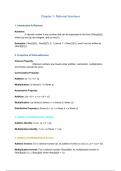
Chapter 1: Rational Numbers
1. Introduction to Rational
Numbers:
A rational number is any number that can be expressed in the form (\frac{p}{q}),
where (p) and (q) are integers, and (q \neq 0).
Examples: (\frac{2}{3}, -\frac{5}{7}, 0, 1) (since 1 = (\frac{1}{1}), and 0 can be written as
(\frac{0}{1})).
2. Properties of RationalNumber
Closure Property:
Rational numbers are closed under addition, subtraction, multiplication,
and division (except by zero).
Commutative Property:
Addition: (a + b = b + a)
Multiplication: (a \times b = b \times a)
Associative Property:
Addition: ((a + b) + c = a + (b + c))
Multiplication: ((a \times b) \times c = a \times (b \times c))
Distributive Property:(a \times (b + c) = a \times b + a \times c)
3. Additive and Multiplicative Identity
Additive Identity: 0 (i.e., (a + 0 = a))
Multiplicative Identity: 1 (i.e., (a \times 1 = a))
4. Additive and Multiplicative Inverse
Additive Inverse: For a rational number (a), its additive inverse is (-a) (i.e., (a + (-a) = 0)).
Multiplicative Inverse: For a rational number (\frac{a}{b}), its multiplicative inverse is
(\frac{b}{a}) (i.e., (\frac{a}{b} \times \frac{b}{a} = 1)).

