

Liffe at a molecular and , cellular
Elsessme levell
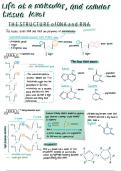
T H E S T R U C T U R E o f DN A a n d R N A
The nucleic acds DNA and RNA are polymers of
estides
molecular structure made of three units
-complicated
.
phosphate
phosphate group baseermamide
&
=
&
e
Sugar
=
phosphate 7 baseme
=
nitrogenous base
ribonucleic and
I sugar I sugar
#
The four RNA bases
-
:
covalenton is
called :
phosphodiester bond
Adenine :
Kal :
O
N Il
-
One nucleotide bonds to
-
purine -
prymidine
I
·
#
Only RNA
-
in
another between the First
nucleotides the
·
and
sugar
phosphate of the next
Canine :g Cayosine :
nucleotide via a covalent
Il -
purina NHz
bond and this will take
H An-pyrimid
a
J
·
until we have a large
i
place
i polymer
nucleotides
- - - - - - -
with
many RNA
-
# deoxyribonucleic
add
Guanine is alway double bonded to cytosine All bases the except that
*
stay same
3' strand and thymine is
always triple bonded Instead of uracil that is
only found in
5'strand
& to Adenine :
RNA there is
&
swamust
G => C , A =
T mine HzC 9
I·
ant
--- this
a
is
complementary
purine always joins
base
to a
pairing as
pyramidine Y
be summer a
---
Antiparallel :
-je
double helix made of two 51
* DNA is a
a
antiparallel strands of nucleotides
Phosphodiester bond linkedby hydrogen bonding between
- -
bonds
hydrogen complementary base pairs
- :
9
, -
differences between RNA and DNA
-structural
-
TYPES OF RNA AND DNA
provisionI
=
1) MRNA-messenger RNA
found
· made in the nucleus
using DNA as a template · in the nucleus and
packaged in structures
transports code for protein synthesis to ribosome called chromosomes in association with histone proteins
I
2) tRNA-transfer RNA 2) mtDNA- Mitochondrial DNA
found
· made in nucleus and its function is to
bring · in Mitochondria and are ring shaped
amino acids to ribosome for protein inherited from mother only (found in egg cell)
synthesis ·
J 16 500 base pairs
rRNA-ribosomal RNA
minsets or
endosympathetic theory
, The function of DNA
carries the code for protein production . This code is passed on from parent to
offspring
and is therefore known as hereditary material . The code is carried on the
genes
DNA (STR) important concepts :
non-coding >
-
different species have different numbers of
&
chromosomes
-
I cell in the
body has the exact copy
- -
every
of DNA
gene
In the
>
-
body cells the chromosomes come in
pairs
DNA REPLICAT ION
↳ known as semi-conservative replication
> interphase
In
as
-
cytokinesis
the newly formed DNA , she strand is new - >
-
goth
and the other is conserved from original DNA mitosis/
·
Meiosis
PROCESS :
-
I
G DNA unwinds and unzips . -NA
E
↑
② I bonds between complementary bases break. replication
-
· ③ organelle
+
.
catalyzed by the enzyme hellcase rowth
-
replication
& free DNA nucleotides in nucleus will le next to their
j complementary base. [A=T and G =
C)
⑤ H bonds form between complementary bases and sugar phosphate backbone reforms
&
⑳ DNA can only replicate in the 5' to 3 direction (the 5'strand is called the leading Strand
·
.
and nucleotides are laid down in a continuous manner
& The 3'strand nucleotides down discontinous
is called
lagging strand
the + are laid in a
manner . (i .
e in
fragments
A T
I &
- template
jAT-
·
E
In
GC
GC
replication
= & GC
original
&
GC
new
G
new
C
-
2 new Identical DNA strands
PCR Technology
:
↳ polymerase chain reaction
blotechnology process used to amplify a sample of DNA .
-
/
y?
1. forensics to make more DNA Found at a crime scene .
amplify genes to be used
I . in recombant
technology -
.
3 Inexpensive and fast .
Elsessme levell
T H E S T R U C T U R E o f DN A a n d R N A
The nucleic acds DNA and RNA are polymers of
estides
molecular structure made of three units
-complicated
.
phosphate
phosphate group baseermamide
&
=
&
e
Sugar
=
phosphate 7 baseme
=
nitrogenous base
ribonucleic and
I sugar I sugar
#
The four RNA bases
-
:
covalenton is
called :
phosphodiester bond
Adenine :
Kal :
O
N Il
-
One nucleotide bonds to
-
purine -
prymidine
I
·
#
Only RNA
-
in
another between the First
nucleotides the
·
and
sugar
phosphate of the next
Canine :g Cayosine :
nucleotide via a covalent
Il -
purina NHz
bond and this will take
H An-pyrimid
a
J
·
until we have a large
i
place
i polymer
nucleotides
- - - - - - -
with
many RNA
-
# deoxyribonucleic
add
Guanine is alway double bonded to cytosine All bases the except that
*
stay same
3' strand and thymine is
always triple bonded Instead of uracil that is
only found in
5'strand
& to Adenine :
RNA there is
&
swamust
G => C , A =
T mine HzC 9
I·
ant
--- this
a
is
complementary
purine always joins
base
to a
pairing as
pyramidine Y
be summer a
---
Antiparallel :
-je
double helix made of two 51
* DNA is a
a
antiparallel strands of nucleotides
Phosphodiester bond linkedby hydrogen bonding between
- -
bonds
hydrogen complementary base pairs
- :
9
, -
differences between RNA and DNA
-structural
-
TYPES OF RNA AND DNA
provisionI
=
1) MRNA-messenger RNA
found
· made in the nucleus
using DNA as a template · in the nucleus and
packaged in structures
transports code for protein synthesis to ribosome called chromosomes in association with histone proteins
I
2) tRNA-transfer RNA 2) mtDNA- Mitochondrial DNA
found
· made in nucleus and its function is to
bring · in Mitochondria and are ring shaped
amino acids to ribosome for protein inherited from mother only (found in egg cell)
synthesis ·
J 16 500 base pairs
rRNA-ribosomal RNA
minsets or
endosympathetic theory
, The function of DNA
carries the code for protein production . This code is passed on from parent to
offspring
and is therefore known as hereditary material . The code is carried on the
genes
DNA (STR) important concepts :
non-coding >
-
different species have different numbers of
&
chromosomes
-
I cell in the
body has the exact copy
- -
every
of DNA
gene
In the
>
-
body cells the chromosomes come in
pairs
DNA REPLICAT ION
↳ known as semi-conservative replication
> interphase
In
as
-
cytokinesis
the newly formed DNA , she strand is new - >
-
goth
and the other is conserved from original DNA mitosis/
·
Meiosis
PROCESS :
-
I
G DNA unwinds and unzips . -NA
E
↑
② I bonds between complementary bases break. replication
-
· ③ organelle
+
.
catalyzed by the enzyme hellcase rowth
-
replication
& free DNA nucleotides in nucleus will le next to their
j complementary base. [A=T and G =
C)
⑤ H bonds form between complementary bases and sugar phosphate backbone reforms
&
⑳ DNA can only replicate in the 5' to 3 direction (the 5'strand is called the leading Strand
·
.
and nucleotides are laid down in a continuous manner
& The 3'strand nucleotides down discontinous
is called
lagging strand
the + are laid in a
manner . (i .
e in
fragments
A T
I &
- template
jAT-
·
E
In
GC
GC
replication
= & GC
original
&
GC
new
G
new
C
-
2 new Identical DNA strands
PCR Technology
:
↳ polymerase chain reaction
blotechnology process used to amplify a sample of DNA .
-
/
y?
1. forensics to make more DNA Found at a crime scene .
amplify genes to be used
I . in recombant
technology -
.
3 Inexpensive and fast .

