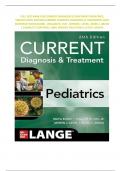
FULL TEST BANK FOR CURRENT DIAGNOSIS & TREATMENT PEDIATRICS,
TWENTY-SIXTH EDITION (CURRENT PEDIATRIC DIAGNOSIS & TREATMENT) 26TH
EDITION BY MAYA BUNIK , WILLIAM W. HAY , MYRON J. LEVIN , MARK J. ABZUG
| COMPLETE CHAPTERS| 100% VERIFIED SOLUTIONS| LATEST UPDATE
,Table Of Contents
Chapter 1. Advancing The Quality & Safety Of Care ..................................................................................... 3
Chapter 2. The Newborn Infant .................................................................................................................. 36
Chapter 3. Child Development And Behavior ............................................................................................. 42
Chapter 4. Adolescence .............................................................................................................................. 50
Chapter 5. Adolescent Substance Abuse .................................................................................................... 55
Chapter 6. Eating Disorders ........................................................................................................................ 63
Chapter 7. Child & Adolescent Psychiatric Disorders & Psychosocial Aspects Of Pediatrics...................... 67
Chapter 8. Child Abuse And Neglect ........................................................................................................... 75
Chapter 9. Ambulatory & Office Pediatrics................................................................................................. 84
Chapter 10. Immunization .......................................................................................................................... 93
Chapter 11. Normal Childhood Nutrition And Its Disorders ..................................................................... 130
Chapter 12. Emergencies And Injuries ...................................................................................................... 137
Chapter 13. Poisoning ............................................................................................................................... 140
Chapter 14. Critical Care ........................................................................................................................... 142
Chapter 15. Skin ........................................................................................................................................ 147
Chapter 16. Eye ......................................................................................................................................... 154
Chapter 17. Oral Medicine & Dentistry .................................................................................................... 161
Chapter 18. Ear, Nose, & Throat ............................................................................................................... 163
Chapter 19. Respiratory Tract & Mediastinum ......................................................................................... 170
Chapter 20. Cardiovascular Diseases ........................................................................................................ 186
Chapter 21. Gastrointestinal Tract............................................................................................................ 199
Chapter 22. Liver & Pancreas .................................................................................................................... 215
Chapter 23. Fluid, Electrolyte, & Acid-Base Disorders & Therapy ............................................................ 241
Chapter 24. Kidney And Urinary Tract ...................................................................................................... 247
Chapter 25. Neurologic And Muscular Disorders ..................................................................................... 254
Chapter 26. Orthopedics ........................................................................................................................... 274
Chapter 27. Sports Medicine .................................................................................................................... 295
Chapter 28. Rehabilitation Medicine ........................................................................................................ 301
Chapter 29. Rheumatic Diseases .............................................................................................................. 308
Chapter 30. Hematologic Disorders .......................................................................................................... 311
Chapter 31. Neoplastic Disease ................................................................................................................ 319
Chapter 32. Pain Management And Palliative Care & End-Of-Life Care ................................................... 329
,Chapter 33. Immunodeficiency ................................................................................................................. 334
Chapter 34. Endocrine Disorders .............................................................................................................. 341
Chapter 35. Diabetes Mellitus .................................................................................................................. 350
Chapter 36. Inborn Errors Of Metabolism ................................................................................................ 357
Chapter 37. Genetics And Dysmorphology ............................................................................................... 361
Chapter 38. Allergic Disorders .................................................................................................................. 370
Chapter 39. Antimicrobial Therapy ........................................................................................................... 373
Chapter 40. Infections: Viral And Rickettsial ............................................................................................ 377
Chapter 41. Human Immunodeficiency Virus Infection............................................................................ 383
Chapter 42. Infections: Bacterial And Spirochetal .................................................................................... 389
Chapter 43. Infections: Parasitic And Mycotic .......................................................................................... 395
Chapter 44. Sexually Transmitted Infections ............................................................................................ 420
Chapter 45. Travel Medicine ..................................................................................................................... 424
Chapter 46. Chemistry & Hematology Reference Intervals ...................................................................... 434
Chapter 1. Advancing The Quality & Safety Of Care
Multiple Choice
1. When Describing The State Children's Health Insurance Program (Schip) To A Group Of Families,
What Information Would The Nurse Include?
A. It Provides Health Insurance To Children Whose Families Are Not Eligible For Medicaid But Cannot
Afford To Purchase Health Insurance.
B. Medicaid Enrollment Is Necessary To Receive A Basic Set Of Comprehensive Services For Children For
Health Promotion And Early Treatment.
C. The Program Provides Monthly Payments To Income-Eligible Individuals, Including Children Who Are
Blind Or Disabled.
D. States Use Federal Funds For Preventive, Primary, And Specialty Care Programs For Pregnant Women,
Mothers, Infants, Children, And Adolescents.
ANS>>> A. It Provides Health Insurance To Children Whose Families Are Not Eligible For Medicaid But
Cannot Afford To Purchase Health Insurance.
The State Children's Health Insurance Program (Schip) Is Designed To Expand Health Insurance To
Children Whose Families Make Too Much Money To Qualify For Medicaid, But Who Cannot Afford To
Purchase Health Insurance. The Early And Periodic Screening, Diagnostic And Treatment Program (Epsdt)
Is A Program Whose Goal Is To Ensure That Children Enrolled In Medicaid Receive A Basic Set Of
, Comprehensive Services To Promote Health And Identify And Treat Health Problems At Early Stages.
Supplemental Security Income (Ssi) Provides Monthly Payments To Income-Eligible Individuals Who Are
Older Than Age 65, Blind Or Disable. The Maternal And Child Health Services Block Grant Provides
Federal Funds To The States For Preventive, Primary, And Specialty Care For Pregnant Women, Mothers,
Infants, Children, And Adolescents.
2. What Is A Current Trend In Child Health Care?
A. Children Are Hospitalized For Observation More Than Previously.
B. Health Promotion Rather Than Health Restoration Is Stressed.
C. Child Health Care Is Moving Out Of Regional Centers.
D. Nursing Roles Are Decreasing Because Of The Increasing Role Of Families.
ANS>>> B. Health Promotion Rather Than Health Restoration Is Stressed.
It Is Recognized That Keeping Individuals Well Is More Cost Effective For A System Than Helping Ill
Individuals Return To Wellness.
3. In 2007 The World Factbook Published Statistics That Showed The United States Still Lagged
Behind Other Industrialized Nations In The Incidence Of Infant Mortality. What Is One Reason
That The United States Has A Higher Infant Mortality Rate Than Other Countries?
A. Low Birth Weight
B. Early Prenatal Care
C. Low Adolescent Delivery Rates
D. Home Deliveries
ANS>>> A. Low Birth Weight
Many Factors May Be Associated With High Infant Mortality Rates And Poor Health. Low Birth Weight
And Late Or Nonexistent Prenatal Care Are The Main Factors In The Poor Rankings In Infant Mortality.
4. The Nurse Is Working With The Parents Of An Infant And A Toddler In The Clinical Setting. What
Statement By The Parent Would Alert The Nurse To Assess The Children Further?
A. "We Enjoy Taking Walks In The Park And Playing Outside As Much As Possible."
B. "We Have Baby Gates Installed At The Top And Bottom Of Our Stairs In Our Home."
C. "We Live In An Old House, And We Are Planning To Renovate It When The Kids Are Older."
D. "We Have To Hire Babysitters Sometimes Because Our Parents Are Not Able To Help Babysit."
ANS>>> C. "We Live In An Old House, And We Are Planning To Renovate It When The Kids Are Older."
Older Homes Are At Risk For Having Lead-Based Paint (Usually Those Built Before The Mid To Late
1970s) And Lead Pipes Used In Plumbing. The Nurse Would Further Assess For The Children's Exposure
To Lead Pipes, Paint, Paint Chips, Lead Dust, And Soil Containing Lead Dust And Paint Chips. Additionally,
TWENTY-SIXTH EDITION (CURRENT PEDIATRIC DIAGNOSIS & TREATMENT) 26TH
EDITION BY MAYA BUNIK , WILLIAM W. HAY , MYRON J. LEVIN , MARK J. ABZUG
| COMPLETE CHAPTERS| 100% VERIFIED SOLUTIONS| LATEST UPDATE
,Table Of Contents
Chapter 1. Advancing The Quality & Safety Of Care ..................................................................................... 3
Chapter 2. The Newborn Infant .................................................................................................................. 36
Chapter 3. Child Development And Behavior ............................................................................................. 42
Chapter 4. Adolescence .............................................................................................................................. 50
Chapter 5. Adolescent Substance Abuse .................................................................................................... 55
Chapter 6. Eating Disorders ........................................................................................................................ 63
Chapter 7. Child & Adolescent Psychiatric Disorders & Psychosocial Aspects Of Pediatrics...................... 67
Chapter 8. Child Abuse And Neglect ........................................................................................................... 75
Chapter 9. Ambulatory & Office Pediatrics................................................................................................. 84
Chapter 10. Immunization .......................................................................................................................... 93
Chapter 11. Normal Childhood Nutrition And Its Disorders ..................................................................... 130
Chapter 12. Emergencies And Injuries ...................................................................................................... 137
Chapter 13. Poisoning ............................................................................................................................... 140
Chapter 14. Critical Care ........................................................................................................................... 142
Chapter 15. Skin ........................................................................................................................................ 147
Chapter 16. Eye ......................................................................................................................................... 154
Chapter 17. Oral Medicine & Dentistry .................................................................................................... 161
Chapter 18. Ear, Nose, & Throat ............................................................................................................... 163
Chapter 19. Respiratory Tract & Mediastinum ......................................................................................... 170
Chapter 20. Cardiovascular Diseases ........................................................................................................ 186
Chapter 21. Gastrointestinal Tract............................................................................................................ 199
Chapter 22. Liver & Pancreas .................................................................................................................... 215
Chapter 23. Fluid, Electrolyte, & Acid-Base Disorders & Therapy ............................................................ 241
Chapter 24. Kidney And Urinary Tract ...................................................................................................... 247
Chapter 25. Neurologic And Muscular Disorders ..................................................................................... 254
Chapter 26. Orthopedics ........................................................................................................................... 274
Chapter 27. Sports Medicine .................................................................................................................... 295
Chapter 28. Rehabilitation Medicine ........................................................................................................ 301
Chapter 29. Rheumatic Diseases .............................................................................................................. 308
Chapter 30. Hematologic Disorders .......................................................................................................... 311
Chapter 31. Neoplastic Disease ................................................................................................................ 319
Chapter 32. Pain Management And Palliative Care & End-Of-Life Care ................................................... 329
,Chapter 33. Immunodeficiency ................................................................................................................. 334
Chapter 34. Endocrine Disorders .............................................................................................................. 341
Chapter 35. Diabetes Mellitus .................................................................................................................. 350
Chapter 36. Inborn Errors Of Metabolism ................................................................................................ 357
Chapter 37. Genetics And Dysmorphology ............................................................................................... 361
Chapter 38. Allergic Disorders .................................................................................................................. 370
Chapter 39. Antimicrobial Therapy ........................................................................................................... 373
Chapter 40. Infections: Viral And Rickettsial ............................................................................................ 377
Chapter 41. Human Immunodeficiency Virus Infection............................................................................ 383
Chapter 42. Infections: Bacterial And Spirochetal .................................................................................... 389
Chapter 43. Infections: Parasitic And Mycotic .......................................................................................... 395
Chapter 44. Sexually Transmitted Infections ............................................................................................ 420
Chapter 45. Travel Medicine ..................................................................................................................... 424
Chapter 46. Chemistry & Hematology Reference Intervals ...................................................................... 434
Chapter 1. Advancing The Quality & Safety Of Care
Multiple Choice
1. When Describing The State Children's Health Insurance Program (Schip) To A Group Of Families,
What Information Would The Nurse Include?
A. It Provides Health Insurance To Children Whose Families Are Not Eligible For Medicaid But Cannot
Afford To Purchase Health Insurance.
B. Medicaid Enrollment Is Necessary To Receive A Basic Set Of Comprehensive Services For Children For
Health Promotion And Early Treatment.
C. The Program Provides Monthly Payments To Income-Eligible Individuals, Including Children Who Are
Blind Or Disabled.
D. States Use Federal Funds For Preventive, Primary, And Specialty Care Programs For Pregnant Women,
Mothers, Infants, Children, And Adolescents.
ANS>>> A. It Provides Health Insurance To Children Whose Families Are Not Eligible For Medicaid But
Cannot Afford To Purchase Health Insurance.
The State Children's Health Insurance Program (Schip) Is Designed To Expand Health Insurance To
Children Whose Families Make Too Much Money To Qualify For Medicaid, But Who Cannot Afford To
Purchase Health Insurance. The Early And Periodic Screening, Diagnostic And Treatment Program (Epsdt)
Is A Program Whose Goal Is To Ensure That Children Enrolled In Medicaid Receive A Basic Set Of
, Comprehensive Services To Promote Health And Identify And Treat Health Problems At Early Stages.
Supplemental Security Income (Ssi) Provides Monthly Payments To Income-Eligible Individuals Who Are
Older Than Age 65, Blind Or Disable. The Maternal And Child Health Services Block Grant Provides
Federal Funds To The States For Preventive, Primary, And Specialty Care For Pregnant Women, Mothers,
Infants, Children, And Adolescents.
2. What Is A Current Trend In Child Health Care?
A. Children Are Hospitalized For Observation More Than Previously.
B. Health Promotion Rather Than Health Restoration Is Stressed.
C. Child Health Care Is Moving Out Of Regional Centers.
D. Nursing Roles Are Decreasing Because Of The Increasing Role Of Families.
ANS>>> B. Health Promotion Rather Than Health Restoration Is Stressed.
It Is Recognized That Keeping Individuals Well Is More Cost Effective For A System Than Helping Ill
Individuals Return To Wellness.
3. In 2007 The World Factbook Published Statistics That Showed The United States Still Lagged
Behind Other Industrialized Nations In The Incidence Of Infant Mortality. What Is One Reason
That The United States Has A Higher Infant Mortality Rate Than Other Countries?
A. Low Birth Weight
B. Early Prenatal Care
C. Low Adolescent Delivery Rates
D. Home Deliveries
ANS>>> A. Low Birth Weight
Many Factors May Be Associated With High Infant Mortality Rates And Poor Health. Low Birth Weight
And Late Or Nonexistent Prenatal Care Are The Main Factors In The Poor Rankings In Infant Mortality.
4. The Nurse Is Working With The Parents Of An Infant And A Toddler In The Clinical Setting. What
Statement By The Parent Would Alert The Nurse To Assess The Children Further?
A. "We Enjoy Taking Walks In The Park And Playing Outside As Much As Possible."
B. "We Have Baby Gates Installed At The Top And Bottom Of Our Stairs In Our Home."
C. "We Live In An Old House, And We Are Planning To Renovate It When The Kids Are Older."
D. "We Have To Hire Babysitters Sometimes Because Our Parents Are Not Able To Help Babysit."
ANS>>> C. "We Live In An Old House, And We Are Planning To Renovate It When The Kids Are Older."
Older Homes Are At Risk For Having Lead-Based Paint (Usually Those Built Before The Mid To Late
1970s) And Lead Pipes Used In Plumbing. The Nurse Would Further Assess For The Children's Exposure
To Lead Pipes, Paint, Paint Chips, Lead Dust, And Soil Containing Lead Dust And Paint Chips. Additionally,